|


Return to the May 1998 A&E Preview Cover |
Arts & Entertainment Preview - May 1998
    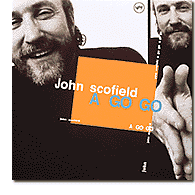 The guitarist John Scofield's jazz combines populism and iconoclasm. A member of
the 1970s generation, weaned on fusion before bebop, he fills his music with
hooks and raunchy blues echoes that always turn unexpected corners. Such
diversity was perfect for the Miles Davis band, which featured Scofield in the
early 1980s, and has been refined in a series of his own albums that tacks from
dance-friendly rhythms on the New Orleans paean Flat Out (Gramavision)
and funk summitry with the saxophone innovator Eddie Harris on Hand Jive
(Blue Note) to a combustible early-nineties quartet with Joe Lovano and the
chamber-music mystique of last year's all-acoustic Quiet (Verve). A
Go Go (Verve) brings Scofield back to his basic rhythms and surrounds his
maverick guitar lines with the edgy alternative grooves of Medeski Martin and
Wood. Because MMW recently signed a contract with Blue Note, the trio's
presence isn't made apparent on the album cover, but it deserves co-billing on
a program that Scofield clearly fashioned with his collaborators in mind. A
slew of deliberate pop echoes are here, such as the "Mercy, Mercy, Mercy" quote
that gets tipped on its side during "Boozer," and a dash of Twilight
Zone atmospherics on "Kubrick." Primarily, though, A Go Go delivers
head-shaking adventures, like "Hottentot," that sound determined to take jazz
back to its dance-hall roots. --B.B.
The guitarist John Scofield's jazz combines populism and iconoclasm. A member of
the 1970s generation, weaned on fusion before bebop, he fills his music with
hooks and raunchy blues echoes that always turn unexpected corners. Such
diversity was perfect for the Miles Davis band, which featured Scofield in the
early 1980s, and has been refined in a series of his own albums that tacks from
dance-friendly rhythms on the New Orleans paean Flat Out (Gramavision)
and funk summitry with the saxophone innovator Eddie Harris on Hand Jive
(Blue Note) to a combustible early-nineties quartet with Joe Lovano and the
chamber-music mystique of last year's all-acoustic Quiet (Verve). A
Go Go (Verve) brings Scofield back to his basic rhythms and surrounds his
maverick guitar lines with the edgy alternative grooves of Medeski Martin and
Wood. Because MMW recently signed a contract with Blue Note, the trio's
presence isn't made apparent on the album cover, but it deserves co-billing on
a program that Scofield clearly fashioned with his collaborators in mind. A
slew of deliberate pop echoes are here, such as the "Mercy, Mercy, Mercy" quote
that gets tipped on its side during "Boozer," and a dash of Twilight
Zone atmospherics on "Kubrick." Primarily, though, A Go Go delivers
head-shaking adventures, like "Hottentot," that sound determined to take jazz
back to its dance-hall roots. --B.B.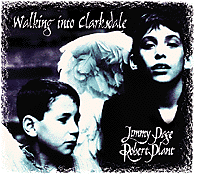 Just as new writers are advised to hook
the reader on the first page, new bands pretty much have to put the best song
near the beginning. Older bands have the luxury of ordering their songs
according to a governing aesthetic. Veterans of Led Zeppelin, Jimmy Page and
Robert Plant can record anything they want in any order they want and expect a
full and careful listening. Even so, it's odd to hear an album that delivers
its five least interesting songs first and then catches fire on the sixth song
and sustains the burn through the twelfth and final cut. On Walking Into
Clarksdale (Atlantic), Page & Plant, as they are billed, do exactly
that and then get possessed by the spirit of Robert Johnson, who came from
Clarksdale, and do some of their most inspired work since the seventies.
Influenced by Middle Eastern music and the blues, Page & Plant play a
unique and eerie hybrid. They used to call their sound "tight but loose" in Led
Zeppelin. "Hot but chilling" might be more accurate now. No one in
rock-and-roll has ever moaned and wailed like Plant, and he has been most
inspired when Page has given him great riffs to moan and wail around. They need
each other, and for seven songs here they actually find each other. By today's
industry standard, their batting average would put them in contention for a
title. The rhythm section of Charlie Jones on bass and Michael Lee on drums
hits hard enough to ... well, nobody's going to forget John Paul Jones and
John Bonham in their prime. Let's just say the new boys hold their own, and
that's enough. --C.M.Y.
Just as new writers are advised to hook
the reader on the first page, new bands pretty much have to put the best song
near the beginning. Older bands have the luxury of ordering their songs
according to a governing aesthetic. Veterans of Led Zeppelin, Jimmy Page and
Robert Plant can record anything they want in any order they want and expect a
full and careful listening. Even so, it's odd to hear an album that delivers
its five least interesting songs first and then catches fire on the sixth song
and sustains the burn through the twelfth and final cut. On Walking Into
Clarksdale (Atlantic), Page & Plant, as they are billed, do exactly
that and then get possessed by the spirit of Robert Johnson, who came from
Clarksdale, and do some of their most inspired work since the seventies.
Influenced by Middle Eastern music and the blues, Page & Plant play a
unique and eerie hybrid. They used to call their sound "tight but loose" in Led
Zeppelin. "Hot but chilling" might be more accurate now. No one in
rock-and-roll has ever moaned and wailed like Plant, and he has been most
inspired when Page has given him great riffs to moan and wail around. They need
each other, and for seven songs here they actually find each other. By today's
industry standard, their batting average would put them in contention for a
title. The rhythm section of Charlie Jones on bass and Michael Lee on drums
hits hard enough to ... well, nobody's going to forget John Paul Jones and
John Bonham in their prime. Let's just say the new boys hold their own, and
that's enough. --C.M.Y.
Bob Blumenthal is a jazz critic for The Boston Globe. Charles M. Young reviews popular music for Playboy, Musician, and other publications.  
Copyright © 1998 by The Atlantic Monthly Company. All rights reserved. | ||||||||||||
| |||||||||||||