
Return to the May 1998 A&E Preview Cover
|
Arts & Entertainment Preview - May 1998


B Y N A N C Y D A L V A & J O H N I S T E L

It Takes Two

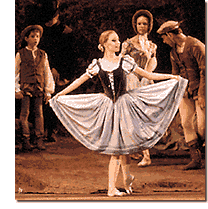 | Amanda McKerrow
as Giselle
|
A susceptible young woman. Her devoted mother. A powerful man whose ring is worn
by a similarly powerful woman. Fascinated and horrified bystanders. A whistle
blower. And, hot on the trail, a prosecutor backed by a like-minded team.
Washington, D.C., circa winter of 1998? No, the ever-popular ballet
Giselle, circa 1841. In this work -- the very epitome of the Romantic
movement in dance -- the eponymous heroine is a gullible village girl; her
worried mother is named Berthe; the powerful man is Albrecht, Duke of Silesia
(disguised for a time as a commoner); his intended is the well-dressed
Bathilde; the vengeful whistle blower, a gamekeeper, is one Hilarion. The
prosecutor is the scary Myrtha, whose night-of-the-living-dead attendants can
hound a man to death. The book, by Vernoy de Saint-Georges, Théophile
Gautier, and Jean Coralli, is one that -- despite a very much of-its-day
perfume -- has been set and reset over the years, with artistic directors
transporting Jules Perrot and Jean Coralli's choreography to various times and
climes (including the Dance Theatre of Harlem's ingenious Creole versions). The
best Giselles cleave to tradition, providing a frame for the juicy lead
roles. Among the most celebrated twosomes were Alicia Alonso and Igor
Youskevitch (whose offstage romance spiced up the on-stage proceedings); Margot
Fonteyn and Rudolf Nureyev (her mad scene was a delicate unraveling horrific in
its detail); and Carla Fracci and Erik Bruhn (the most romantic of ballerinas
and the most noble of classicists). This month and next in New York, American
Ballet Theatre offers no fewer than six pairings from its current starry roster
(May 21-23 and June 16-18 at the Metropolitan Opera House; 212-362-6000).
Tomorrow's legends will depend on the dancers of today: McKerrow and Malakhov;
Ferri and Bocca; Ananiashvili and Graffin; Kent and Carreño; Tuttle and
Corella; Jaffe and Stiefel. What fun it would be to see them all; this is a
story in which the casting tells the tale. --N.D.
From Sitcom Mom to a Woman of Scorn
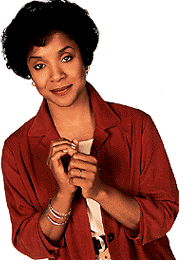 | Phylicia Rashad
tackles Medea
|
For Kenny Leon, the artistic director of Atlanta's Alliance Theatre Company,
casting Phylicia Rashad as Medea was as American as, well, Mom and apple pie.
Yes, the princess of Colchis murders her kids in Euripides' tragedy; and no,
Rashad, best known for the years she spent playing Clair Huxtable opposite Bill
Cosby on TV, wouldn't be considered typecasting. But Leon believes it's a
natural way to make Medea relevant for the Media Age. "If everybody's
Mom -- which is how Phylicia is known from television -- can kill her kids, what
does that say about our society?" he asks. Since taking over the Alliance, in
1990, Leon has raised national awareness of the company while diversifying its
offerings: he premiered the Tony Award-winning The Last Night of
Ballyhoo, produced most of August Wilson's plays, and stages an annual
Christmas Carol whose Ghost of Christmas Present wears dreadlocks and a
kilt. Little surprise, then, that Leon's Medea (May 7-June 13;
404-733-5000) focuses on the regal couple's cultural clash to highlight the
acrimony in Jason and Medea's matrimony. "Because of the world Medea was
leaving and the world she was entering, which was Jason's world, I thought they
should look different visually and culturally," Leon says. "It was important to
me that Medea be black and Jason be white." There's no doubt in Leon's mind
that Rashad has the chops for one of the theater's most demanding roles: "Most
people don't know she was trained for the stage at Howard University.
Phylicia has the talent to play an extreme range of characters." --J.I.
The Playwright at the Helm
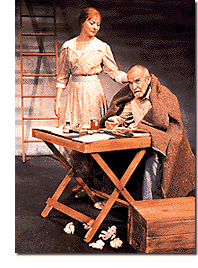 | The Captain's Tiger
|
As a playwright, Athol Fugard has always proved to be a master landscape artist.
For most of the past forty years his keenly honed works have explored the blood
knot tying his characters to the tragic terrain of his homeland -- South Africa.
Written by a white man under apartheid, Fugard's plays offered audiences their
first chance to see blacks and whites interact, linked by his lyrical dialogue.
While the setting often shifted, from the coffee shop in "Master Harold" . .
. and the boys to the carnival entryway in Playland, his focus on
his country's inner, moral peaks and valleys never wavered. Since the fall of
apartheid Fugard has been sketching interior landscapes in wistful memory
plays. In The Captain's Tiger, which receives its U.S. premiere at the
McCarter Theatre, in Princeton, New Jersey, this month (May 5-24;
609-683-8000), Fugard clearly senses enough peace in the political scenery
to write more personally. It's his second post-apartheid play produced in
the United States, and as with Valley Song, the first, Fugard
directs and acts in it. But if Valley Song explored the future,
through a young black teen who wants to be a famous singer, The Captain's
Tiger looks back, to trace this writer's beginnings as a twenty-year-old
steward on a merchant-marine ship. Fugard plays a figure called "The Author" as
well, giving the play its overly introspective patches. But few writers have
earned the right to indulge such meanderings into memory; Fugard remains an
enlightening tour guide to his country's soul. --J.I.
Nancy Dalva is the author of Dance Ink: Photographs.
John Istel is a senior editor at Stagebill.
Go to ...
 
Copyright © 1998 by The Atlantic Monthly Company. All rights reserved.
|