|


Return to the May 1997 A&E Preview Cover |
Arts & Entertainment Preview -- May 1997
   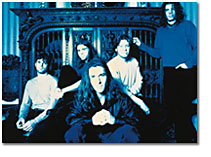 Collective Soul plays a radio-friendly brand of rock-and-roll that for some reason is also critic-hostile. Its leader and chief songwriter, Ed Roland,
loved Elton John and the Cars in his formative adolescence, and has never
renounced those influences for the taboo-tromping of punk rock or postmodern
disengagement of the emotions. It almost takes a few months of Zen meditation
for the college-educated to figure out Collective Soul: the group plays
incredibly catchy riffs because they sound good. A few million music fans
agreed about Collective Soul's first two albums, and now the band is back with
Disciplined Breakdown (Atlantic), which a few million more music fans
will likely find agreeable. Collective Soul plays a radio-friendly brand of rock-and-roll that for some reason is also critic-hostile. Its leader and chief songwriter, Ed Roland,
loved Elton John and the Cars in his formative adolescence, and has never
renounced those influences for the taboo-tromping of punk rock or postmodern
disengagement of the emotions. It almost takes a few months of Zen meditation
for the college-educated to figure out Collective Soul: the group plays
incredibly catchy riffs because they sound good. A few million music fans
agreed about Collective Soul's first two albums, and now the band is back with
Disciplined Breakdown (Atlantic), which a few million more music fans
will likely find agreeable. 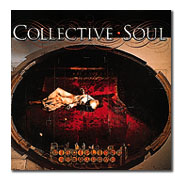 Where the first two albums were informed by an
almost naive idealism (the band members were often accused of being hippies or
Christians on a stealth mission into rock-and-roll), the third is informed by a
brutal legal battle with the band's former manager (not an uncommon story in
the music biz). As Nietzsche once said, that which doesn't kill you makes you
stronger, and fighting for freedom, not to mention royalties, has added new
dimension to the group both lyrically and musically. Collective Soul still
sings about love occasionally, but having been through such a trying time
of disillusion, the group also sings about anger and defiance and the joy
of freedom. Greater emotional range can only add to its credibility, and makes
for a complete as well as catchy listening experience. If a band can still love
after spending a couple of years getting knocked around by lawyers, it can
claim to know what it's talking about. Call the members sadder but wiser.
--C.M.Y. Where the first two albums were informed by an
almost naive idealism (the band members were often accused of being hippies or
Christians on a stealth mission into rock-and-roll), the third is informed by a
brutal legal battle with the band's former manager (not an uncommon story in
the music biz). As Nietzsche once said, that which doesn't kill you makes you
stronger, and fighting for freedom, not to mention royalties, has added new
dimension to the group both lyrically and musically. Collective Soul still
sings about love occasionally, but having been through such a trying time
of disillusion, the group also sings about anger and defiance and the joy
of freedom. Greater emotional range can only add to its credibility, and makes
for a complete as well as catchy listening experience. If a band can still love
after spending a couple of years getting knocked around by lawyers, it can
claim to know what it's talking about. Call the members sadder but wiser.
--C.M.Y.Disciplined Breakdown, Collective Soul
"Precious Declaration," AU (225k), Real Audio 28.8 Copyright 1997, Atlantic Records
During a career of more than four decades the legendary jazz guitarist Jim Hall has provided occasional reminders of his conservatory studies at the Cleveland Institute of Music. Nothing as comprehensive, however, as Textures (Telarc), which features seven extended compositions that offer a prime example of concert Hall. The balance of writing and improvising throughout is exemplary. Hall's work with a ten-piece brass ensemble is especially pungent, glowing on the folklike "Fanfare" and the spry waltz "Reflections." He also recalls Eastern European modalities in his orchestral writing on "Ragman," and jumps into more-abstract terrain with a string quartet on "Quadrologue." There is even a dash of Caribbean whimsy, "Sazanami," built around the steel drummer Derek DiCenzo.
Hall tends to lead a trio in live performances, whereas his recent Telarc albums emphasize his versatility. The solo Dedications & Inspirations and guest-heavy Dialogues preceded Textures. All three prove that where others look to tribute albums for concepts, Jim Hall can generate more than enough music on his own. --B.B. Textures, Jim Hall
"Fanfare," AU (221k), Real Audio 28.8 Copyright 1997, TELARC
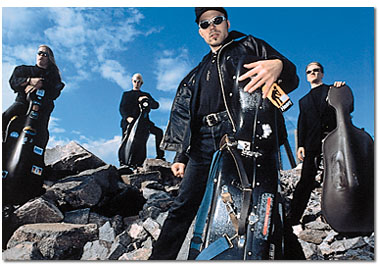 The deadly-serious alienation that has characterized so much alternative rock and heavy metal had to lift sometime, and sometime appears to be now. The year's not half over, and already we have two of the best musical jokes in decades. First we got Pat Boone's In a Metal Mood: No More Mr. Nice Guy (Hip-O), on which the Christian crooner does big-band arrangements of the biggest (and most pagan) hits in the history of metal. And now Apocalyptica delivers Apocalyptica Plays Metallica by Four Cellos (Mercury), in which ... well, the title explains the situation. These four cello students at the Sibelius Academy, in Helsinki, Finland, decided to expand their repertoire by covering their favorite heavy-metal band. The resulting album is hilarious when you think about where the melodies came from, and strangely moving when you forget. Since the cello is bowed and not strummed, it can never match the breathtaking speed of the electric guitar. Apocalyptica solves this problem by playing Metallica's slowest songs. Even so, Apocalyptica must have done some serious training to develop the endurance to play these tunes. Not only do the dark melody lines -- Metallica sings almost exclusively about death -- fit the de profundis emotional range of the cello, but they are explored in new arrangements that the morbid Sibelius himself could have appreciated. --C.M.Y. Apocalyptica Plays Metallica By Four Cellos, Apocalyptica
"Enter Sandman," AU (221k), Real Audio 28.8 Copyright 1997, Mercury
Bob Blumenthal is a jazz critic for The Boston Globe.
 
Copyright © 1997 by The Atlantic Monthly Company. All rights reserved. | ||||||||||||
 | |||||||||||||
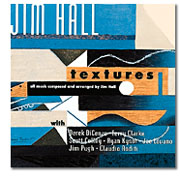 Ryan Kisor, Joe Lovano, and Claudio Roditi are among the other guest soloists,
each bringing the right touch to his featured piece. The same can be said seven
times over for Hall, who develops his improvisations out of interchanges with
the surrounding ensemble. Basic and blues-driven one moment, reminding us that
he plays electric guitar the next, Hall encompasses his instrument's
history from the seminal modernist Charlie Christian to Bill Frisell and other
second-generation disciples of his own.
Ryan Kisor, Joe Lovano, and Claudio Roditi are among the other guest soloists,
each bringing the right touch to his featured piece. The same can be said seven
times over for Hall, who develops his improvisations out of interchanges with
the surrounding ensemble. Basic and blues-driven one moment, reminding us that
he plays electric guitar the next, Hall encompasses his instrument's
history from the seminal modernist Charlie Christian to Bill Frisell and other
second-generation disciples of his own.