|


Return to the May 1997 A&E Preview Cover |
Arts & Entertainment Preview -- May 1997
   The American musical is turning back the clock, not a minute too soon. Real lyrics with real tunes have returned, thank heaven. For proof see Broadway's dance-marathon tale Steel Pier, songs by Chicago and Cabaret's John Kander and Fred Ebb (for tickets call 212-307-4100), and off-Broadway's black-comedy murder mystery The Green Heart, songs by Rusty Magee (212-239-6200).  Both opened last month,
long after we went to press, but in invitational rehearsals (no sets, no
costumes) they looked like winners. Deep enough into the process to start
owning their material, far enough from opening night to breathe easy, the
performers were blazing with star quality. Noting disarmingly that he is not
British and that he has no title, Magee displayed in his songs wittily wicked
turns of phrase and a gift for melody in many hummable styles. "I'm poor!"
exploded the riveting David Andrew Macdonald as a suddenly penniless playboy.
(It does not hurt that he resembles Christopher Reeve.) Ruth Williamson, the
show's Lady Macbeth type, had brass to flatten any Miss Hanagan. At Steel
Pier a more sophisticated tone prevailed. The brightest gem: "Dance With
Me," with Daniel McDonald rhapsodizing in song as Karen Ziemba filled the stage
with rhapsodic movement. Count on it to become a classic. --A.B. Both opened last month,
long after we went to press, but in invitational rehearsals (no sets, no
costumes) they looked like winners. Deep enough into the process to start
owning their material, far enough from opening night to breathe easy, the
performers were blazing with star quality. Noting disarmingly that he is not
British and that he has no title, Magee displayed in his songs wittily wicked
turns of phrase and a gift for melody in many hummable styles. "I'm poor!"
exploded the riveting David Andrew Macdonald as a suddenly penniless playboy.
(It does not hurt that he resembles Christopher Reeve.) Ruth Williamson, the
show's Lady Macbeth type, had brass to flatten any Miss Hanagan. At Steel
Pier a more sophisticated tone prevailed. The brightest gem: "Dance With
Me," with Daniel McDonald rhapsodizing in song as Karen Ziemba filled the stage
with rhapsodic movement. Count on it to become a classic. --A.B.
Not much that passes for plot in the four long acts of George Bernard Shaw's Man and Superman is hard to predict. Will a blandly manipulative heiress take to husband the moony lad who puts her on a pedestal or the  crackpot ideologue she scares out of his wits? Guess. Few spectators will gasp
when a "fallen" young lady proves to be married, or when her spouse's
identity is revealed. But Act Three contains an astonishment: a dream sequence
so far exceeding any reasonable measure that it can stand alone as Don Juan
in Hell, a full evening in itself. Alternatively it can be cut altogether.
The American Repertory Theatre, in Cambridge, Massachusetts, incorporates the
divertimento, thus honoring Man and Superman for the whirling Wimbledon
of ideas it truly is. The topic: the nature of sexual attraction. (Query: Is
Woman "Superman"?) Even so, ART must omit much unactable prose: an "epistle
dedicatory," essay-length stage directions, and the scandalous pamphlet "The
Revolutionist's Handbook." (May 9-June 8; 617-547-8300.)
--A.B. crackpot ideologue she scares out of his wits? Guess. Few spectators will gasp
when a "fallen" young lady proves to be married, or when her spouse's
identity is revealed. But Act Three contains an astonishment: a dream sequence
so far exceeding any reasonable measure that it can stand alone as Don Juan
in Hell, a full evening in itself. Alternatively it can be cut altogether.
The American Repertory Theatre, in Cambridge, Massachusetts, incorporates the
divertimento, thus honoring Man and Superman for the whirling Wimbledon
of ideas it truly is. The topic: the nature of sexual attraction. (Query: Is
Woman "Superman"?) Even so, ART must omit much unactable prose: an "epistle
dedicatory," essay-length stage directions, and the scandalous pamphlet "The
Revolutionist's Handbook." (May 9-June 8; 617-547-8300.)
--A.B.
The Royal Ballet leaves its home at Covent Garden, in London, for a late-month engagement at the Orange County Performing Arts Center, in Costa Mesa, California, bringing two programs. The first bill (May 20, 21, 24, and 25) is a surefire crowd-pleaser in a new and controversial incarnation, the second a dance fanatic's delight. For decades The Sleeping Beauty has been the jewel in the Royal's crown, a ballet in which the company seemed instinctively and distinctively at home. 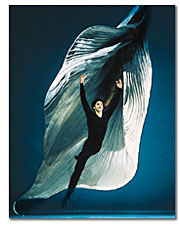 However, just as British royalty isn't
what it once was, neither is this beautiful ballet, here presented in surreal,
Magritte-meets-Louis Quinze decor by Maria Bjørnson, best known for her
fog-filled, chandeliered sets for Sir Andrew Lloyd Webber's The Phantom of
the Opera. She is a designer who sends you home humming the scenery -- you
will either love what she has done with Beauty or think it beastly.
Either way, you will see the still wonderful Royal offering a meticulous
depiction of the marvelous characters who inhabit this much-loved fairy tale.
The company fills it with a roster of internationally renowned stars, both
homegrown and imported, and a tradition that not even the most skewed of
productions can conceal. The Royal Ballet's second program, called A Ravel
Evening (May 22-23), is a quadruple bill. It opens with the 1958 La
Valse, a tribute to the Viennese waltz by the late Sir Frederick Ashton,
Britain's greatest choreographer -- indeed, one of this century's greatest. The
Royal performs his work with an authority no other company can muster. The
evening concludes with Ashton's 1951 setting of Daphnis and Chloë,
composed by Ravel for Serge Diaghilev in 1912. Slotted between these gems are
Kenneth MacMillan's La Fin du jour -- set to the Piano Concerto in G, and
meant to evoke fashionable society of the 1930s -- and a setting of the brief and
ineffable Pavane pour une infante défunte by Christopher
Wheeldon, a young choreographer who lately has attracted considerable interest
and acclaim on both sides of the Atlantic. (A Ravel Evening will
also be presented in New York during The Royal Ballet's appearances at
Lincoln Center, July 8-27; 212-875-5928.) For tickets to the Orange County
Performing Arts Center events call 714-740-7878. --N.D. However, just as British royalty isn't
what it once was, neither is this beautiful ballet, here presented in surreal,
Magritte-meets-Louis Quinze decor by Maria Bjørnson, best known for her
fog-filled, chandeliered sets for Sir Andrew Lloyd Webber's The Phantom of
the Opera. She is a designer who sends you home humming the scenery -- you
will either love what she has done with Beauty or think it beastly.
Either way, you will see the still wonderful Royal offering a meticulous
depiction of the marvelous characters who inhabit this much-loved fairy tale.
The company fills it with a roster of internationally renowned stars, both
homegrown and imported, and a tradition that not even the most skewed of
productions can conceal. The Royal Ballet's second program, called A Ravel
Evening (May 22-23), is a quadruple bill. It opens with the 1958 La
Valse, a tribute to the Viennese waltz by the late Sir Frederick Ashton,
Britain's greatest choreographer -- indeed, one of this century's greatest. The
Royal performs his work with an authority no other company can muster. The
evening concludes with Ashton's 1951 setting of Daphnis and Chloë,
composed by Ravel for Serge Diaghilev in 1912. Slotted between these gems are
Kenneth MacMillan's La Fin du jour -- set to the Piano Concerto in G, and
meant to evoke fashionable society of the 1930s -- and a setting of the brief and
ineffable Pavane pour une infante défunte by Christopher
Wheeldon, a young choreographer who lately has attracted considerable interest
and acclaim on both sides of the Atlantic. (A Ravel Evening will
also be presented in New York during The Royal Ballet's appearances at
Lincoln Center, July 8-27; 212-875-5928.) For tickets to the Orange County
Performing Arts Center events call 714-740-7878. --N.D.
Austin Baer is a writer based in New York.
 
Copyright © 1997 by The Atlantic Monthly Company. All rights reserved. | ||||||||||||
 | |||||||||||||