

World-Wide Weather
Separating the average weather watcher from the bona fide junkie.
96.12.04
Crossing the Frontier
A challenging look at the American West.
96.11.27
AOL: Back to the Future
A sure escape from the confusing Web space of the present.
96.11.20
The CIA
One of the great oxymorons in cyberspace.
96.11.13
Web Del Sol
The "Locus of Literary Art on the WWW."
96.11.06
Metrobeat NY
The Web isn't only about connecting the global village.
96.10.30
Idea Central
An antidote to the airy nothings of today's
political rhetoric.
96.10.23
DisInformation
"Everything You Know Is Wrong." Or so the creators of this new search
engine are out to prove.
96.10.16
World Birthday Web
Banal online gimmick or digital dadaism?
96.10.09
Witness: Roads to Refuge
An innovative online documentary looks at the plight of Bosnia's
uprooted population.
96.10.03
The Library of Congress Exhibitions
A look at one of the country's -- and
the Web's -- most extraordinary resources.
For more, see the complete Web Citations
Index.
 December 18, 1996
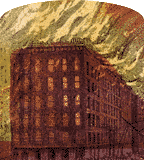
With a thoughtful and judicious combination of hypertext, graphics, film, music, and other multimedia technologies, a well-designed Web site can give history a sense of almost palpable immediacy. "The Great Chicago Fire and The Web of Memory," an online-only exhibit created by the Chicago Historical Society and Academic Technologies of Northwestern University to commemorate the 125th anniversary of the disaster, succeeds in this endeavor.
Chicago before the Great Fire was, the exhibition tells us, "the nexus between the manufacturing East and the agricultural West," a burgeoning and chaotic work-in-progress. An eleven-photograph panorama, taken in 1858, gives visitors to the exhibition a bird's-eye view of the city before it went up in flames, and the site's designers have cleverly fused the eleven images into one interactive, 360-degree look at the city. There it sits: bustling, thriving, and sprawling in every direction. (Be warned, however: there have been technical difficulties viewing the panorama through the Netscape browser. We've been provided with this alternate URL.)
The Great Fire struck Chicago on October 8, 1871, and raged for two days; one witness, quoted in the exhibition, describes it as "rushing most frantically, leaping from block to block -- whole squares vanishing as if they were gossamer." In the end some 2,000 acres and 100,000 homes in the northern section of the city -- whose streets and sidewalks were mostly "paved" with wood -- were destroyed. With the help of 3-D glasses (which, the site explains, can be ordered from the Reel 3-D Enterprises Web site), visitors can "enter" pictures of a smoldering Chicago in the wake of the disaster. Also on display are before-and-after pictures of a half-dozen of Chicago's pre-fire landmarks and their burnt-out remains -- poignant reminders of the architectural beauty that was lost.
 The exhibit -- which provides a wealth of information in both primary and secondary sources -- is divided into two sections: "The Great Chicago Fire" and "The Web of Memory." These sections are then further divided into several "chapters" -- each comprising a (gracefully written) essay, a library, and a gallery, all thoughtfully interlinked. "The Great Chicago Fire" section ranges from descriptions and drawings of the fire to essays on how Chicago, the "Queen of the West," rose from the ashes to become even more vibrant than before. "The Web of Memory" section presents various ways in which the memory of the fire has been preserved -- through fiction, art, songs, and eyewitness accounts, for example -- and of course includes the legend of Mrs. O'Leary's ill-fated cow that is supposed to have caused the blaze by knocking over a lantern.
The site bills itself as an online exhibition, but don't approach it as you would a museum exhibit. With its layers of hundreds of documents and images, it's not intended to be entirely digested in a single visit. While some might argue that the material could have been pared down for easier and more complete consumption, others would point out that cyberspace renders such trimming unnecessary, and that when it comes to understanding the past, more is more. With no one on your heels and as much time to wander as you wish, you may find yourself completely absorbed in the world of nineteenth-century Chicago and discover one of the more enjoyable ways to learn about history.
Copyright © 1996 by The Atlantic Monthly Company. All rights reserved.
 |
 |
 |
 |
 |
 |