



Previously in Atlantic Abroad
For more, see the complete Atlantic Abroad Index.
Share your tales of life abroad in Post & Riposte.
November 4, 1998
Recently I went to church in Ennis, County Clare, on Ireland's west coast. The day before, I'd had the opportunity to talk to the minister -- a bearded Anglican from Northern Ireland, assigned to St. Columba's in Ennis as part of a tour of duty in the Republic. I was intrigued. In a country where more than 90 percent of the population is Catholic and where Catholicism itself has come to symbolize resistance to centuries of Protestant English rule, finding a Protestant minister is no piece of cake.
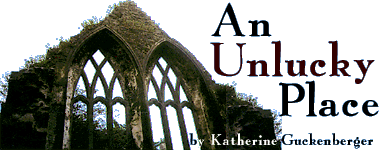
Built in 1871 in Ireland's rock of choice (limestone, which is mined in County Clare), St. Columba's replaced the town's makeshift house of Protestant worship in the Ennis Friary -- originally a thirteenth-century Franciscan complex. Today the friary, like countless churches in Ireland, is in ruins, the victim of Henry VIII's steel hand and of centuries of neglect. The friary's walls are intact, but the entire structure is roofless, and the lancet windows, once filled with blue stained glass, are empty. Weeds grow in every crevice. St. Columba's, on the other hand, on a busy bend in the road, has every outward appearance of a thriving, active church. Inside, I found a different story.
Encouraged by the minister's invitation to attend a service, I showed up early on Sunday morning, pleased to find the church decorated with lilies and rhododendrons left over from a town festival that had taken place the previous week. As I approached the flowers, however, I noticed that all the petals were curled and outlined with the brown of rot. Closer to the apse entire arrangements drooped, as if nodding off to a dull sermon. It occurred to me that only a nearly dead church would keep nearly dead flowers: though Ennis is one of the fastest growing towns in Europe, with a population of 30,000, the congregation of St. Columba's has never been so tiny. At last count, there were twenty active members, only one of whom, an eighty-year-old woman, had been born in Ireland. The rest of the congregation is made up of transplants.
The shape of St. Columba's is atypical -- there are no arm-like transepts and no chapels. Instead, there is a double nave, built to accommodate the legions of church-going Anglicans who attended services there during the English occupation. The result is a church that looks twice as fat as it should be and holds some 500 people. The mere sixteen of us in attendance that day sat in the choir, the nave itself absurdly large for such a small group.
The minister asked if one of the women would agree to read the Epistle, before communion. No one volunteered, so I said I'd do it, even though I'm not a lay reader and have never read in front of a congregation. Desperate times require desperate measures, I thought, as I quickly skimmed the passage for unfamiliar turns of phrase. The minister clicked on a tape, and the service began with a hymn I didn't know. I turned the pages of my tiny hymnnal carefully, as though handling an antique. The pages were so thin in places that the print looked embossed.
Sitting so close to the altar, I took the opportunity to admire St. Columba's most prized feature, a painted row of disciples, each standing under a trompe l'oeil arch, like the foil-wrapped chocolate disciples of my youth that came lined-up in a box, each in his own plastic niche. Soon the service began to take on the familiarity I love about church; I recognized the passages I know by heart without ever having had to memorize them.
Then I noticed a startling difference. The Church of Ireland's Book of Common Prayer is coded in alarm-red ink. Parentheticals in front of certain phrases -- "(NI)," for "Northern Ireland," and "(IR)," for Irish Republic" -- direct readers in prayer, based on their latitude. When the congregation is called on to bless their leader, for example, the people in Northern Ireland are instructed to bless "our Queen, Elizabeth." Since we were in the Irish Republic, we blessed "the President."
When it came time for me to read the Epistle, the minister motioned to me to stand. I did, and turned my body catty-corner to the congregation, which meant facing the nave of the church. I cleared my throat, and began to read. The first words out of my mouth were unintentionally loud. What struck me as I spoke, however, was not the magical amplification of my voice, carried through the church like a whisper over an arch, but rather the rows and rows of empty pews in front of me. I continued, at certain points looking over the heads of my fellow worshippers into the cavernous nave. I couldn't help but think of the friary, that stone skeleton across town, and wonder what would happen to St. Columba's. Lonely and unloved, would this vestige, too, soon die?
When I got home a friend gave me a poem written by Philip Larkin, called "Church Going." It's about stopping at a church in Ireland, and the irresistible compulsion to compare it to church ruins around the country. Driven by curiosity and secular respect, Larkin and I had had remarkably similar experiences. In my mind he could have been writing about St. Columba's:
When churches fall completely out of use
What shall we turn them into, [shall we] keep
A few cathedrals chronically on show,
Their parchment, plate and pyx in locked cases,
And let the rest rent-free to rain and sheep.
Shall we avoid them as unlucky places?
Katherine Guckenberger is a staff editor at The Atlantic Monthly. Her last Atlantic Abroad dispatch was from France.
Share your thoughts on Atlantic Abroad in Post & Riposte.
Copyright © 1998 by The Atlantic Monthly Company. All rights reserved. Photograph by Katherine Guckenberger.