




Garlic Broth
Curried Squash and Apple Soup
Scallop and Endive Soup
Tortilla Soup
November 11, 1998
 Barbara Kafka is a fearlessly original cook. She knows all the rules and
merrily breaks them, following her marvelously eccentric interests. I won't
hide my nearly limitless admiration for Kafka, or how lucky I feel to have her
as a friend -- a friend as challenging as she is loving.
Barbara Kafka is a fearlessly original cook. She knows all the rules and
merrily breaks them, following her marvelously eccentric interests. I won't
hide my nearly limitless admiration for Kafka, or how lucky I feel to have her
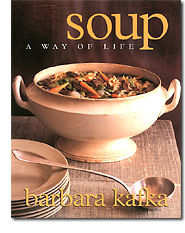
as a friend -- a friend as challenging as she is loving. Those challenges and that love are apparent in her new book, Soup: A Way of Life, which is full of fascinating recipes likely to set trends, a Kafka specialty. I predict quick appearance on the menus of alert chefs the many soups of her Russian heritage -- especially the numerous variations on her beloved borscht -- and the Ecuadorian soups, inspired by recent travels, full of New World gifts like potatoes, peppers, pumpkin, hominy, and plantains. Some recipes are as exotic and possibly scary as Catalan eel soup, mussels with sauerkraut and riesling, and okroshka -- a Russian soup that begins with pumpernickel fermented with beer for two weeks. The book has plenty of comforting and utterly appealing recipes, too, like creamy oyster soup, chicken in the pot with Chinese flavors, chicken gumbo, fish soup Caribbean style, bourbon corn chowder, and ginger peach soup. All these are original.
Previously in Corby's Table:
A trip to Abruzzo with Anna Teresa Callen, whose new book draws on culinary memories of this less-traveled Italian region.
Paula Wolfert's latest Mediterranean explorations.
The ultimate guide to eating your vegetables.
Jasper White gets up close and personal with lobster claws, tails, and tomalley.
A rare book that shows Italy unromanticized -- and more appetizing.
New reasons not to get out of bed in the morning.
In Ruth Reichl's new memoir, Tender at the Bone, food is about more than eating.
South America's well-traveled cuisine.
Just in time for the holidays, a look back over the year's best.
A book to help one get wise to the whys of cooking.
More by Corby Kummer in Atlantic Unbound
 |
| Barbara Kafka |
Finally, tortilla soup is a make-your-own-meal dish, "more an event than a soup," in which guests garnish chicken broth with avocado, red onion, cilantro, jalapeño peppers, limes, tomatoes, and white cheese. It's a terrific and fun idea, one Kafka took from Shirley Collins, the founder and mastermind of Sur la Table, the West Coast culinary-equipment store. Kafka knows style when she sees it. She makes style, too. The food world, not to mention the world of her many students and friends, would be impoverished without her.
-- Corby Kummer
Excerpts from Soup, A Way of Life, by Barbara Kafka (Artisan)
Broccoli di Rape and Garlic Soup
The slight bitterness of the broccoli di rape contrasts pleasantly with the sweetness of the garlic. The pasta makes the soup more substantial.
| Garlic Broth | Fresh lemon juice, to taste |
| 2 1/2 teaspoons kosher salt | Freshly grated Parmesan cheese, for serving |
| 1/2 teaspoon freshly ground black pepper | Kosher salt, to taste, optional |
| 3/4 cup ditalini or other small pasta shape | Freshly ground black pepper, to taste, optional |
| 1 medium bunch broccoli di rape, stems cut off, yellow and wilted leaves discarded, and tops and leaves sliced across into 1/2-inch pieces |
In a medium saucepan, combine the garlic broth, salt, and pepper. Bring to a boil. Stir in the pasta and boil for 6 minutes.
Stir in the broccoli di rape and return to a boil. Lower the heat and simmer until the broccoli di rape is tender, about 4 minutes. Remove from the heat and stir in the lemon juice to taste. Check the seasoning and add salt and pepper, if necessary.
Pass grated cheese at the table.
Garlic Broth
This is really a base for other soups that can also be served on its own -- but consider adding some jalapeno pepper, cilantro, and lime juice; or diced tomato, chopped parsley, matchsticks of zucchini, and thinly sliced basil; cooked peas and small leaves of spinach; lemongrass, curry leaves, and lime juice; or any other seasoning group that seems enjoyable. See the notes on garlic below.
| 3 small heads garlic, smashed and peeled | Kosher salt, to taste, optional |
| 1 tablespoon olive oil | Freshly ground black pepper, to taste, optional |
Cut the garlic cloves in half lengthwise and, if necessary, remove the green germ growing through the center.
In a medium saucepan, heat the oil over low heat. Stir in the garlic cloves and cook, stirring often, until the outside of the garlic is translucent and the cloves are soft, about 20 minutes. Don't let the garlic brown.
Pour in 9 cups water. Bring to a boil. Lower the heat and simmer, uncovered, for 40 minutes. The garlic will be very tender. To eat the broth on its own, season with salt and pepper to taste; or use as a stock.
Stone Soup and Garlic
 HERE IS AN OLD TALE of two very hungry men who enter a town and ask for
something to eat. The townspeople very sadly reply that they have no food
themselves. The men ask if they have a pot. Yes. "Good," say the men, "because
with a pot and water we can make stone soup." The hungry townspeople are fascinated. They
bring their pot, put water in it, and set it over a fire. The men wash off three
good-sized stones and put them in the water. One of the men asks if by any
chance someone has an onion, because stone soup is better with onion. A woman
brings an onion. A few minutes later, the same man asks for a carrot. To make a
shaggy tale short, after a while there is vegetable soup.
HERE IS AN OLD TALE of two very hungry men who enter a town and ask for
something to eat. The townspeople very sadly reply that they have no food
themselves. The men ask if they have a pot. Yes. "Good," say the men, "because
with a pot and water we can make stone soup." The hungry townspeople are fascinated. They
bring their pot, put water in it, and set it over a fire. The men wash off three
good-sized stones and put them in the water. One of the men asks if by any
chance someone has an onion, because stone soup is better with onion. A woman
brings an onion. A few minutes later, the same man asks for a carrot. To make a
shaggy tale short, after a while there is vegetable soup.The moral of the tale is that poor people make their food from the minimum of ingredients. They certainly do not kill an animal to make stock. Hence the many stories of the prosciutto bone passed around the village to boil in the soup until there is no flavor left. One has only to look at a Sicilian soup such as Spelt and Lentil Soup and Ecuadorian Quinoa Soup to see how good minimal can be. My candidate for the Ur basic soup is Garlic Broth, which uses nothing but garlic, olive oil, and water, and, if desired, salt and pepper. These ingredients are on hand in any Mediterranean home and some version of the soup is made in most.
There are few versions here; but remember that the broth can be used as a vegetarian alternative in almost any hearty vegetable soup or in place of chicken stock in simple soups such as Brodo con Straciatella or its variants.
Garlic
Not everybody loves garlic as much as I do. In fact, there are those who would prefer the vampire to the garlic. I at least have health information on my side. Garlic helps clear the arteries and acts as a fungicide and a mild antibiotic. For those who fear the odor, I can aver that several sprigs of parsley, chewed, and a Marc de Bourgogne, drunk, after indulging should set all right.
There are many different kinds of garlic. To understand the full spectrum, search out books by Chester Aaron, the American guru of garlic. In America, we mostly find large white heads from Gilroy, California. I prefer the smaller reddish purple heads I get in the South of France or from organic growers here. It is impossible to tell without nibbling a little bit exactly how hot or sweet a given crop of a given variety of garlic will be. Crops vary, depending on the amount of sun and rain the year has had. Use your judgment. Garlic that cooks for a long time has a mellow, somewhat sweet flavor. Raw garlic is sharper. Hence, some recipes add garlic twice.
The easiest way to separate the garlic cloves and to peel them is to put them on a stable surface, cover them with a cloth so the cloves don't jump all over the room, and bring a heavy pot or a large heavy knife down on them with a solid thwack. Lift the cloth. The cloves will be separated and the excess papery skin can be removed. Select just the number of cloves needed and repeat the process. This will loosen the skins from the garlic, so that they are easily peeled. If only peeling one or two cloves of garlic, holding a knife in one hand with the palm of the other hand laid flat on the blade of the knife, give the clove a sharp whack with the flat of the blade. (Be sure to keep the fingers holding the handle well back from the work surface.)
There are two advantages, in addition to ease, in this method. First, garlic is a living plant -- like a tulip bulb. Whacking it kills it, which prevents it from deploying its self-protective stink. Second, the clove is liable to split open, which makes it easy to see the germ, the central part that turns green and becomes the sprout of the new plant. If the germ (sprout) is heavy or turning yellow or green, it will be bitter and should be removed with the point of a knife
Garlic soups, however, should never be made with sprouting garlic in the spring. The taste will be nasty.
Curried Squash and Apple Soup
This vegetarian soup can be a silky and succulent first course for a fall or winter evening; but I prefer to serve it as a main course with boiled rice on the side and a sprinkling of raisins and slivered almonds on top. A chutney would not be out of place.
| 2 medium acorn squash, cut in half lengthwise, and seeds and fibers removed | 1 1/2 tablespoons very finely chopped peeled ginger |
| 1/4 cup vegetable oil | 4 cups Roasted Vegetable Broth |
| 4 teaspoons black mustard seed | Lime juice, to taste |
| 3 tablespoons curry powder | 2 teaspoons kosher salt |
| 2 large Granny Smith or other tart apples, quartered, cored, cut into 1-inch cubes, and tossed with the juice of 1 lime | for serving |
| 1 medium onion, cut into chunks | 1 lime, sliced across into very thin rounds |
| 10 medium cloves garlic, smashed and peeled | 3/4 cup yogurt |
Heat the oven to 500° F. Roast the squash cut side up in a roasting pan for 50 minutes, or until soft. Scoop the pulp from the squash.
In a medium saucepan, stir together the vegetable oil and mustard seeds over medium heat until the seeds are popping (be careful -- it is very easy to burn the spices if the oil gets too hot). Stir in the curry powder and cook, stirring constantly, over medium-low heat for about 1 1/2 minutes.
Stir in the apples, squash, onion, garlic, ginger, and stock. Bring to a boil. Lower the heat. Simmer for 20 minutes, or until the apples and onions are soft.
In a food processor, working in batches, purée the soup; or pass through the medium disc of a food mill. The soup can be made ahead to this point and refrigerated for up to 3 days.
Return the soup to the pot and heat through. Season with the lime juice and salt. Top each serving with a thin slice of lime and a dollop of yogurt.
Scallop and Endive Soup
If I do say so myself, this is spectacularly good. The slight bitterness of the endive balances the sweetness of the scallops. The tarragon provides a top note to the base of the cream.
| 2 pounds sea scallops, small connective muscles removed and reserved | 1 cup heavy cream |
| 3 medium shallots, coarsely chopped | 1 tablespoon cornstarch |
| 1 cup (250 ml) dry white wine | 2 teaspoons kosher salt |
| 3 large Belgian endive [chicory], trimmed and cut across into 1/2-inch pieces | Freshly ground black pepper, to taste |
| 1/4 cup tarragon leaves |
Place the connective muscles from the scallops, the shallots, the wine, and 3 cups water in a small saucepan. Bring to a boil. Lower the heat and simmer for 15 minutes. Strain through a fine-mesh sieve into a medium saucepan and discard the solids.
Bring the liquid to a boil. Stir in the endive. Return to a boil. Add the scallops and tarragon, stirring once to separate the scallops. Return barely to a simmer, without stirring again.
Stir in 1/2 cup heavy cream. Dissolve the cornstarch in the remaining cream. Ladle a few spoonfuls of the hot soup into the cornstarch mixture. Pour the cornstarch mixture back into the soup, stirring gently to incorporate. Cover and return to a boil. As soon the soup returns to a boil, uncover the pot, or it will overflow. Lower the heat and simmer, uncovered, for 3 minutes. Season with the salt and pepper.
Tortilla Soup
Roccoco Sopa Azteca
I first had a version of this soup at the home of Shirley and Alf Collins in Seattle. We had a wonderful time sitting around their kitchen table. Shirley would get up from time to time to toast more tortillas on the electric burner. We made bowlfu1 after bowlful, each bowl a little different depending on what we put in and how much. We drank Superior Mexican beer and had a wonderful evening.
While there is a recipe here, it's just a question of how much to allow per eater. As a rule, allow per person: 2 cups broth, 2 flour tortillas, 1/2 avocado, 1/3 cup of shredded chicken or turkey, 1/3 medium red onion, 1/3 cup cilantro leaves, 1/2 jalapeno, 1/2 lime, 1/2 small tomato, and 1/3 cup shredded cheese.
This is more of an event than a soup. Bring the broth hot to the table and allow guests to make their own.
| 8 cups Basic Chicken Stock or Roasted Turkey Stock | 1 large red onion, coarsely chopped |
| Kosher salt, to taste | 1 large bunch cilantro, leaves only |
| 8 flour tortillas, grilled over a burner or in a pan under a broiler until slightly crisp and mottled, and shredded | 2 medium jalapeño peppers, seeded and finely chopped (hotter chilies can be used for a spicier dish) |
| Freshly ground black pepper, to taste | 2 limes, cut into wedges |
| 2 Hass avocados, seeded, peeled, and cut into 1/2-inch cubes | 2 small tomatoes cut into 1/4-inch dice |
| 1 whole skinless boneless chicken breast, cooked and shredded | 1 1/3 cups shredded queso blanco, mozzarella, or rinsed mild feta cheese |
In a medium saucepan, bring the stock to a boil. Season with salt and pepper. Bring the broth to the table in a fondue pot or chafing dish to keep it hot as the diners ladle as little or as much as they desire into their bowls. Present the remaining ingredients in bowls so diners can add as many as they like.
Corby Kummer is a senior editor at The Atlantic Monthly and the author of The Joy of Coffee.
More by Corby Kummer in Atlantic Unbound
Copyright © 1998 by Corby Kummer.
Recipes from Soup, A Way of Life by Barbara Kafka. Artisan: New York, New York, 1998. Hardcover, 556 pages. ISBN: 1579651259. $35.00. Copyright © by Barbara Kafka. Headline photograph of tortilla soup ©1998 Gentl & Hyers.
 |
 |
 |
 |
 |
 |