




|
Arepas Russian Salad Roast Chicken with Plantain and Sausage Stuffing Garlic and Chipotle Mashed Potatoes Brazilian Carnival |
January 22, 1998
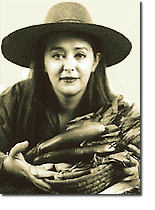 Anya von Bremzen goes everywhere. It's part of her job as restaurant critic
for Travel & Leisure magazine. But it's part of her nature, too.
Von Bremzen grew up in Moscow, where she trained as a pianist. She came to New
York in the mid-1970s, still in her teens, to study at Juilliard. By the type
of odd circumstance that seems to thread through every food writer's life, she
was able to combine great linguistic fluency and a taste for offbeat travel
with research into various cuisines. Her first book was the prizewinning
Please to the Table (1990), a comprehensive guide to Russian
cooking; the next was Terrific Pacific (1995), a tour of the Pacific
Rim.
Anya von Bremzen goes everywhere. It's part of her job as restaurant critic
for Travel & Leisure magazine. But it's part of her nature, too.
Von Bremzen grew up in Moscow, where she trained as a pianist. She came to New
York in the mid-1970s, still in her teens, to study at Juilliard. By the type
of odd circumstance that seems to thread through every food writer's life, she
was able to combine great linguistic fluency and a taste for offbeat travel
with research into various cuisines. Her first book was the prizewinning
Please to the Table (1990), a comprehensive guide to Russian
cooking; the next was Terrific Pacific (1995), a tour of the Pacific
Rim. Von Bremzen seems to know exactly what will be the next trend. But her interest in Latin America goes back to her secondary school in Moscow, where many of her classmates came from Spanish-speaking countries. They made her wish she could go home to some of the dishes they described: "In a classroom where Spanish was taught by a niña de la guerra (one of the many Spaniards who were brought to Russia as children during the Spanish Civil War), I shared my desk with students from Havana and Santiago, Buenos Aires, and Bogotá. During class, my friends -- forced to subsist on watery borscht and appalled by our habit of eating ice cream in sub-zero temperatures -- whispered deliriously delicious stories of soups teeming with meats and tropical vegetables, gigantic steaks, exotic fruit, and pastries steamed in banana leaves."
Previously in Corby's Table:
Just in time for the holidays, a look back over the year's best.
A book to help one get wise to the whys of cooking.
Fred Plotkin shows why Liguria's is "the great undiscovered cuisine of Italy."
Olive Oil: From Tree to Table explains what makes an olive oil great -- and then how to cook with it.
In Honey from a Weed, Patience Gray shows that the best salad ingredients might not be what you planted in the garden.
Carol Field travels to Italy to record the traditional dishes of the nonnas, or grandmothers, who are at the heart of Italian cooking.
More by Corby Kummer in Atlantic Unbound
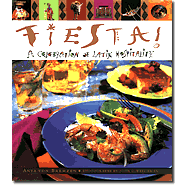 Von Bremzen's newest cookbook, Fiesta!, is a sort of once-over of South
America -- something she could almost have accomplished by strolling through
her New York City neighborhood, Jackson Heights. "Like my neighbors," she
writes, "I go out to dance salsa on Mondays, tango on Wednesdays,
charanga on Thursdays, and rumba on Sundays. I make tamales on Sundays,
salt cod on Fridays, and crispy suckling pig for the holidays." Fiesta! takes
us through the countries from which her neighbors emigrated, including Spain
and Portugal, for the sources of dishes that have been transformed by native
South American cooks. There's no Mexico, since von Bremzen is well aware of
how many books have been written on the subject.
Von Bremzen's newest cookbook, Fiesta!, is a sort of once-over of South
America -- something she could almost have accomplished by strolling through
her New York City neighborhood, Jackson Heights. "Like my neighbors," she
writes, "I go out to dance salsa on Mondays, tango on Wednesdays,
charanga on Thursdays, and rumba on Sundays. I make tamales on Sundays,
salt cod on Fridays, and crispy suckling pig for the holidays." Fiesta! takes
us through the countries from which her neighbors emigrated, including Spain
and Portugal, for the sources of dishes that have been transformed by native
South American cooks. There's no Mexico, since von Bremzen is well aware of
how many books have been written on the subject. The recipes in Fiesta! -- which are lively, straightforward, and vibrant -- recall the many festivals she happened upon during her research. "You will always have enough food for everyone," she promises, "plus leftovers for days to come." Here are some samples from von Bremzen's book -- one for arepas, or cheesy white-cornmeal pancakes, I've included for sentimental reasons, since von Bremzen so delightfully evokes the woman who after midnight hawks on a "not-too-savory street corner"; another for Russian salad, which is not a sentimental holdover from her childhood but a familiar and satisfying potato salad that is more popular in South America than it is in Russia; a third for a hearty and spicy roast chicken; and a recipe for mashed potates that will help anyone who likes garlic and chiles get through the winter.
-- Corby Kummer
Excerpts from Fiesta!, by Anya von Bremzen (Doubleday)
Arepas
It's midnight. My phone rings. I jump. It must be my father from Moscow. "She is here, I found her!" The voice on the other end belongs to my sometime-food-writer, sometime-trombonist friend Jim. Jim is the godfather of the New York underground food scene--he drives miles scouring street corners in search of "the most incredible!!!" arepas, pombasos, bougasas, papusas, or whatever else is his latest obsession. But for all the Egyptian grandmothers, mustached souvlaki vendors, and Peruvian guinea pig sellers that he adopts, his heart really belongs to her, our angelic-looking diminutive Colombian arepa lady, who periodically appears like a heavenly apparition on a not-too-savory street corner between 12 and 3 in the morning, hawking the most lusciousarepas (white corn cakes) slathered with butter and white cheese. I put my clothes on and run out to meet them. I give her a big kiss, and Jim buys her a guanabana milk shake from the juice bar on the corner. We have our ritual arepa. Now, everyone in my Colombian neighborhood sells arepas, but none come close to hers. Jim doesn't want to know her name, to him she is the saint of street vendors, a creature to be worshiped from afar. I, however, befreinded her and went to visit her in the house where she lives with her teenage sons and a big dog. Her name, Piedad (Piety), is fittingly angelic. Here is her arepa recipe.
|
2 cups milk 4 tablespoons (1/2 stick) unsalted butter, cut into pieces, plus more for serving 1 1/2 cups white arepa flour (called masarepa or arepaharina), available at good Hispanic markets 1 teaspoon salt |
1 1/2 tablespoons sugar 1 cup grated processed mozzarella cheese (do not use fresh Italian mozarella) Vegetable oil, for the griddle 1 1/4 cups finely grated queso blanco (Hispanic white cheese), for serving |
2. In a large bowl, stir together the masarepa, salt, sugar, and mozzarella. Make a well in the center and pour in the hot milk. Stir the masa and milk together until there are no lumps. Knead the mixture, sprinkling in the remaining 1/2 cup milk, until you have a smooth sticky dough. This should take about 5 minutes.
3. Roll the dough into a 1/2-inch-thick sheet between two pieces of wax paper. With a cookie cutter or the rim of a glass, cut out 3-inch circles. Reroll the scraps and cut out more circles. You should have eight.
4. Brush a griddle or a large cast-iron skillet lightly with oil and preheat over medium-low heat. Fry as many arepas as will fit, until they are soft within and golden and slightly crusty on the outside, about 4 minutes per side. Keep separating the arepas from the skillet with a metal spatula, or they will stick. Keep the finished arepas warm in a low oven.
5. To serve, spear a pat of butter with a fork and brush the arepas while still hot. Immediately sprinkle them with a generous coating of grated cheese and serve.
Russian Salad
Being Russian, I am always amused to encounter this dish at places like railway station restaurants in Turkey, an Iranian dive in Santa Monica, a Korean barbecue house, or a tapas bar in Bilbao. But nowhere is it a bigger hit than in South America, where its popularity surpasses even its fame in its own homeland. By the way, in Russia this salad is called "Olivier," and is said to have been invented in the nineteenth century by a visiting French chef. Essentially, it's just a good all-purpose potato salad (which is what, no doubt, accounts for its international popularity), with the addition of a few cooked vegetables, and sometimes meats. It makes a great picnic dish or accompaniment to cold meats. Don't frown at the canned peas; their slightly mushy texture is an integral part of the classic taste.
|
4 large russet potatoes, peeled and cooked 2 large carrots, peeled and cooked 1 1/2 cups drained canned green peas 1 large dill pickle, cut into small dice 1/3 cup sliced pimiento-stuffed olives |
2 hard-cooked eggs, chopped 1 cup best-quality mayonaise 1 tablespoon Dijon-style mustard 2 tablespoons fresh lemon juice 2 tablespoons water Salt and freshly ground black pepper, to taste |
2. In a bowl, whisk together the mayonaise, mustard, lemon juice, and water. Toss the dressing gently but thoroughly into the salad. Season with salt and pepper to taste.
Señora Sanchez's Roast Chicken with Plantain and Sausage Stuffing
Señora Sanchez is the wife of my ebullient Colombian butcher. He noticed my interest in culinary matters (I am the only gringa on the block who buys pig's feet, dried meat, and his excellent chorizo) and introduced me to his wife, Soledad, a well-known cook in the Colombian community. "The pollo is so sabroso, and you won't find this 'formula' in any book," she exclaimed, proud of her invention. She was right, the plantains make a great stuffing for the bird. They have the right starchy, lush texture, which doesn't disintegrate with slow cooking, and a striking flavor, which combines excellently with smoked meats or sausages. The same stuffing will also work with turkey--just triple the amount.
|
3 cloves garlic, crushed through a press 1 teaspoon coarse (Kosher) salt, or to taste 2 tablespoons Annatto Oil 2 tablespoons fresh sour orange juice or a combination of lime and orange juice 1 roasting chicken (about 5 pounds) rinsed and patted dry |
2 large ripe plantains, peeled and cut into 1/2-inch slices 2 tablespoons unsalted butter, melted 1 1/2 cups coarsely chopped onions 2 small chorizo sausages, sliced 1/4 cup thinly sliced pitted green olives 1/2 cup chicken stock, canned lower-salt chicken broth, or water Salt to taste |
1. To prepare the chicken: In a mortar and pestle, pound the garlic to a paste together with the salt. Whisk in the oil and orange juice. Rub the chicken all over with this mixture and let it stand while you prepare the stuffing.
2. To make the stuffing: Boil the plaintains in salted water to cover until tender, about 10 to 15 minutes. Drain.
3. Preheat the oven to 350 degrees F.
4. In a large skillet, melt the butter over medium heat. Add the onions and cook, stirring, until wilted, about 5 minutes. Add the chorizo and cook until lightly browned. Pour off all but 2 tablespoons of the fat. Add the plantains, olives, and stock, and cook for 10 minutes, stirring until the plantains are soft. Season with salt to taste.
5. Stuff the cavity of the bird with the stuffing and truss the bird.
6. Place the chicken on a rack in a large roasting pan and roast until the juices run clear when you prick the thickest part of the thigh with a skewer, about 1 1/2 hours.
7. Remove the stuffing from the chicken, transfer it to a bowl, and cover it with foil. Cover the chicken loosely with foil and let it stand for 10 mintues.
8. Carve the chicken and serve accompanied by the stuffing.
Garlic and Chipotle Mashed Potatoes
A hot Latin fantasy on the perennial theme of mashed potatoes. The best chipotles (large, smoky Mexican chiles) for this dish are the canned ones, packed in adobo sauce. If you can find only dried chipotles, stem, seed, and soak them in warm water to cover for 1 hour before beginning the recipe
|
6 large baking potatoes (about 3 pounds), peeled and cubed 2 large canned chipotle chiles, seeded and chopped 1/3 cup warm milk |
3 cloves garlic, crushed through a press 3 tablespoons virgin olive oil Salt and freshly ground black pepper, to taste |
2. Pass the potatoes through a ricer into a bowl and stir in the milk and garlic. Whisk in the oil and season with salt and pepper. Transfer to a serving dish and serve.
Brazilian Carnival: The Greatest Spectacle on Earth
The Carnaval of Brazil is a creative fusion of various festivities -- the Catholic Three Kings celebration, medieval shepherd's plays, and festive African folk pageants, the last cleverly adopted by the Portuguese Catholic clergy to offer slaves on the sugar plantations a momentary break from the hardships of everyday life. Over the years, the Brazilian Carnaval, with its elaborately symbolic costumes and music, evolved (and is still evolving) into a complex whole, an appropriation of sacred and secular traditions from three continents.
From Thursday noon to the dawn of Ash Wednesday, all other activities in Rio are suspended, and Cariocas pour into the streets, dancing to the orgiastic beat of thousands of drums until, quite literally, everyone drops. Beyond its anarchic appearance, however, the famous Carnaval of Rio is a carefully staged event, governed by the complex hierarchies and fierce competition of the neighborhood associations known as escolas de samba (samba schools). Months of rehearsals and frantic preparations culminate in the desfile, the spectacular parade of the samba schools.
The organization of the Rio Carnival is beyond baroque in its complexity. The samba schools are divided into three groups, the first group comprised of twelve schools, with 2,500 participants, the second group of eighteen, and the third of fourteen, each with a lesser number of participants. There are also parades of other, smaller organizations: blocos (blocks), groups of frêvo (a genre of music from the northeast), and banhos de mar à fantasia (costumed baths by the sea). The Carnaval is not only a show but a sport, a contest, the grand finale of which is the announcement of the winner. For each year's Carnival, each samba school invents a theme, reflected in its costumes, dances, and the decoration of its floats. The same is true for the music. Each school issues an outpouring of new songs, which blast from every radio in town before and after the Carnaval. The successful ones go on to become Brazil's newest hits.
To experience a real grass-roots street Carnival (which the Brazilians call "Carnival of Participation"), one has to travel to the northeast, to the state of Pernambuco, or to Bahia, Brazil's resplendent former capital and the cradle of Afro-Brazilian popular culture. In the uniquely eclectic world of Bahia, African deities double as Catholic saints, and the music, costumes, and dance are hybrids of European traditions and the rich cultural and religious heritage of the slaves. During Carnaval, people of the street, dressed in bizarre fanciful costumes, dance behind decorated trucks equipped with enormous loudspeakers and bands of drummers and string players known as tríos eléctricos, filling the streets with spectacular, otherworldly levels of noise. The music, unlike the carioca samba, is a mix of northeastern genres, such as frêvo and passo, and other African- and Caribbean-influenced beats.
Most Brazilian feasts, especially those of African origin, feature food prominently, but not the Carnival, which is the antithesis of a cozy family holiday. The foods that fare best at this frantic time are take-out affairs, mostly pizza or lasagna. After all, the word Carnival is derived from the Latin carne vale, which means "farewell to flesh," or, more literally, "take away the meat."
Copyright © 1998 by Corby Kummer.
Recipes from Fiesta! by Anya von Bremzen. Doubleday: New York 1997. Hardcover, 388 pages. ISBN: 0385475268. $29.95. Copyright © by Anya von Bremzen. Author photograph by John Welchman.
 |
 |
 |
 |
 |
 |