

98.06.18
Free Truman Burbank!
For some, television's pernicious influence is no joking matter.
98.06.04
Alexandria's Ghosts.
As the Internet makes abundantly clear, the line between an archive and a rubbish heap is a fine one.
98.05.27
I Thee Web
Get me to the church online.
98.05.20
Virtuala Esperanto
A language of optimists takes root on the Internet.
98.05.13
6 Billion Human Beings
An online exhibit from the Museum of Natural History in Paris looks at our burgeoning humanity, en masse and one at a time.
98.05.06
Beyond Interface
The state of art on the Net.
98.04.29
Child's Play
The CIA reaches out to a new generation of spies.
98.04.23
Multicultural Lite
A multimedia "essay" has technology serve humanity, and vice versa.
For more, see the complete Web Citations Index.
 With the recent launch of The Chemical Scorecard, put together by the
Environmental Defense Fund, those who shy away from environmental
activism because of the amount of time and effort required have no more excuses.
With the recent launch of The Chemical Scorecard, put together by the
Environmental Defense Fund, those who shy away from environmental
activism because of the amount of time and effort required have no more excuses. Enter a zipcode and Scorecard will quickly pull up a lengthy report on the major manufacturing polluters in that area (and how they stack up against factories in the rest of the state or the country), along with exactly what chemicals they release, the health effects of those chemicals, and the regulatory controls on them. Visitors to the site can then delve deeper into Scorecard's resources to do a risk assessment of the chemicals, or can take advantage of Scorecard's instant-complaint mechanism: a pre-written fax to each of the most dangerous polluters in a given area detailing the environmental offenses of each company and demanding any information on chemical releases that the company has not yet provided. Scorecard has also compiled an "environmental directory" -- a list of local groups that have an interest in pressing specific companies to curb their pollution.
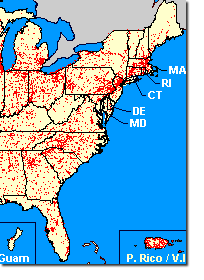 All of the information that Scorecard provides is public, but, as the executive
director of EDF writes on the site, "we know from experience how hard 'public'
information can be to find, even in one database, much less the 150 different
databases that Scorecard now combines."
Since the passage of what is commonly known as the "Right-to-Know Act," in 1986, manufacturing companies
have been required to report publicly the type and amount of chemicals that
they're releasing into the environment; it is probably not coincidental that
during the past twelve years pollution from these companies has dropped by more
than 45 percent. If The Chemical
Scorecard works as the EDF hopes it will, that sort of pressure should increase
dramatically as more and more people become aware of exactly what is going on
in their neighborhoods -- and are handed the tools to do something about it.
Judging by the initial interest in Chemical Scorecard (the site got more than a
million hits in its first twenty-four hours on the Web) armchair activism is a
popular concept.
All of the information that Scorecard provides is public, but, as the executive
director of EDF writes on the site, "we know from experience how hard 'public'
information can be to find, even in one database, much less the 150 different
databases that Scorecard now combines."
Since the passage of what is commonly known as the "Right-to-Know Act," in 1986, manufacturing companies
have been required to report publicly the type and amount of chemicals that
they're releasing into the environment; it is probably not coincidental that
during the past twelve years pollution from these companies has dropped by more
than 45 percent. If The Chemical
Scorecard works as the EDF hopes it will, that sort of pressure should increase
dramatically as more and more people become aware of exactly what is going on
in their neighborhoods -- and are handed the tools to do something about it.
Judging by the initial interest in Chemical Scorecard (the site got more than a
million hits in its first twenty-four hours on the Web) armchair activism is a
popular concept.Copyright © 1998 by The Atlantic Monthly Company. All rights reserved.
 |
 |
 |
 |
 |
 |