

98.04.23
Multicultural Lite
A multimedia "essay" has technology serve humanity, and vice versa.
98.04.16
Do-It-Yourself Adventure
"Interactive fiction" moves to the Web.
98.04.08
The "Why?"s Have It
For a nation of strangers, the simplest questions can help bridge the widest distances.
98.04.01
Dances With Words
Experiments in "information choreography."
98.03.25
Non-virtual Communities
Competing visions of post-suburban life give new meaning to the "global village."
98.03.18
Gothic Gardening
Martha Stewart it's not.
98.03.11
Pay Day
Slate's big gamble.
98.03.04
Banking on Bright Ideas
What do lost-pet ads, dentist-office ceilings, and in-flight recordings have in common?
98.02.25
ThinkQuest
Techno-savvy kids.
98.02.19
Mapping Cyberspace
Is there a "there" there?
98.02.11
Information-Free
Sometimes the Web can be its own best antidote.
98.02.04
Clintonalia
Investigating rumors of a vast conspiracy.
For more, see the complete Web Citations Index.
 Perhaps the scene went something like this:
 A group of grim-faced men and women in charcoal-gray suits gather at Langley for the first-annual CIA seminar on image-building. It's been a bad few years. Respect ratings are down, and as a result so is recruitment. A public-relations initiative is needed to entice a new generation to enlist. Suggestions for a bring-your-daughter-to-work day at Langley and a Big Brother program in the Directorate of Operations are rejected. Only when someone comes up with the idea of promoting the Agency to impressionable kids on the Internet do people get excited. Six months later the CIA Kids Page is added to the Agency's Web site, and the era of warm and fuzzy intelligence has begun.
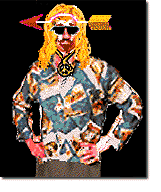
The result is a site geared toward providing information about the CIA in a fun and easily digestible way -- with an emphasis on digestible. In the section on intelligence and how it is collected, the definitions are at times so cleaned up and simplified as to be laughable. ("Some sources are 'covert' -- that is, other people's secrets. We persuade these people to tell us their secrets.") Using the Shockwave plug-in, children can dress up male and female spies in disguises. The elements include fake antlers, an arrow-hat that looks like it goes through the head, some purple Jacqueline Kennedy-type sunglasses, a cowboy hat, and a blond hippie-like wig attached to a peace-sign necklace.
 Those who visit the Canine Corps page, where four dogs describe life as experts in finding
explosives, may be disappointed by the amount of information actually provided, since the dogs dispense
more substanceless advice than actual detail about how they are trained or what they do. One of the dogs, for example, advises kids, "Always remember to be a 'top dog' at
anything you do. Set your goals, get an education, be dedicated, and be the
best you can be at whatever you do."
Those who visit the Canine Corps page, where four dogs describe life as experts in finding
explosives, may be disappointed by the amount of information actually provided, since the dogs dispense
more substanceless advice than actual detail about how they are trained or what they do. One of the dogs, for example, advises kids, "Always remember to be a 'top dog' at
anything you do. Set your goals, get an education, be dedicated, and be the
best you can be at whatever you do." Only on the Famous People page will visitors find some relatively unvarnished details about acts of espionage (though half of those profiled were spies during the Revolutionary War, and George Bush is the only one of the group who worked in intelligence after the Second World War). For instance, Benjamin Franklin's story, told in an imaginary first-person voice, includes a surprisingly frank (at least for this site) account:
 "I remember a bit of propaganda I produced to discourage the Hessian
mercenaries fighting us. I concocted a letter from a German prince to the
commander of his mercenaries stating the commander should leave his wounded for
dead rather than have them unfit to serve their prince. At the same time, to
their homeland I wrote a news article detailing the horrible deaths of these
soldiers and others at the hands of the Indians."
"I remember a bit of propaganda I produced to discourage the Hessian
mercenaries fighting us. I concocted a letter from a German prince to the
commander of his mercenaries stating the commander should leave his wounded for
dead rather than have them unfit to serve their prince. At the same time, to
their homeland I wrote a news article detailing the horrible deaths of these
soldiers and others at the hands of the Indians." It's easy to make fun of this site's (and the CIA's) obvious shortcomings, but perhaps it will attract future CIA recruits anyway. One can only hope that those recruits will know enough not to disguise themselves in antlers and purple sunglasses.
Copyright © 1998 by The Atlantic Monthly Company. All rights reserved.
 |
 |
 |
 |
 |
 |