



|

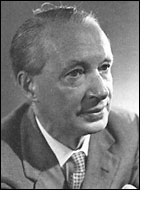 |
| Edwin Muir |
In the dream I was walking with some people in the country, when I saw a shining grey bird in a field. I turned and said in an awed voice, "It's a heron." We went towards it, but as we came nearer it spread its tail like a peacock, so that we could see nothing else. As the tail grew I saw that it was not round, but square, an impenetrable grey hedge of feathers; and at once I knew that its body was not a bird's body now, but an animal's, and that behind that gleaming hedge it was walking away from us on four feet padded like a leopard's or a tiger's. Then, confronting it in the field, there appeared an ancient, dirty, earth-coloured animal with a head like that of an old sheep or a mangy dog. Its eyes were soft and brown; it was alone against the splendid-tailed beast; yet it stood its ground and prepared to fight the danger coming towards it, whether that was death or merely humiliation and pain. From their look I could see that the two animals knew each other, that they had fought a countless number of times and after this battle would fight again, that each meeting would be the first meeting, and that the dark, patient animal would always be defeated, and the bright, fierce animal would always win. I did not see the fight, but I knew it would be ruthless and shameful, with a meaning of some kind perhaps, but no comfort.Those who find adumbrations of the Cold War in "The Combat" may have a clue to the poetic truth of Muir's achievement. But Muir's imagination also locates warm-blooded symbols for the arrogant attacker and the drab sufferer, the irresistible force and the immoveable object.
The CombatMuir's English (he was not an advocate of poetry in the Scottish dialect) always takes plain ways to evoke profound forces. We can hear hints of William Blake's visionary language in the way it speaks and moves, and its rhythms also partake of the old border ballad tradition; yet this combat admits of no victory, any more than Blake's "The Marriage of Heaven and Hell" allows for one. Though Muir was a religious believer, the struggle he evokes in this poem reeks more of The Trial than of Paradise Lost: there is no reward, no triumph, either for the strong or the weak. Muir's early self-education in poetry, reading his family copy of Chambers's Cyclopaedia of English Literature, was limited to Shakespeare, Milton, and the Romantic Movement. He recalled in An Autobiography the influence of Blake and of particular poems by Wordsworth, Keats, Shelley, Tennyson, and Swinburne. Still, in none of his own poetry does the language call attention to itself: it acts, rather, as a channel to the emotions underlying it. As T. S. Eliot wrote in a preface to Muir's Collected Poems,
It was not meant for human eyes,
That combat on the shabby patch
Of clods and trampled turf that lies
Somewhere beneath the sodden skies
For eye of toad or adder to catch.
And having seen it I accuse
The crested animal in his pride,
Arrayed in all the royal hues
Which hide the claws he well can use
To tear the heart out of the side.
Body of leopard, eagle's head
And whetted beak, and lion's mane,
And frost-grey hedge of feathers spread
Behind—he seemed of all things bred.
I shall not see his like again.
As for his enemy, there came in
A soft round beast as brown as clay;
All rent and patched his wretched skin;
A battered bag he might have been,
Some old used thing to throw away.
Yet he awaited face to face
The furious beast and the swift attack.
Soon over and done. That was no place
Or time for chivalry or for grace.
The fury had him on his back.
And two small paws like hands flew out
To right and left as the trees stood by.
One would have said beyond a doubt
This was the very end of the bout,
But that the creature would not die.
For ere the death-stroke he was gone,
Writhed, whirled, huddled into his den
Safe somehow there. The fight was done,
And he had lost who had all but won.
But oh his deadly fury then.
A while the place lay blank, forlorn,
Drowsing as in relief from pain.
The cricket chirped, the grating thorn
Stirred, and a little sound was born.
The champions took their posts again.
And all began. The stealthy paw
Slashed out and in. Could nothing save
These rags and tatters from the claw?
Nothing. And yet I never saw
A beast so helpless and so brave.
And now, while the trees stand watching, still
The unequal battle rages there.
The killing beast that cannot kill
Swells and swells in his fury till
You'd almost think it was despair.
There is ... something essential which is neither English nor Scottish, but Orcadian. There is the sensibility of the remote islander, the boy from a simple primitive offshore community who then was plunged into the sordid horror of industrialism in Glasgow, who struggled to understand the modern world of the metropolis in London and finally the realities of central Europe in Prague where he and his wife—to whom together we owe our knowledge of Kafka—saw the iron curtain fall and where they saw their friends gradually finding it safer to avoid their company."The Combat" is especially characteristic of Muir in the way it refrains from embracing a single point of view, either that of the victor or the vanquished, as though the poem were speaking for civilization itself. The drama unfolds before us without judgment, framed by a landscape of "somewhere": an undescribed, unevoked place, and watched, as so many of the goings-on in Muir's poems are, by uninvolved onlookers: crickets chirping, thorn stirring, trees standing, all taking in the fateful rough-and-tumble of the archetypal combatants. The watchers, like those who hear the sounds of poetry, are amazed, but we comprehend the actions only, not the motives, of the crested, clawed, dominating attacker, and of its brown-bag-rags-and-tatters opponent; and we award victory to—which?