




The Atlantic's poetry editor reflects on the career of W. S. Merwin, whose long association with the magazine spans great distances of geography and art
by Peter Davison
August 28, 1997
Over the past twenty-five years the poems of W. S. Merwin have appeared in The Atlantic Monthly's pages more frequently than those of any other poet. The editors have been deeply attracted to the vivid movement and activity of his poetry, which seem to flow up from an underground river that lies beneath mere speech, as though written in some pre-verbal language of which all later languages have proved to be a mere translation. Here's a sample from a 1970s poem called "The Dreamers":
a man with his eyes shut swam upward
through dark water and came to air
it was the horizon
he felt his way along it and it opened
and let the sun out
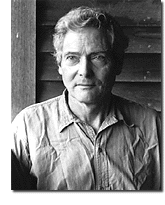 Merwin's work has followed his life. Born seventy years ago in Union City, New Jersey, he was raised first in a Presbyterian rectory looking across the
Hudson toward the towers of New York and then later in Scranton, Pennsylvania. He graduated in 1947 from Princeton University, where he learned from John Berryman, and set out for Europe to encounter the Romance languages. During the early 1950s he lived as a translator of Latin, French, Spanish, and Portuguese on Majorca (where he tutored the children of the poet Robert Graves) and in Spain, Portugal, and England. He eventually settled in the south of France and headquartered there during most of the 1960s, though after a time he spent parts of nearly every year in New York. Later he wandered into Mexico for several years. Since 1975 he has resided in Hawaii, where he maintains a miniature forest of trees and plants of species that are threatened elsewhere in the world.
Merwin's work has followed his life. Born seventy years ago in Union City, New Jersey, he was raised first in a Presbyterian rectory looking across the
Hudson toward the towers of New York and then later in Scranton, Pennsylvania. He graduated in 1947 from Princeton University, where he learned from John Berryman, and set out for Europe to encounter the Romance languages. During the early 1950s he lived as a translator of Latin, French, Spanish, and Portuguese on Majorca (where he tutored the children of the poet Robert Graves) and in Spain, Portugal, and England. He eventually settled in the south of France and headquartered there during most of the 1960s, though after a time he spent parts of nearly every year in New York. Later he wandered into Mexico for several years. Since 1975 he has resided in Hawaii, where he maintains a miniature forest of trees and plants of species that are threatened elsewhere in the world.
Return to:
Discuss this article in the Arts & Literature forum of Post & Riposte.
|
Recent poems from The Atlantic Monthly, with readings by the author recorded specially for Atlantic Unbound: Three French Poems: "Vehicles," "The Speed of Light," and "End of a Day" (September 1994) "Green Fields" (February 1995) Three Poems: "Another River," "Echoing Light," and "Remembering" (April 1997) |
 Merwin's recent poetry, to borrow the words of Robert Frost, may be thought of as "the tribute of the current to the source." During the 1980s and 1990s Merwin has gradually allowed his mind and language (which in a poet are especially hard to separate) to range across the wide regions of his own reading and travelling, while also plumbing the feelings and reasonings that arise from his deeply held beliefs. He is not only profoundly anti-imperialist, pacifist, and environmentalist, but also possessed by an intimate feeling for landscape and language and the ways in which land and language interflow. The Rain in the Trees (1988), Travels (1993), and The Vixen (1996) take the reader inside the implacable intentions of conquistadors, naturalists, and explorers, across the Pacific to the ravaged jungles of the Philippines, into the gentle tilt of a Pennsylvania pasture, to the flicker of health in a New York hospital or the business of a weasel in the wall of an old French farmhouse. Increasingly he has been arrested by an intensely sensuous involvement with place. His beautiful prose work, The Lost Upland (1992), and The Vixen are both book-length eulogies to the ancient farming country above the Dordogne River that Merwin left thirty years earlier -- written in Hawaii about France, a tremendous expedition through time and space to encounter the remnants of our medieval past. And listen to this recollection in another prose work, Unframed Originals (1982):
The smell of barns drifted even through the market towns that were themselves not much larger than villages, and in the evenings cows swayed through the streets guided by peasants with the same long sticks. Pigs grunted behind arched cellar doors, and were butchered in back alleys, with groups of experts standing around, and the cobbles running blood. The farm dogs appeared to be a random mix, but many of them had one pale and one dark eye. They knew their jobs. They ate soup. The language on the farms was a patois descended from a Languedoc tongue older than the French of Tours and Paris.The intentions of Merwin's poetry are as broad as the biosphere yet as intimate as a whisper. He conveys in the sweet simplicity of grounded language a sense of the self where it belongs, floating between heaven, earth, and underground. The tone and directness of his intentions are clearly declared at the outset of Travels in a poem called "Cover Note":
...reader I doIt's that ingratiating tone that Merwin's poems take -- confiding, in the most private way, the most generous of concerns -- that has made him so welcome and frequent a visitor to The Atlantic Monthly's poetry pages.
not know that anyone
else is waiting for these
words that I hoped might seem
as though they had occurred
to you and you would take
them with you as your own
Peter Davison is the poetry editor of The Atlantic Monthly. His books include the memoir The Fading Smile: Poets in Boston, 1955-1960 (1994) and The Poems of Peter Davison 1957-1995, recently published in paperback.
Discuss this article in the Arts & Literature forum of Post & Riposte.
Copyright © 1997 by The Atlantic Monthly Company. All rights reserved.
 |
 |
 |
 |
 |
 |