
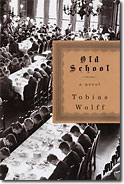
Old School
[Click the title
to buy this book]
by Tobias Wolff
Knopf
208 pages, $22
| |
Old School [Click the title to buy this book] by Tobias Wolff Knopf 208 pages, $22 |
I knew that Maupassant, whose stories I loved, had been taken up when young by Flaubert and Turgenev; Faulkner by Sherwood Anderson; Hemingway by Fitzgerald and Pound and Gertrude Stein. All these writers were welcomed by other writers. It seemed to follow that you needed such a welcome, yet before this could happen you somehow, anyhow, had to meet the writer who was to welcome you. My idea of how this worked wasn't low or even practical. I never thought about making connections. My aspirations were mystical. I wanted to receive the laying on of hands that had written living stories and poems, hands that had touched the hands of other writers. I wanted to be anointed.When not seeking authorial anointment, the narrator and his classmates act like, well, teenage boys—they vie for the attention of teachers, smoke on the sly, and get rowdy at dinner. Wolff beautifully depicts both the oppressiveness and the privilege of boarding school:
A warm wind blew across the hilltop, and with it the faint cries of boys chasing balls. The school lawns and fields were a rich, unreal green against the muddy brown expanse of surrounding farmland.... From this height, it was possible to see into the dream that produced the school, not merely English-envy but the yearning for a chivalric world apart from the din of scandal and cheap dispute, the hustles and schemes of modernity itself. As I recognized this dream I also sensed its futility, but so what? I loved my school no less for being gallantly unequal to our appetites—more, if anything.It is this contradiction between chivalric ideals and more prosaic appetites that is the narrator's undoing in the short-term. However, the glimpses we get of his adult life reveal that he eventually does become a successful writer. Although writing about writing is tricky, Old School never feels self-consciously literary; Wolff's observations are entirely organic to the novel, and deeply true. He eschews the cheesy, cheerful maxims of "how to" books, instead acknowledging that how and why people write, and especially how and why they write well, often remains essentially mysterious.
 |
|
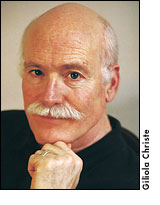
Tobias Wolff |