




Ian Frazier talks about his new book, On the Rez, and what he's learned about the Oglala Sioux, American heroism, and the art of writing
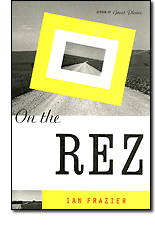 Descriptions of the Pine Ridge Reservation in South Dakota usually emphasize that it is the poorest place in the United States, but Ian Frazier found something else there during the time he spent researching On the Rez. "Here was a hero -- not a folk hero, a sports hero, a tribal hero, or an American hero, but a combination of all of these," Frazier writes. "I had thought that Oglala heroes existed mostly in the past. But a true Oglala hero appeared in the late 1980s, while the rest of the world was looking the other way, in suffering Pine Ridge, right under everyone's noses." Frazier's hero, SuAnne Big Crow, was a star basketball player for Pine Ridge High School who, when just a sophomore, led her team to victory at the state championship -- a great source of pride for a town that sorely needed something to be proud of. But her most famous deed on the court had nothing to do with her formidable basketball skills. At an away game during SuAnne's freshman year a sell-out crowd taunted her team with racist chants. SuAnne's response -- a lone Lakota shawl dance at midcourt, an act Frazier calls "one of the coolest, bravest deeds I ever heard of" -- at first silenced the crowd, and then turned their taunts to cheers. She drew her people together by other means, too, and when she died in a car accident at age seventeen, the Oglala honored and mourned her in a way they reserved for very few.
Humane Development (December 15, 1999)
Akash Kapur speaks with Amartya Sen, the Nobel Prize-winning economist and author of Development as Freedom.
Song and Story (November 24, 1999)
Steven Cramer interviews Ellen Bryant Voigt, a poet whose new collection of essays offers a defense of the lyric mode and a portrait of an uncommon reader's mind.
Fallen Beauty (November 10, 1999)
For Mark Doty, the poet and author of the new memoir Firebird, the imperfect surface is the touchstone of art.
America the Irrational (November 3, 1999)
Wendy Kaminer, the author of Sleeping With Extra-Terrestrials, sees a disturbing decline of reason in our public life.
A Cold, Comic Heart (October 20, 1999)
Leslie Epstein, the author of the new novel Ice Fire Water, talks about Hollywood, the Holocaust, and why his critics are nuts.
The Myth of Meritocracy (October 7, 1999)
In his new book, The Big Test,Nicholas Lemann argues that the structure of educational opportunity in America is inherently flawed and must be rebuilt.
More Atlantic Unbound interviews.
More on books in Atlantic Unbound and The Atlantic Monthly.
Join the conversation in Post & Riposte.
More by Ian Frazier from The Atlantic's archives:
"Pick Your Part" (March, 1999)
Looking for a rearview mirror or a clutch fan in the far reaches of Los Angeles.
"Journalism Today" (October, 1998)
An intimate look at a great citizen (I'd like to work for).
"The Writing Life" (July, 1998)
The rigors of high-yield creativity.
"Typewriter Man" (November, 1997)
The need for a new letter on an old manual machine
leads the author to the shop of Martin Tytell, now in his
seventh decade as repairman, historian,
and high priest of typewriters.
"The Positive Negative" (June, 1997)
Saying no with a smile.
"Laws Concerning Food and Drink; Household Principles; Lamentations of the Father" (February, 1997)
"Of the beasts of the field, and of the fishes of the sea, and of all foods that are acceptable in my sight you may eat, but not in the living room."
"Accompanying Franz" (June, 1996)
A book tour is hard enough on an author without competition from a genius out of the past.
"No Phone, No Pool, No Pets" (March, 1996)
Living in a van.
Readers might remember Le War Lance from Frazier's best-selling Great Plains (1989), a travelogue and chronicle of the region. Frazier is also the author of the critically acclaimed Family (1994), in which he traced the history of his relatives and of his native town, in Ohio. But he may be best known for his humorous contributions to The New Yorker, where he worked from 1974 until 1995. Many of his magazine pieces, including several from The Atlantic Monthly, have been collected in Dating Your Mom (1986) and Coyote v. Acme (1996), which was awarded the inaugural Thurber Prize for American Humor.
Frazier spoke recently with Atlantic Unbound's Katie Bacon.
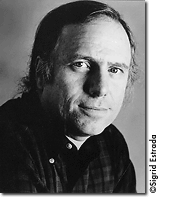 |
| Ian Frazier |
All I know is that I keep doing it -- it's just part of my personality. Each place has something that I love, and each place has important things that it lacks. It feels very strange to move back and forth, but at this point I accept that I do it. To me it's almost seasonal. When the days start to get shorter, I want to be in some nice brick building on the East Coast with the lights glowing in the windows. When the daylight starts changing, I want to be out West.
America to me is so varied and exciting. I always feel nostalgia for the place I'm not in, and then I get there and find myself in a traffic jam going into the Lincoln Tunnel and I think, God, why was I romanticizing this part of the country? I think it has to do with the romantic, unrealistic temperament.
Could you talk about the sense of freedom that the Native Americans of the West evoke for you?
It goes back to when I was a kid; I always wanted to dress up like an Indian, play Indian -- I was just fascinated by them. I had all these books about how to make your own war bonnet and other really complicated things involving dangerous chemicals which my parents would never let me make. To me it was a complete escape from ordinary life. The idea that Indians were the original, free people of the continent is very much a part of America. If what Europeans had found here was some kind of elaborate hierarchy involving a caste system, with pyramids being built by slaves dragging giant blocks, our view of this continent would have been very different. But in fact what the Europeans saw were people who were apparently free of just about every constraint that the Europeans had rebelled and chafed against. There were probably more constraints than were evident, and more disadvantages to the freedom, but still, as I say in On the Rez, in the land of the free, the Indians were the original free.
Did your feeling about freedom change after you had spent some time on the reservation?
Yes. I had already thought about the ideas of American democracy -- ideas we take for granted -- and decided that they seem a little willful and strange. "All men are created equal" is a great notion, but are all people equal in a practical sense? The Indian idea of freedom is similarly problematic. If we're all free and equal, it becomes very difficult, for example, to deal with the really extraordinary person who's born into your midst. How do you deal with somebody like Red Cloud, an Oglala leader of the late-nineteenth century, who was a great chief, a great man, physically tougher and braver, smarter, more enterprising than anyone else? How do you deal with someone like SuAnne Big Crow, who was just a better athlete and a person of great gifts? If someone is really superior, often you tear them down. You try to find out what's small about them, and cut them down to your size.
The other disadvantage of freedom and equality is chaos. A lot of what I saw on the reservations was too many wills pulling in too many directions, and not enough emphasis put on the common good. So I did see where the idea of freedom taken to its extreme can lead, which was something I hadn't really given much thought to before.
The question of freedom was considered for centuries before people even began to put it into whatever practice it was put into in America. And yet I guess the reason it seems compelling to me is that now I get much more of a sense that life is hierarchical, that power is only in the hands of a few, and that the rest of us must be nice to the people in power. I would hate to see the idea of freedom disappear, and I wonder if maybe it will.
What drew you to write about the Oglala Sioux, and specifically Le War Lance and SuAnne Big Crow?
I just think the Oglala are really cool -- buffalo-hunting, semi-nomadic Plains warriors on horseback have always appealed to me deeply. Of the Indians of the Plains the Oglala were in my opinion the best fighters, the toughest, the smartest -- I just loved them. And I loved Crazy Horse, who was the great Oglala. His intransigence, his determination to be himself -- even though they ended in his death -- gave us a different kind of person that we could choose to be. And Le and I had been friends for so long. I was friends with Le in New York because he was so different from everything else about New York. He was the one guy I knew in the city who liked country music. And he loved Westerns. So I could talk about my favorite thing in a Western, and he would know about it -- well, he's a full-blood Oglala. I never thought I'd be talking about Westerns with somebody from the other side of the western story. All of that combined to draw me to the Oglala.
I didn't know about SuAnne Big Crow before I went out there, but when I went to the Big Crow Center and learned about her I immediately thought she was one of the great Oglala of all time. It's amazing the way a tribe makes a hero. To see it happen right in Pine Ridge, which is the poorest place per capita in the United States, with 65 percent unemployment, a high rate of alcoholism, and low life expectancy -- it was like seeing something that I'd only read about in a book. I'd read about Crazy Horse, and I knew how people felt about him from reading interviews with those who had known him. It was amazing to realize that it had happened again -- here was another hero. To me it was like finding an incredible rock on the prairie which you'd only seen in a museum. Of course, I started the book in 1995, and SuAnne died in 1992, so I was after the fact. But when I used to read about Crazy Horse I thought that if I'd been alive in, say, 1917, when a lot of the old men who had known him as a young man were still alive, I would have talked to everyone asking what he was like. And so I decided to do the same thing with SuAnne.
How did SuAnne Big Crow fit into the tradition of Oglala heroism?
In the early part of my book Le War Lance sings a song attributed to Red Cloud that goes something like, "You ask me to be a Lakota, and that's the hardest thing in the world to be. I'm a Lakota so I suffer for my people." What SuAnne did was bring people together in her tribe at the sacrifice of herself. The Oglala culture is not one that makes life easy for celebrities. From the beginning of her heroism to the end, everyone assumed that she was exactly like them. The people I talked to said that she let the other girls take credit for the basketball team, that she was self-effacing. It's unnatural to do that, it seems to me. I couldn't have done that. If I were she, I would have shattered in a million pieces. It's just too difficult to have those two pressures on you -- one to be the star, and the other to pretend that you're not. We often say, of a remarkable person, "he's just like anybody else when you get to talk to him." But he's not just like anybody else. Einstein wasn't like anybody else, and neither was SuAnne. Simply put, she helped to knit the tribe back together after what had been, in effect, a tribal civil war between the traditionalist American Indian Movement (AIM) and the "Goons," or anti-AIM side.
In the 1960s AIM brought attention to Indian issues like self-determination and tribal sovereignty. Are Indian issues getting as much attention these days as they have in the past?
Sovereignty comes and goes as an issue, but I do think that the big question of identity this implies -- are you a tribal person, or are you a citizen of the United States -- is a real issue that will only get more attention. It's the one thing people are really confused about. You can explain the casino boom and the enormous amount of money that very few tribes are making off gambling casinos as the result of these sovereignty issues being raised in the sixties. Would tribes have realized exactly what they could do with their sovereignty in terms of gambling if people hadn't been talking about sovereignty all those years?
In general, if you asked people about Indians back in 1974 they would think in terms of protest. Now 90 percent of people would mention gambling. We always have some easy blinders that we wear on the subject of Indians, and right now casinos are providing that blinder effect.
You mention many instances when you gave money to Le and others on Pine Ridge. Why document these things?
A lot of it was simply that it was the fact; it had always been the fact, long before I wrote the book -- I've known Le and friends of his for twenty years. But I think I wanted to make it clear that giving money was a part of many transactions. The reader can judge for herself whether the people I talked to really are friendly or whether they're just being friendly because I gave them forty dollars. I shouldn't say it was part of every transaction -- with many people, they and I just talked and that was it. But Le and his family are sort of like my relatives, and you get into that kind of demand with relatives sometimes. Also, maybe mentioning those transactions would give people an idea of how poor this place really is. You could be looking at somebody and interviewing them, and they really needed something -- not just theoretically but right at that moment -- a ride to the doctor, for example. So you have to take them to the doctor. Or maybe someone needed money right then, and I had money. I didn't have a lot, but it's pretty remarkable to see how much a twenty dollar bill is worth there. It means something.
Has welfare reform had an effect on the reservation?
I think that it has, although it's not something that I particularly looked into myself. Anything that happens in the larger society has a very exaggerated effect on that reservation. The civil war of the seventies, if you can call it that, the battles that raged on the reservation leading up to and then for a while after the standoff at Wounded Knee in 1973 -- those were magnifications of the larger country's battles over Vietnam. And the idea that the poor had better get off the dole and go do something has had a general effect of creating additional difficulty on a reservation that already had a lot of difficulty.
One of the most surprising facts in your book is that there are no alcohol treatment facilities on the reservation.
There are things like AA meetings, but I don't think they're well-attended, and they only seem to meet once a week. There may be some kind of hospital inpatient thing that's briefly available, but there's not the big alcohol treatment center that the reservation would certainly seem to call for. That I can't really explain. I'm sure there are some politics involved in it. I thought I drank before I went to the reservation. I was not drinking compared to what they were doing. After the first time I visited I quit drinking and haven't had a drink since. I am really persuaded by people on the reservation like SuAnne and her mother who don't drink. I'm persuaded that not drinking is the right thing. I just hope that the idea will take off, that more people will accept it, but drinking's just such a part of how many people on the reservation live. I can only speculate that somehow it's seen as being important to have the free will to drink.
Until the thirties alcohol sales were very much restricted; it was even a crime for Indians to have alcohol. That policy was part of a paternalistic view of the reservations. There was the idea that the Indians were wards, and the government should take care of them as if they were children. Once the New Deal policies came along in the thirties, Indian reservations were given more control over what they did. People say that the drinking got really bad only after the New Deal legislation -- that it had not been terrible before then. But again, what you're seeing is the magnification of another trend in America. Indian alcoholism at the beginning was part of a widespread frontier alcoholism. Just about everybody on the frontier drank. The recent bad times for alcoholism on the reservation paralleled a bad time for alcoholism in America in general.
SuAnne's stand against drinking was one of the things that made people hostile toward her. It made her seem better-than-thou. Not that she acted like that, but hers was a very hard position to take. If you've ever been the designated driver, it's not fun, and it's not well-received by other people, even if you're doing a useful thing. That, I think, is maybe the simplest explanation for why there is no treatment center. It's hard to be in the minority when so many other people are drinking -- sobriety's not always comfortable, and I'm sure it wasn't always comfortable for SuAnne.
Early in On the Rez you reject the term "bleak," which so many others use to describe Indian reservations, but at the end of the book you say, "there's evil here." What led you to say that?
For me it felt controversial and strange to say that, but having been there as much as I had been and seen the stuff that happened, I realized that there's real mischief afoot on the reservation sometimes, and most of it has to do with the history of the place. The massacre at Wounded Knee was one of the worst pages in American history, and it happened on the reservation where the Oglala live, where they drive by every day. That's a legacy that's hard to live with. What I object to in the description "bleak" is that it's so easy to say -- "It's bleak, let's not think about it anymore. We've got a label for it, let's move on." SuAnne and others who grew up there did not see it as bleak -- they saw it maybe as a horrible nightmare sometimes, and other times as a wonderful, warm village. I am vexed in general by the kind of journalism where somebody is "choppered" in -- we look around, see what's here, it doesn't look too good, back to the hotel. That sort of journalism is very unsatisfying, especially if it's about a subject that appeals to you. Usually the bleakness isn't even very well done. If you're going to do bleakness, then give me some real bleakness, give me some exciting, weird bleakness.
The first time I went to the Museum of the American Indian in New York, one of the displays was of ration-card holders. When Indians were given ration cards, which in early reservation days they needed in order to buy things, they made beaded holders for their cards. They were the most beautiful things. And they combined all the bureaucratic dumbness of the reservation with this tribal culture that made a beaded item out of it. Just because a people's situation changes doesn't mean that their culture changes. The culture of the Oglala is still really strong. You can find it even in what at first looks bleak. If you look harder you can see that these are people who just a few generations ago were hunting buffalo, who fought and beat the cavalry of the United States. What's good in their culture is still here; maybe hard to see behind the car with its hood up, sitting on blocks -- but still here.
How would you compare the experience of writing this book with others you've written?
It was more emotional, more personal. Other things I could say would make it sound like I'm feeling sorry for myself, because in some ways this book was harder. I hope not to have to do that kind of driving again. Driving on Pine Ridge in bad weather, and just driving on Pine Ridge in general, wondering if I was going to get in a wreck -- that was hard. Also, this book was more about suffering. Great Plains was kind of idyllic, and this is not an idyll, it's not lyrical. It's about how you suffer through things.
Your writing career began at The New Yorker. How did you get started there?
When I was just graduating from college, in 1973, I didn't know what I wanted to do -- I was just going to go back to Ohio and kick back -- and I looked in The New Yorker and there was a profile of Jonathan Winters, my favorite comedian. I thought, If that's in The New Yorker, maybe I can write for them. That piece was by Bill Whitworth [later The Atlantic's editor]. He did many great profiles, and I admired them enormously. Everything else in The New Yorker was on the Strategic Arms Limitation Talks or something, and I didn't know anything about that at twenty-two years old. I had been on The Lampoon at Harvard, and I'd written a lot of humor pieces for them, so I just sent a whole package of stuff down to William Shawn. Then I met with the personnel director, and he said that he thought there were too many people from Harvard there. That really cut me to the quick, because I felt like I was never even really present at Harvard; I felt like a complete outsider. I thought of myself as a Midwesterner. So I went to Chicago and worked for Oui, a spinoff of Playboy, writing captions. It was not the most glorious thing I ever did in my life. Oui published what they considered sophisticated, French-type pictorials that were just extremely cheesy. It was naked guys and women at some resort in Mexico -- very wild and sybaritic. It took all my creativity. It's one of those things you think anybody could do. But anybody can't do that; it's really hard. It was just completely wrong for me, and so I split after about six weeks. But when I came back to The New Yorker, which I did the next year, and said I had been working at Playboy, that kind of surprised them. At my first meeting with Mr. Shawn he said, "so what were you writing for this magazine?" And I said, "Oh, they mainly had me doing the S&M stuff, the leather, the whips." Which wasn't even true -- I don't know why I said it, I guess I was trying to shock him. He was this extremely polite guy and said, "Oh my God!" Then they gave me a job as a "Talk of the Town" reporter, and I was there for twenty years in various capacities. I resigned in 1995. It was a great place for a long time, but it became impossible for me to stay when Tina Brown was there.
Many of your humorous essays start with some quirky thing that you've read -- a magazine mention of satanism and university presidents turns into a commencement speech gone very wrong, for instance. In general, what sorts of things spark ideas, and how do you spin the ideas out into a piece?
I just like anything that's fun to play with. Some really ridiculous thing that somebody says, or a voice that's really exciting, a voice I had never really thought of before. In Coyote v. Acme I poke fun, for instance, at Bob Hope's voice. I have every book that Bob Hope ever "wrote" -- and his voice just really got under my skin. It's such a Cold War voice -- it's like the American winner, the winner of World War Two talks like this. I loved that voice, so it was fun to do. And that's a lot of what goes into a humor piece, finding a voice that I like. The problem is, I've never found a voice that I can sustain for longer than about 2,000 words without getting sick of it. That's why I admire something like Charles Portis's True Grit -- or Huckleberry Finn -- because it is a voice all the way through, but it doesn't get tiring.
Dorothy Parker once said about humor writers, "There must be a disciplined eye and a wild mind. There must be a magnificent disregard for your reader, for if he cannot follow you, there is nothing you can do about it." Do you agree with her assessment? How do you think about the reader as you're writing?
I don't have a disregard for my reader in humor pieces. What I like about humor pieces is that it's such a win or lose situation. You can't say, "Well it's a wonderful piece, but I didn't laugh." If you didn't laugh, it's not a humor piece. That kind of damning criticism is not really available to the reader of a short story. They can say, "I didn't get it, I thought it was pretentious." But they can't give you that one kick in the shins that ruins everything. I think it's great that there's a kind of writing that can be destroyed with a single sentence. I just think it's more fun to do.
Nobody will really pay you to do humor pieces at any length. In my case, I don't get that many ideas in a year, so I could never really support myself at it. It's extremely perishable; many, many humor pieces depend on references that are only of the moment. Most humor has that "you had to be there" quality. Publishers don't particularly like to do collections of humor pieces, unless you're a national columnist or someone who already has a following. It approaches being the least cost-effective thing to do with your time as a writer. But I'm addicted to doing it; I just keep trying. A friend of mine said, "to write something on a piece of paper and put it in a mailbox and to have it appear in a magazine, and to have a person you don't know read the magazine and laugh until he cries -- that's a great achievement." To me that's like getting the space probe to Mars and getting it to tell us exactly what's happening. It's a hard thing to do, and yet it can't look hard, it has to look like you just tossed it off. I love to do it, but I also like to do really long and serious and painful kinds of things.
Join the conversation in Post & Riposte.
More Atlantic Unbound interviews.
More on books in Atlantic Unbound and The Atlantic Monthly.
Katie Bacon is the executive editor of Atlantic Unbound.
Copyright © 2000 by The Atlantic Monthly Company. All rights reserved.
 |
 |
 |
 |
 |
 |