



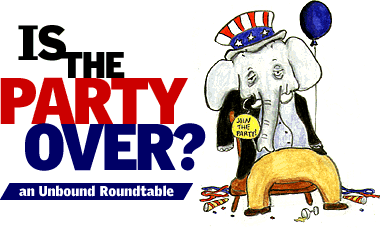
Round Two: Response
As we continue this fun roundtable on the proposition that the Republican Party is finished, I hate to be a party pooper. So I'll be brief in mentioning the most recent Pew Center poll (June 4-8) that found likely voters favoring the Republicans in this fall's House elections by 48 percent to 44 percent.
Now back to our debate.
Stanley Greenberg makes two claims: first, that there is a worldwide trend against conservative parties, and second, that in the United States the Democratic Party under Clinton has moved to the center and ceased to be its old "big-spending, big-taxing, unpatriotic, and anti-middle class" self.
|
Christopher Caldwell responds: "Maybe Mr. Norquist is right that conservative governments are often thrown out of office only after raising taxes. But why are they always raising taxes?"
See the rest of Caldwell's response. |
What Do You Think?
Join the debate in The Body Politic. We'll highlight selected readers' comments here in the margins as the Roundtable progresses.
Stanley Greenberg's assertions that the Democratic Party has moved toward the center and abandoned its losing beliefs on foreign policy, crime, high taxes, and big-spending centralized government are his own wishful thinking. Bill Clinton's moderate-sounding rhetoric is not the same thing as a sea change in the core beliefs and interests that animate the modern Democratic Party.
The Republican Party is the coalition of individuals (the "Reagan Coalition") who wish to be left alone by the government. The Democratic Party is now the "Taking Coalition" -- a collection of interest groups who view the proper role of government as taking things (usually money) from one group of people and giving to others (usually themselves). This includes the labor-union bosses, the trial lawyers, the corrupt big-city machines, the beneficiaries of government spending and grants, and the two wings of the dependency movement (those locked into welfare dependency and those who make $80,000 a year managing the dependency of others, making sure they don't escape, get a job, and become Republicans).
|
Stanley Greenberg responds: "Norquist grabs hold of the NEA as evidence that the Democratic Party remains unreformed and unrepentant. Somehow he failed to notice what happened to Bob Dole when he attacked the teachers' unions and promised to abolish the Department of Education.... Voters are looking for a politics that is relevant to their lives, and the right seems not to get it."
See the rest of Greenberg's response. |
Trial lawyers keep Clinton and the Democrats from cleaning up the environment by insisting on siphoning off most of the money that's supposed to be for cleaning up toxic waste sites. And the trial lawyers opposed any caps on their profits from the proposed tobacco-tax increase.
As soon as Clinton won the presidency he pushed for tax hikes. He did so again through his proposed tobacco-tax increase. He has also asked for billions in other taxes recently, including gasoline and energy taxes. The Democratic Party remains the high-tax party, opposing the IRS-reform legislation this past year until the public outcry made Clinton retreat.
The Republicans still have their central winning issue: lower taxes. They are pushing this year to abolish the marriage-penalty tax that Clinton defends. They are pushing for abolishing the death tax Clinton wants to increase and the capital-gains tax that Clinton has already tried to raise.
On education policy the Democratic Party is held hostage by the teachers' unions. On economic policy the Democrats are owned by labor unions and trial lawyers. And Clinton's foreign policy on China and Iraq, not to mention his hostility to Israel, make McGovern look strong. This is the "new" Democratic Party?
Introduction and opening questions by Jack Beatty
Round One: Opening Remarks -- posted on June 18, 1998
Round Two: Responses -- posted on June 25, 1998
- Christopher Caldwell
- Stanley B. Greenberg
- Terence P. Jeffrey
- Grover Norquist
Grover Norquist is the president of Americans for Tax Reform and a close advisor to the Speaker of the House, Newt Gingrich.
Copyright © 1998 by The Atlantic Monthly Company. All rights reserved.
 |
 |
 |
 |
 |
 |