
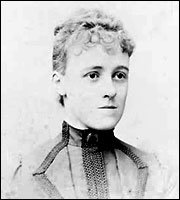
Edith Wharton in the early 1880s

| |
Edith Wharton in the early 1880s |
Why have you never asked me for a story for the Atlantic? I am tired of waiting ... My usual price for a short story is $500 but I know that the Atlantic does not pay as high prices as the illustrated magazines and I shall be quite satisfied with this ... first because I have always thought it was an honor to appear in the Atlantic and secondly because I believe it is always advantageous to a writer to get a fresh audience.Her petition was successful: the following year The Atlantic Monthly published her story "The House of the Dead Hand" (August 1904), the tragic tale of a young woman kept from the man she loves by a domineering father. And eight years later, her short story "The Long Run" (February 1912), about the consequences of a man's decision not to run away with a married woman, was published as the cover story. That issue of The Atlantic sold out in just two days.
On reading The House of Mirth, the first sensation of everybody, included or not among those whose plebiscite granted the laurel, was one of exultation, of "I told you so," as they recognized all Mrs. Wharton's talents, but better and brighter. Her mastery of the episode is as dashing as ever, and more delicate.This summer The Atlantic Monthly once again addresses the work of Edith Wharton in a review by the British novelist Margaret Drabble of two collections of Wharton's short stories which were published this winter. In "Wharton's Sharp Eye" (July/August 2001) Drabble discusses a number of Wharton's stories individually, and offers an impressive portrait of Wharton as a woman who shrewdly observed and captured the social landscape of her time.
Wharton had a sharp eye for the whims and dictates of fashion in literature, in art, in intellectual debate, in décor, and in haute couture. She could detect a fake, and she could recognize the real thing. She was in every sense a well-traveled woman of the world, and the range of her discrimination was considerable. She was no modernist in manner, but she was formidably well read and relentlessly up-to-the-minute—indeed, ahead-of-the-minute—in her methods of social analysis. Her astute perception of the changing of fashion in morals has long been recognized as one of the major strengths of her novels, and in many of these stories she applied herself to charting the new social map of the twentieth century.