




February 11, 1998
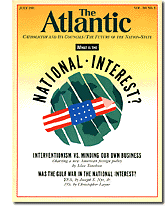
The tension in the international community over Saddam Hussein's prolonged refusal to allow UN inspectors full access to weapon production facilities in Iraq seems finally to have reached a head. As the U.S. and British military buildup continues in the Persian Gulf region, questions left open in the wake of the Gulf War are resurfacing. Shortly after that war, The Atlantic Monthly's editors asked two prominent writers the question, "Was the Gulf War in the National Interest?" The two responses were published in the July, 1991, issue. Revisiting them lends some perspective to the current face-off between Iraq and the United Nations.
In "Why the Gulf War Was Not in the National Interest," Christopher Layne argued that blunt military coercion by an external power such as the United States can never adequately resolve the subtle complexities of the Persian Gulf's political conflicts:
The Administration has been an innocent abroad in a region where problems are intractable and politics are Byzantine. The United States has been manipulated by regional powers -- Saudi Arabia, Israel, Syria, Turkey, and Egypt -- pursuing their own agendas.... Americans should beware of the overweening ambition that is born of hubris. The world is not infinitely malleable. The United States has seldom done well trying to stage-manage the process of political change in other countries. It is the people in those countries who pay the price when American experiments in "nation-building" go awry. There are many problems in the world but few of them have "Made in America" solutions.
 Arguing from a different standpoint in "Why the Gulf War Served the National
Interest," Joseph S. Nye Jr. wrote that America's role in the Gulf War was
crucial for three reasons: to protect the oil markets, to restore order, and to
combat weapons proliferation. Nye claimed that, "Higher oil prices from the
Persian Gulf have two kinds of effects on the U.S. economy: a larger import
bill, and shocks to the economy that interrupt growth." In terms of the United
States's interest in restoring order, Nye maintained that as the strongest
nation in the world -- no longer sharing the stage with Russia -- America must
take the lead in asserting its central role in global affairs. If the United
States had remained isolated from the larger world, this approach would only have hurt
the country, as it did in the late 1930s. "One does not have to believe,"
wrote Nye, "that Saddam Hussein is another Hitler to believe that the failure
of the United States to support the UN collective-security system in the first
major post-Cold War crisis would have come back to haunt us in the future."
Arguing from a different standpoint in "Why the Gulf War Served the National
Interest," Joseph S. Nye Jr. wrote that America's role in the Gulf War was
crucial for three reasons: to protect the oil markets, to restore order, and to
combat weapons proliferation. Nye claimed that, "Higher oil prices from the
Persian Gulf have two kinds of effects on the U.S. economy: a larger import
bill, and shocks to the economy that interrupt growth." In terms of the United
States's interest in restoring order, Nye maintained that as the strongest
nation in the world -- no longer sharing the stage with Russia -- America must
take the lead in asserting its central role in global affairs. If the United
States had remained isolated from the larger world, this approach would only have hurt
the country, as it did in the late 1930s. "One does not have to believe,"
wrote Nye, "that Saddam Hussein is another Hitler to believe that the failure
of the United States to support the UN collective-security system in the first
major post-Cold War crisis would have come back to haunt us in the future."Copyright © 1998 by The Atlantic Monthly Company. All rights reserved.
 |
 |
 |
 |
 |
 |