




July 24, 1998
This week a panel of scholars and writers commissioned by the Modern Library released a ranking of the hundred-best English-language novels of the twentieth century. The list, articles about which appeared in newspapers around the country, became yet another occasion for the ongoing debate about what actually makes a "classic." That debate (itself rapidly becoming a highly debatable classic) is not likely ever to be resolved, but while it's in the air we thought we'd reacquaint readers with a popular Atlantic Unbound feature that has been dormant of late and that we're planning to revive: Classic Reviews.
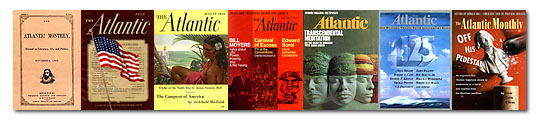
The Atlantic has been published continuously since 1857, and throughout its history the magazine has been dedicated to (among other things) the thoughtful review of new works of literature. The result is that hidden away in our archives are reviews of many nineteenth- and twentieth-century works before those works became Great Literature, and over the years we've collected many of these reviews online. The writing is sometimes as revealing about the age in which the books were published as about the books themselves, as a quick look at some of our collection reveals:
- Les Misérables, by Victor Hugo (July, 1862)
"Every resource of bookselling ingenuity has been exhausted in order to make every human being who can read think that the salvation of his body and soul depends on his reading Les Misérables."
- Leaves of Grass, by Walt Whitman (January, 1882)
"Imperfect though the [human] race is, it still remains so much purer than the stained and distorted reflection of its animalism in Leaves of Grass, that the book cannot attain to any very wide influence."
- The Bostonians, by Henry James (June, 1886)
"It might be supposed, at first glance, that Mr. James in The Bostonians was not going to let us off, but intended to drag us with him into the labyrinth of the woman question. Nothing could be more unjust."
- Little Women and An Old-Fashioned Girl, by Louisa May Alcott
(April, 1903)
"There is, in short, no separate standard of taste by which to determine the value of books written for children."
- Ulysses, Finnegan's Wake, and A Portrait of the Artist as a Young Man by James Joyce
(December 1946)
"Joyce renews our apprehension of reality, strengthens our sympathy with our fellow creatures, and leaves us in awe before the mystery of created things."
- A Portrait of the Artist as a Young Man by James Joyce
(March 1958)
"I predict with confidence that when the rest of Joyce's books pass into temporary disfavor A Portrait of the Artist As a Young Man will go on being read, possibly as much as ever, by youths from eighteen to twenty-two."
- Lolita, by Vladimir Nabokov (September, 1958)
"The novel's scandal-tinted history and its subject ... inevitably conjure up expectations of pornography. But there is not a single obscene term in Lolita, and aficionados of erotica are likely to find it a dud. Lolita blazes, however, with a perversity of a most original kind. For Mr. Nabokov has distilled from his shocking material hundred-proof intellectual farce."
There are many more of these Classic Reviews in our digital archives -- among them reviews of works by Charles Dickens, George Eliot, Rudyard Kipling, Mark Twain, and Robert Louis Stevenson. In the coming months our Classic Reviews index will grow as we look through The Atlantic's print archives for pieces to add to the collection -- but don't expect our book list to look exactly like the Modern Library's.
Copyright © 1998 by The Atlantic Monthly Company. All rights reserved.
 |
 |
 |
 |
 |
 |