



A Conversation
with Joel Ostrow
April 17, 1997
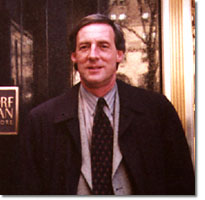
Joel Ostrow's short story "Small Consolation" (April, 1997, Atlantic) represents a string of firsts -- it was Ostrow's first submission to a magazine, it was accepted by the first publication to which he sent it, and it is his first piece of fiction to appear in print. This would seem to be the beginning of a promising career for Ostrow, but in fact he already has one. Ostrow is an attorney who has been practicing in Chicago since 1973. Tired of the "constant shading, high stress, and unjust results" that he has found all too often to be the norm in practicing law, Ostrow is eager to do more creative writing. His early success has made a full-time commitment to writing seem appealing -- so much so that he has expanded "Small Consolation" into a novel -- but it is a risky leap for a husband and father of three.
Ostrow recently spoke with Atlantic Unbound's Katie Bolick.
From The Atlantic Monthly, April 1997
|
Character Sketch
Home Deerfield, Illinois. Education B.A., University of Wisconsin, Madison, 1969. J.D., DePaul University College of Law, 1973. Age Fifty. First Publication This one. Last Book Read Of Human Bondage,by W. Somerset Maugham. Writing Habits I write on a word processor on weekday mornings and on Saturdays in my office in downtown Chicago. I start around 7:15 a.m. and usually write till about 8:30 or 8:45 a.m. I've really only been keeping that schedule for the last six months. I periodically wrote short stories prior to "Small Consolation," but only one every four or five years. Advice to Writers Don't be too self-conscious or self-critical. You can't write one brilliant sentence after another. Read Fitzgerald's short story "Winter Dreams." |
It's not often that a first-time author also happens to be a practicing attorney. Does this publication mark an impending shift in your career, or have you been managing both vocations all along?
I hope it marks a career shift, although getting my novel published would obviously be a great help. I have written periodically in the past but I haven't devoted nearly as much time to it as I have lately.
What compelled you to start writing more?
Two of my three kids are away from home -- one is in grad school, one is in college, one is in high school -- and I just found that I had more time to do it. I used to spend a lot of time with them, which I don't regret, but as they left I found I had time that I could use to write. I've always liked writing. It's fun for me, actually.
As an undergraduate you majored in English, then worked for a year as an Associated Press wire-service reporter before entering law school. What made you choose law?
I was engaged to be married at the time, and the woman to whom I was engaged said, "You'll never make enough money as a reporter -- why don't you go to law school?" So I went to law school. It beat working! I broke up with my fiancée five days before we were supposed to get married -- and she's gotten even by knowing I've been a lawyer ever since. Maybe I'll try to put this in perspective in fiction some day.
Your writing can't help but be affected by your experience as an attorney -- which at this point amounts to some twenty-four-year's worth. Could you comment on the nature of this influence?
I'm somewhat cynical to begin with, but practicing law has made me more so. You never get used to the greed and dishonesty you deal with on an almost daily basis. In my novel I make a few references to the law -- the main female character went to law school, got divorced, dropped out -- but I wouldn't want to write explicitly about law. When I tell people I've written a novel they assume I'm the next Scott Turow or John Grisham. I realize that legal thrillers are much in vogue these days and that you can make a lot of money writing them, but they don't interest me. I'm trying to write literature.
In "Small Consolation" your narrator's situation is a decidedly contemporary one -- negotiating interpersonal boundaries in the workplace. What made you choose to investigate this territory?
Probably personal experience more than anything else. Even though I'm the sole proprietor of my practice, I have shared office space with a fairly large law firm for the past eighteen years. It's a very friendly atmosphere, and we socialize quite a bit. To a large extent I've been kind of the social focal point of the place because I'm not part of the big law firm. People come to me looking for advice, or with problems they would not bring to a partner above them. It's interesting to be removed from office politics and watch them from the outside; I get to see a lot of behavior that, fortunately, I've never had to be a part of. It's also interesting to watch the interaction of professional staff and clerical staff -- some of the professionals treat the clerical staff very arrogantly and others regard everyone as equal.
Grief can be oddly mysterious to the non-griever, as it apparently is for your narrator. Is there a particular reason your story scours this complicated emotion?
Again, I would say it's a matter of personal experience. I think that one of the most difficult "ordinary" experiences in anyone's life is making a condolence call. It's a very heartrending and uncomfortable process, and I can't imagine a more difficult condolence call to have to make than a call on a parent whose child has died. The paralyzed emotions of a particular person dealing with that kind of situation seemed like fertile territory to examine.
Could you talk about the difference between writing a novel and writing a short story?
The obvious difference is that a novel requires more characters than a story, and more relationships, and if you're writing literary fiction you have to bring some symmetry and poetry to it all. It's also harder to keep things in context. I had to go back over the draft many times and make sure that time elements and character elements were consistent. That's difficult to do as you're going along, and you can't allow yourself to stumble over it.
You are presently submitting your novel to publishing houses. What is that process like for a first-time writer already well into a different career?
I've tried to remain pessimistic -- although as my pessimism is realized it's not so much fun. My understanding is that literature is not in great favor today in publishing houses. So far four publishers have rejected the novel because the characters are too negative, but Of Human Bondage by W.Somerset Maugham, is a book in which the main character is extremely negative. Another book that comes to mind is Madame Bovary. Emma Bovary is an extremely unsentimental character, yet people still read that book and love it. Unhappy people, it seems to me, are much more interesting than happy ones.
Has the reality of publishing tainted some of the charm that writing must have had in relation to practicing law?
I know that publishers have to look at writing from a commercial viewpoint. It's a business, and they have to decide whether a given book will sell. I think I've prepared a good product, but if it's not commercially viable it won't matter. But the creative process itself is pure, and writing is a nice change from what I do for a living on a daily basis. You can, in the creative process, design any world that you want, and I hope I have succeeded in doing that.
What are you working on now?
A new short story. I have also conceived of the framework for a new novel but have only barely gotten started.
Copyright © 1997 by The Atlantic Monthly Company. All rights reserved.
 |
 |
 |
 |
 |
 |