




by Lee Siegel
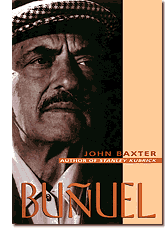 The Spanish filmmaker Luis Buñuel adored paradox. His belief in man's inherent
sinfulness made him a peculiar sort of communist; his atheism made him a
strange sort of Catholic; his tragic sense of life made him an odd sort of
surrealist. I think I would have liked him. John Baxter, Buñuel's latest
biographer, relates how a firm that produced beverages once asked Buñuel to
film a commercial for it. He proposed a crucifixion scene in which Christ,
hanging on the cross, says "I thirst," and a Roman soldier offers him a bottle
of the company's mineral water. Baxter's life of Buñuel, just republished by
Carroll & Graf, is long on such vivid and colorful anecdotes but,
unfortunately, short on analysis of Buñuel's character and work. Yet breezy and
superficial as Baxter's celebrity bio is, it made me revisit some of Buñuel's
films. And that made me wonder about human values in present-day filmmaking.
The Spanish filmmaker Luis Buñuel adored paradox. His belief in man's inherent
sinfulness made him a peculiar sort of communist; his atheism made him a
strange sort of Catholic; his tragic sense of life made him an odd sort of
surrealist. I think I would have liked him. John Baxter, Buñuel's latest
biographer, relates how a firm that produced beverages once asked Buñuel to
film a commercial for it. He proposed a crucifixion scene in which Christ,
hanging on the cross, says "I thirst," and a Roman soldier offers him a bottle
of the company's mineral water. Baxter's life of Buñuel, just republished by
Carroll & Graf, is long on such vivid and colorful anecdotes but,
unfortunately, short on analysis of Buñuel's character and work. Yet breezy and
superficial as Baxter's celebrity bio is, it made me revisit some of Buñuel's
films. And that made me wonder about human values in present-day filmmaking. "Posing for Egon Schiele" (February 1998)
Lee Siegel on the artist, the critics, and the importance of being jaded.
Discuss this column in the Arts & Literature forum of Post & Riposte.
Related Links:
Filmography of Luis Buñuel
A list of Buñuel's films with links to reviews and information about the actors.
Movie Guide Database: Luis Buñuel
A short biography of Buñuel.
Everyman Cinema -- Director Links
A list of links to Web sites with information on Buñuel.
That would not be so bad if movie violence were just the plain old rough-and-ready catharsis it was in the past. In many Hollywood movies, though, violence is also a moral palliative. Take Taxi Driver, more than twenty years old, but still the overpraised classic of violent American films. At film's end Martin Scorsese equates Travis Bickle's psychotic vigilante shooting spree with the lies told by American politicians. Society rewards both, you see. Bickle becomes a hero because no one sees the mad self-absorption behind his actions; the politician in the subplot gets elected because no one sees the asocial self-interest behind his rhetoric. They are interchangeable.
On a different level, recall The English Patient. In that ultimately disappointing attempt at a romantic epic, the love between a man and a woman makes all wartime cruelty, Nazi and Allied alike, morally equivalent. The love story and the action qualify the movie as entertainment. The moral equivalence gives it an intellectual weight, like that of the Oscar statuette, whose physical heft momentarily surprises. Or consider The Godfather, especially parts two and three, where Francis Ford Coppola equates his gangsters with businessmen, politicians, and the Catholic Church; or, most recently (and less artfully), The Peacemaker, in which New York City cops are equated with Bosnian Serb snipers in a moronic parable of U.S. inaction in Bosnia and its tragic effects. The message in all these films is that you are, ultimately, what you hate and fear. The idea is diluted Freud and puréed egalitarianism mashed together with a strain of New Left gruel, and it is the only way contemporary Hollywood can think of to be "serious." Quentin Tarantino's films are so successful because they represent this scheme taken to its furthest extreme: there are neither ambiguously bad characters about to dissolve into good characters nor ambiguously good characters about to dissolve into bad characters. Everyone in his movies is a casually amoral synthesis of both types.
Alongside all this pap, the icy and cynical Buñuel warms and uplifts my heart. In the hothouse of European politics during the thirties, his surrealist preoccupation with Freud ripened into a psychological realism wedded to acute observations of social milieu. Though he left Spain at the outbreak of the civil war, his already dark outlook was radically refined by the impossible betrayals, the shifting alliances and misalliances, and protean brutality of that conflict.
Steeped in surrealism's belief in the strength of subconscious forces -- always sexual and violent -- Buñuel took violence for granted as a universal condition. His art consists of the way he sculpts particular events out of that condition. His most sensational violence occurs on a continuum of motive, act, and consequence. The individuals who commit the violence are connected to other individuals, and to social and political structures somewhere down the line. But each violent moment is violent in its own way.
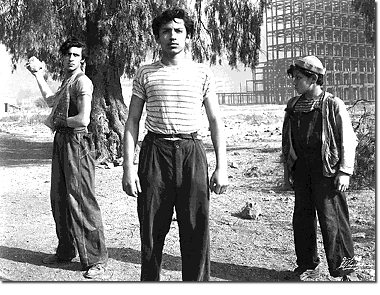
In the extraordinary film The Phantom of Liberty (1974), Buñuel actually creates weird equivalences in order to make moral distinctions. Life is turned utterly upside down in this film. One of the most extreme reversals has a sniper chillingly cutting down pedestrians with a rifle from the upper floor of an office building under construction. He goes on trial for his crimes, gets convicted, and is then let go with handshakes and good wishes from everyone in court. The equivalence Buñuel makes between the sniper and an ordinary man -- he treats the sniper as if he were on a shopping, rather than a shooting spree -- is outrageous and repugnant, and it serves to drive home the difference between a sniper and an ordinary man. The end of the movie has police descending on a zoo from which the animals are escaping, as if they were descending on a prison from which convicts were fleeing. There is a volley of gunshots, and the film abruptly finishes with a frozen shot of an ostrich staring into the camera. Buñuel seems to be asking, Is all this safely absurd and unreal? If you think so, he answers, you have your head buried in the sand and are unable to see that life is as absurd and unreal as it is in this film, and unable to recognize that the cultural and political atmosphere still rings with the memory of police slaughtering students in Mexico City just a few years before as if they were animals. Yet, again, Buñuel makes no simplistic division between good and evil. The world is a place where anything can happen because people are capable of anything. But not everyone does what he or she is capable of.
Discuss this column in the Arts & Literature forum of Post & Riposte.
Lee Siegel is a contributor to several publications, including The New Republic and The New York Times Book Review. He has written recently for The Atlantic on Jane Austen and contemporary women novelists and for Atlantic Unbound on Egon Schiele.
Copyright © 1998 by The Atlantic Monthly Company. All rights reserved.
Artwork reproduced courtesy of the Museum of Modern Art Stills Archive.
 |
 |
 |
 |
 |
 |