



Minestrone, Genoese-Style
Genoese Spinach with Raisins and Pine Nuts
Potato-String-Bean Tart
Bitter Almond Cookies
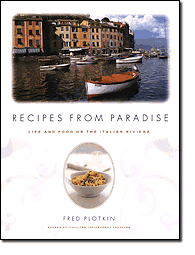 Last year Fred Plotkin spent several months in a small
apartment in Camogli, a port town on the Italian Riviera so perfect that a huge
picture of it washes over the cover of Italy: The Beautiful Cookbook
(1989). After his return to the United States to begin publicizing
his new book, Recipes From Paradise (1997), Plotkin told me of a
dispiriting visit to the Fairway Market, in his Upper West Side neighborhood.
"It was full of people, but they were all in a rush and nobody talked to
anybody else," he said. "You go into a food market in a city or little town in
Italy, and it's a party." With that one example Plotkin summarized why I so
often get glassy-eyed dreaming of living in Italy.
Last year Fred Plotkin spent several months in a small
apartment in Camogli, a port town on the Italian Riviera so perfect that a huge
picture of it washes over the cover of Italy: The Beautiful Cookbook
(1989). After his return to the United States to begin publicizing
his new book, Recipes From Paradise (1997), Plotkin told me of a
dispiriting visit to the Fairway Market, in his Upper West Side neighborhood.
"It was full of people, but they were all in a rush and nobody talked to
anybody else," he said. "You go into a food market in a city or little town in
Italy, and it's a party." With that one example Plotkin summarized why I so
often get glassy-eyed dreaming of living in Italy. Plotkin, who is the author of the single best book on pasta in English -- the aptly named Authentic Pasta Book (1985), thankfully newly available in paperback -- spent a year abroad at the famous University of Bologna, and it was formative. He was understandably enraptured, and translated his love into a career as a writer on Italian culture.
I wouldn't dream of going to Italy without a copy of Plotkin's Italy for the Gourmet Traveler (1996); I need his eye and palate on Italian voyages. I'm also lucky, as a friend of Plotkin's, to have the benefit of his wicked and lightning-quick sense of humor -- he never fails to think of the best pun first -- which to my dismay he usually muzzles when writing.
Recipes from Paradise is Plotkin's account of why he so loves Liguria -- the region along Italy's northern Mediterranean coast -- and feels so good there. After listing the stunning variety of vegetables, herbs, and fruits available there, he concludes that Liguria is, quite simply, Eden. Others, too, are discovering Liguria, finally realizing that one doesn't have to go to Nice -- long part of Italy's territory -- for a combination of Italian and French food.
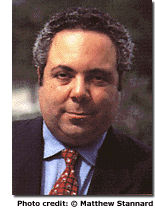 Of course the heart of Recipes From Paradise is the cuisine, the product of
"a dialogue between land and sea that has gone on for thousands of
years." Plotkin believes that "Liguria's is the great undiscovered cuisine of
Italy and ranks with that of Emilia-Romagna as the nation's finest," and
spends most of the book showing us why he risks that opinion.
Of course the heart of Recipes From Paradise is the cuisine, the product of
"a dialogue between land and sea that has gone on for thousands of
years." Plotkin believes that "Liguria's is the great undiscovered cuisine of
Italy and ranks with that of Emilia-Romagna as the nation's finest," and
spends most of the book showing us why he risks that opinion.
Here are a few of the delightful literary excerpts that grace the book and
bring Liguria alive at various times in its history. Here, too, are four
recipes that bring Liguria into your kitchen: minestrone, a good hearty soup
for the fall and winter months; a simple spinach dish with raisins and pine
nuts, of the kind you find to the side of many meat and poultry dishes; a
crustless potato-and-string-bean tart that is really a substantial casserole,
one that can be cooled and cut into cubes for taking on outings; and yet another variation on my favorite Italian dessert -- almond
cookies. These last are homemade amaretti. Note the rest time of three hours
before you bake them: you'll be amazed at the difference in texture. Try these
with some wine and fruit and you will see that Recipes From Paradise is aptly titled.
-- Corby Kummer
Excerpts from Recipes from Paradise: Life and Food on the Italian Riviera, by Fred Plotkin (Little, Brown)
Menestron
Minestrone, Genoese-Style
The wordminestrone means "big soup" and certainly this one is. When most North Americans think of minestrone, it is closer to the vegetable soup popular in Milan, in which one can still readily recognize the different ingredients. By contrast, Ligurian minestrone (menestron in dialect) cooks gently until the ingredients come apart. This is a more homogeneous vegetable soup, but one that is complex in subtle flavors. Ligurian minestrone is always finished with a spoonful of pesto stirred in just before it is served. As always, the pesto is never heated, and the pesto used in soup is traditionally made without either pinoli or walnuts.
This is real old-fashioned Genoese soup, the kind eaten by the dock workers in the harbor. Use the pasta and beans and then select as many ingredients as possible. They should all be fresh, so, for example, frozen peas just will not do. You will note the use of a crust of Parmigiano-Reggiano cheese. This bespeaks frugality as well as taste. After grating cheese down to the crust, wipe it with paper toweling and then wrap it tightly in plastic and store it in the refrigerator. When heated, it will impart wonderful flavor to the soup.
|
2 to 2 1/2 quarts cold water 3 1/2 ounces fresh borlottior red kidney beans 3 1/2 ounces raw cauliflower 3 1/2 ounces pumpkin or yellow squash 2 ounces thin string beans 2 medium potatoes, washed, peeled, coarsely chopped 2 carrots, washed, peeled, coarsely chopped 1 stalk celery, washed, chopped into little bits 2 leeks, chopped into chunks 2 plum tomatoes, peeled and seeded, chopped into chunks 2 medium zucchini, washed, chopped into bite-size pieces |
A few leaves of borage or spinach, washed 1/2 cup fresh peas 1/2 cup fresh fava beans 1 baby eggplant, washed, chopped into bite-size pieces Crust of wedge of Parmigiano-Reggiano (if available) 5 ounces dried pasta, broken into little pieces 1 pinch of sea salt 1 medium onion, coarsely chopped 1 clove garlic, with the green heart removed, chopped into bits 1 sprig fresh Italian (flat) parsley, torn into pieces 2 tablespoons freshly grated Parmigiano-Reggiano 2/3 cup Ligurian extra virgin olive oil 1 tablespoon nut-free pesto per bowl of soup |
"In some places on those desolate mountains, olives grow in abundance, furnishing France with good quantities of oil.... The Genoese also collect a few mushrooms which they manage to make a small business out of.... The countervailing wind prevented my arrival in Portovenere, as I had hoped. So I slept in Portofino, 20 miles from Genoa. With my ship battered by the winds, I wound up with a frightening case of seasickness. I set my stomach right in a little inn, where I found good mullet, good wine and good oil."
--Charles-Louis de Montesquieu, 1728
The Genoese eat this soup hot, tepid, and cold, and it is delicious all three ways.
Spinasci a-a Zeneize
Genoese Spinach with Raisins and Pine Nuts
This combination goes well with cooked meats, especiallytomaxelle, as well as simply prepared fish. The combination of spinach, raisins, and pine nuts is a classic in this stretch of the Mediterranean and is ubiquitous in Barcelona.
|
1 pound fresh spinach 2 tablespoons Ligurian extra virgin olive oil 1 clove garlic, with the green heart removed, minced 1 tablespoon golden raisins (sultanas) or currants, soaked in warm water for 5 minutes |
1 tablespoon pinoli 1 pinch fine sea salt 6 slices toast, each cut into 4 triangles, if serving as an appetizer |
Carefully wash the spinach, removing all of the sand. Steam the spinach for 5 minutes, using only the water that clings to the leaves. Then remove the spinach and carefully squeeze out all of the liquid. Chop coarsely. Heat the olive oil gently in a pan or skillet. Add the garlic and let the oil become fragrant (the garlic should not turn color). Add the spinach, sauté for 3 minutes, then add the raisins, pinoli,and salt, and sauté for 4 to 5 minutes, turning the ingredients frequently so that nothing sticks or burns.
*This spinach is a popular appetizer when served on triangles of toast.
Polpettone
Potato-String-Bean Tart
This popular dish, called porpetton de faxolin in dialect, is irresistible. Polpettone in the rest of Italy means meat loaf, but in vegetable-crazy Liguria there is no meat in sight. This tart is wonderful as a snack, an antipasto, or a main course. For Ligurians it has the particular association of being the food that is packed to take along for hikes and country outings.
|
1 1/4 pounds boiling potatoes, peeled, cut into pieces 3/4 pound string beans, preferably slender 1 tablespoon Ligurian extra virgin olive oil 1 clove garlic, green heart removed, minced 2 tablespoons fresh Italian (flat) parsley, minced |
1 tablespoon fresh oregano or thyme, torn into small pieces 1 cup freshly grated Parmigiano-Reggiano 3 large eggs, lightly beaten 1/2 cup prescinseuaor ricotta Fine sea salt to taste Freshly ground pepper to taste 1 cup unflavored bread crumbs |
--Henry Alford,
The Riviera: Pen and Pencil Sketches from Cannes to Genoa, 1869
Amaretti
Bitter Almond Cookies
These well-known Italian cookies are produced commercially in Saronno, in Lombardy, but this is the recipe from Sasello, in the province of Savona, whose amaretti are homemade and more memorable. In Liguria, amaretti are typically served with tea, with fruit, with wine, and as a stuffing for peaches. You must understand that these are not bitter cookies with almonds, but rather cookies made with sweet almonds (the type you are used to) and bitter almonds (which you can find in pastry shops, good fruit-and-nut sellers, and some health food stores).
|
2 teaspoons sweet butter 1 tablespoon unbleached flour 2/3 cup peeled, blanched bitter almonds (available in health food stores and specialty shops) |
3/4 cup peeled, blanched sweet almonds 3/4 cup granulated sugar 4 egg whites 1 tablespoon confectioner's sugar |
Grease a cookie sheet with the butter and then top with the flour. Tap the tray to dislodge any excess flour. Place the bitter almonds, the sweet almonds, and the granulated sugar in a mortar and pound until you have created a powder (this procedure may also be done in a blender or a food processor, but the traditional method, of course, is in the mortar). Whisk the egg whites in a cold glass or metal bowl until you see peaks. Use a wooden spoon to add the whipped egg whites into the mortar. Then stir for about 5 to 8 minutes, or until the mixture is smooth.
Now make the cookies. There is a family way to do it, and I have also developed a slightly more professional adaptation. To do it as a family cook would, take a heaping teaspoon of the mixture and plop it onto your greased cookie sheet. Each little mound of batter should be about 1 inch in diameter, and should be spaced 1 inch apart. The more professional way to do this is to put the mixture into a pastry bag with a plain tip. Squeeze out enough batter to form mounds 1 inch in diameter. No matter how you make the mounds, when you are done, set the tray aside in a cool, draft-free spot for 3 hours. The mounds will expand as they sit.
Baking: 15 minutes before you are ready to bake, preheat your oven to 350°. Dust the confectioner's sugar over all the mounds and then bake the cookies for about 20 minutes, until they are crunchy and light gold in color. Let cool thoroughly on a wire rack. Serve at room temperature. They may be stored in an airtight plastic container for about ten days, although I doubt such good cookies will be allowed to last that long.
Copyright © 1997 by Corby Kummer.
Recipes from Recipes from Paradise: Life and Food on the Italian Riviera by Fred Plotkin. Little, Brown & Company: New York 1997. Hardcover, 496 pages. ISBN: 0-3167-1071-7. $31.50. Copyright © by Fred Plotkin
 |
 |
 |
 |
 |
 |