

98.04.29
Child's Play
The CIA reaches out to a new generation of spies.
98.04.23
Multicultural Lite
A multimedia "essay" has technology serve humanity, and vice versa.
98.04.16
Do-It-Yourself Adventure
"Interactive fiction" moves to the Web.
98.04.08
The "Why?"s Have It
For a nation of strangers, the simplest questions can help bridge the widest distances.
98.04.01
Dances With Words
Experiments in "information choreography."
98.03.25
Non-virtual Communities
Competing visions of post-suburban life give new meaning to the "global village."
98.03.18
Gothic Gardening
Martha Stewart it's not.
98.03.11
Pay Day
Slate's big gamble.
98.03.04
Banking on Bright Ideas
What do lost-pet ads, dentist-office ceilings, and in-flight recordings have in common?
98.02.25
ThinkQuest
Techno-savvy kids.
98.02.19
Mapping Cyberspace
Is there a "there" there?
98.02.11
Information-Free
Sometimes the Web can be its own best antidote.
98.02.04
Clintonalia
Investigating rumors of a vast conspiracy.
For more, see the complete Web Citations Index.
As new technologies give rise to new media, most of us aren't quite sure how to use them, or what it is even possible to do with them. So it's nice to see that certain adventurous and eccentric souls -- artists -- have rushed like homesteaders into newly opened territory to explore, experiment, make statements, and sometimes just roll around in the vast expanse of virtual grass.
Beyond Interface -- a new exhibition of twenty-four works of Web-based art, selected by jury and including some that date back as far as 1994 -- is one of the best and most ambitious efforts yet to capture the essence of the moment. And, of course, to comment on it. Commissioned as a special exhibition for the 1998 Museums and the Web conference (held April 22-25 in Toronto), Beyond Interface offers no shortage of the kind of talk we've come to expect from art critics and new-media gurus. At times it seems there's more discussion of the possibilities for art in the new media than attention to what is actually being produced. Nevertheless, there's plenty of art here, too, and the best way to experience this exhibit is to bypass the contextualizing, theorizing, and explanatory writing and to dive straight into the works themselves -- likely to be at once the most sophisticated, surprising, baffling, playful, and ironic collection of Web sites you have ever seen. If you're curious as to what, exactly, Web-based art might look like, Beyond Interface will show you.
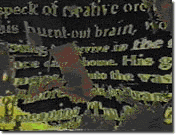 |
| From Grammatron, by Mark Amerika |
As a Web site itself, Beyond Interface is well executed, making smart and at times imaginative use of current Web-design techniques. And yet it's interesting to note the fundamental similarity between the way Dietz has chosen to construct the space and the way exhibitions are often presented in "real" museums. The curator's job has traditionally been understood as one of selection, arrangement, and contextualization -- and, increasingly, of interpretation, relying heavily on references to contemporary critical and theoretical issues. Dietz does all of this, and does it well -- so well, in fact, that the overriding impression one takes away may be more of continuity within the modern tradition of museums and museum curating than of rupture with the past. The Web art itself may go off in wild, uncharted directions, but you can count on the expert curator to supply ample amounts of talk, as though to protect you from an experience that might be unmediated and disorienting, to reassure you that, yes, in the end, it must all mean something.
Copyright © 1998 by The Atlantic Monthly Company. All rights reserved.
 |
 |
 |
 |
 |
 |