



Previously in Atlantic Abroad
For more, see the complete Atlantic Abroad Index.
Share your tales of life abroad in Post & Riposte.

April 14, 1999
Hami, a Silk Road town in the west Chinese province of Xinjiang, is really two towns. One is the ethnic Chinese settlement of unpainted concrete pillbox hovels with blue-tinted windows. Down its coarsely asphalted streets glide legions of Chinese women on bicycles, past the occasional bit of official landscaping -- namely, runty trees plopped in sidewalk planters. The other is the ethnic Uygur warren, with dung-dappled dirt roads, whitewashed stone homes built around courtyards, and lofty willows dancing to the sand-laden gales blowing off the Taklamakan Desert. Uygur mosques, with their turquoise domes and rectangular designs, recall those of Samara and Bukhara in Uzbekistan; they evoke the centuries before Han Chinese control, when the whole region was known as Turkestan.
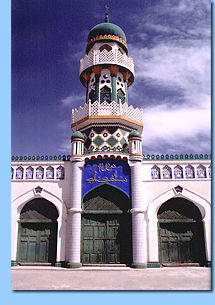 |
| A mosque in Hami |
He nodded at me and hobbled over to the television. He rotated the dial, and suddenly Danny DeVito and Arnold Schwarzenegger hit the screen, a wildly incongruous vision from another planet. Protests erupted from the others in the restaurant. He flicked the dial again and landed on a Uygur drama. Leaving it on at full volume, he disappeared into his black-hole of a kitchen.
He soon limped back carrying a tray covered with bowls of laghmien, or long Central Asian noodles in broth. Arabic-letter credits flashed on the TV screen (Uygur is written in the Arabic script) against shots of charging stallions, skewered sheep, and men dressed in the armor of medieval warriors. The message of the drama seemed to be that life was violent and filled with damsels to steal and lamb to be chewed from the bones of roasted beasts. Every diner dowsed his laghmien with vinegar, stabbed them with chopsticks, and hunkered to his bowl, eyes on the screen. Every man on screen brandished a dagger; every dagger thrown landed in a wood wall inches from a face; every shot fired hit a chest and occasioned a slow-motion explosion of pig's blood from a wounded man's mouth. The show went on, pig's blood and knives, pig's blood and bullets, damsels and feasts and feuds and more pig's blood; the audience chowed down and howled approval of the slaughter through full mouths. Splats of vinegar and half-chewed hunks of noodles sailed toward the screen with every slaying.
My kebab and nan arrived. Then the proprietor brought out bowls of whitish fluid -- kumys, or rancid mare's milk -- and placed them in front of the diners. No one offered me a bowl. Never before had I been so grateful to be ignored and treated as invisible. As bowls were raised to everted lips and a chorus of slurps and gurgles began, on screen a Han Chinese epic replaced the Uygur drama; scraggly beards and sheepskin coats gave way to pigtails and brocaded robes, but daggers still flew and blood still spewed.
The proprietor limped over and left a bowl of kumys under my nose. I raised my arm and gestured avidly that I hadn't ordered it. With equal but grim avidity a dagger-bearing Uygur across the room gestured to me that he had: he was treating me. I nodded thanks and he nodded back, his heavy eyes locked on mine. I raised the bowl to my mouth and paused. The diners turned, noodles dangling from lips, to see if I would spurn this sacred offering of friendship. A sour whiff invaded my nostrils. I took a sip.
The taste was tongue-curling. I had done my duty as a guest and I replaced my bowl, nodding again in gratitude -- but my benefactor and the rest of the crowd were now engrossed in the epic battle on screen. I set about attempting to twirl my laghmien on my chopsticks, enjoying, once again, my strange anonymity.
Jeffrey Tayler is a freelance writer and traveler based in Moscow, and is the author of Siberian Dawn (1999). He contributes regularly to The Atlantic Monthly and files frequent dispatches for Atlantic Abroad.
Share your thoughts on Atlantic Abroad in Post & Riposte.
Copyright © 1999 by The Atlantic Monthly Company. All rights reserved.
Mosque photograph by Jeffrey Tayler.