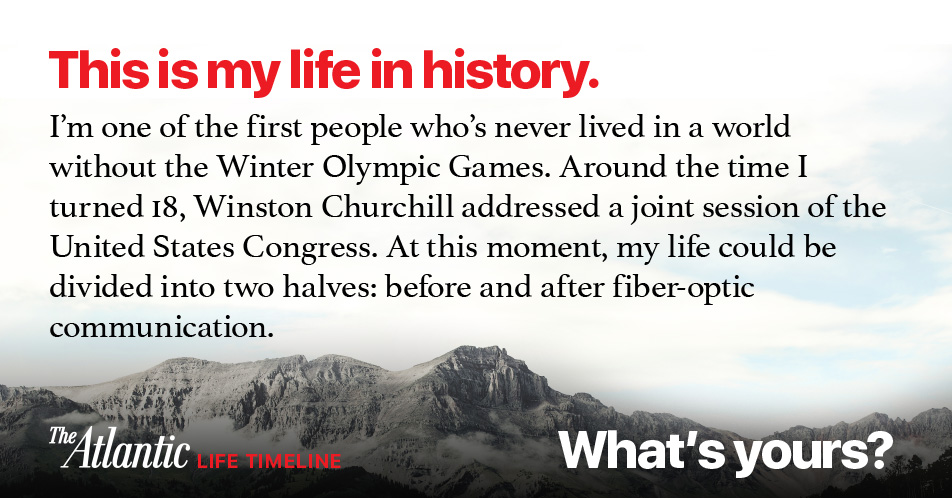
You're one of the first people who's never lived in a world without the Winter Olympic Games.
On February 2014, Philip Bump wrote about how different the 1932 Winter Olympics were from the Winter Olympics today.
You were born in June of 1925. This year, The Atlantic celebrates its 160th birthday, making it 1.7 times as old as you.
The year you were born, Ian Colvin wrote about the life, work, and reputation of Winston Churchill, then British Chancellor of the Exchequer.
Around the time you were born, the American Lieutenant General Nelson A. Miles died.
In the January/February 2015 issue, James Fallows wrote about the complex relationship between the American public and the military.
Around your 18th birthday, Winston Churchill addressed a joint session of the United States Congress.
In March 1965, Eleanor Roosevelt wrote about her recollections of Winston Churchill visiting the White House.

NASA
At 44 years old, you were alive to behold people walking on the moon.
Over the years, the moon landing has come to be lauded as the pinnacle of human achievement, although it was often derided at the time. In 1963, NASA astronauts took to The Atlantic to plead the case for landing on the moon.
Your life can be divided into two halves: before and after fiber-optic communication.
In May 2015, Nicole Starosielski wrote about the underwater network of fiber-optic cables that supports the internet.

Brian Smith / Reuters
In 1979, Margaret Thatcher, who was born the same year as you, became the first female prime minister of the United Kingdom.
In April 2013, Matthew Cooper wrote about the challenges Thatcher faced during her time in office, and how she responded.

NASA / JPL-Caltech / Space Science Institute
When you turned 82, you watched humankind reach the outer solar system.
With NASA's Cassini-Huygens mission in 2005, humans landed a probe in the outer reaches of the solar system for the first time, a moment Ross Andersen called the most glorious mission in the history of planetary science.
History is happening all around you, every day.
The Atlantic is here to help you process it, in stories like these:
Tell your story.