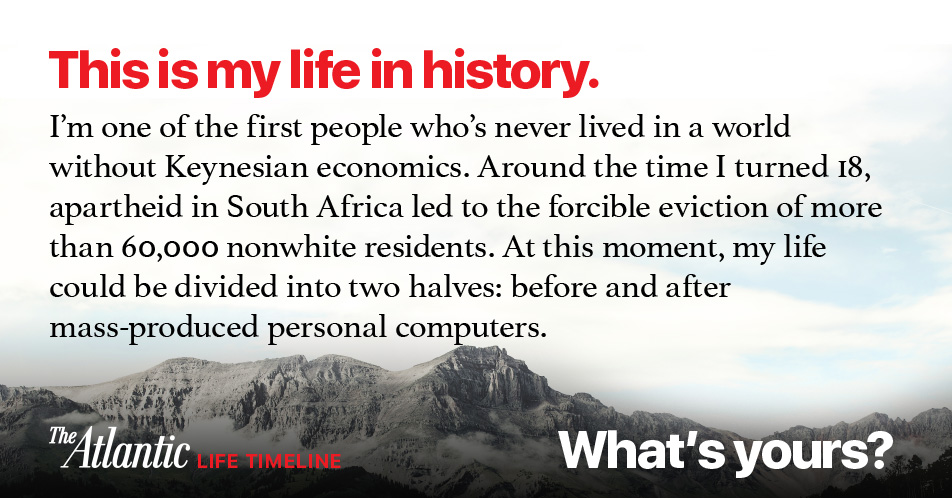
You're one of the first people who's never lived in a world without Keynesian economics.
John Maynard Keynes articulated an early version of his famous theories in our pages in May 1932, arguing that the United States should spend more, not less, in order to curtail the worsening Great Depression.
You were born in February of 1937. This year, The Atlantic celebrates its 160th birthday, making it 1.9 times as old as you.
The year you were born, Henry C. Wolfe wrote about how the Third Reich's expansion would affect the various nations of Eastern Europe. He made these predictions two years before Hitler invaded Poland.
Around the time you were born, a strike ended when General Motors signed a union contract with the United Automobile Workers.
In October 2011, Jordan Weissmann wrote about what a more recent United Automobile Workers contract meant for the future of middle-class manufacturing jobs.
Around your 18th birthday, apartheid in South Africa led to the forcible eviction of more than 60,000 nonwhite residents.
In September 2016, Kenichi Serino wrote about how apartheid continues to cast a shadow over South Africa.

NASA
At 32 years old, you were alive to behold people walking on the moon.
Over the years, the moon landing has come to be lauded as the pinnacle of human achievement, although it was often derided at the time. In 1963, NASA astronauts took to The Atlantic to plead the case for landing on the moon.
Your life can be divided into two halves: before and after mass-produced personal computers.
In June 2015, David Sims wrote about how Apple and IBM convinced people to buy home computers in the 1970s and '80s.

Kevork Djansezian / AP
In 2005, Morgan Freeman, who was born the same year as you, won an Academy Award for Best Supporting Actor for his role in Million Dollar Baby.
In January 2010, Ed Koch wrote about Freeman's "outstanding" performance in Invitctus.

NASA / JPL-Caltech / Space Science Institute
When you turned 70, you watched humankind reach the outer solar system.
With NASA's Cassini-Huygens mission in 2005, humans landed a probe in the outer reaches of the solar system for the first time, a moment Ross Andersen called the most glorious mission in the history of planetary science.
History is happening all around you, every day.
The Atlantic is here to help you process it, in stories like these:
Tell your story.