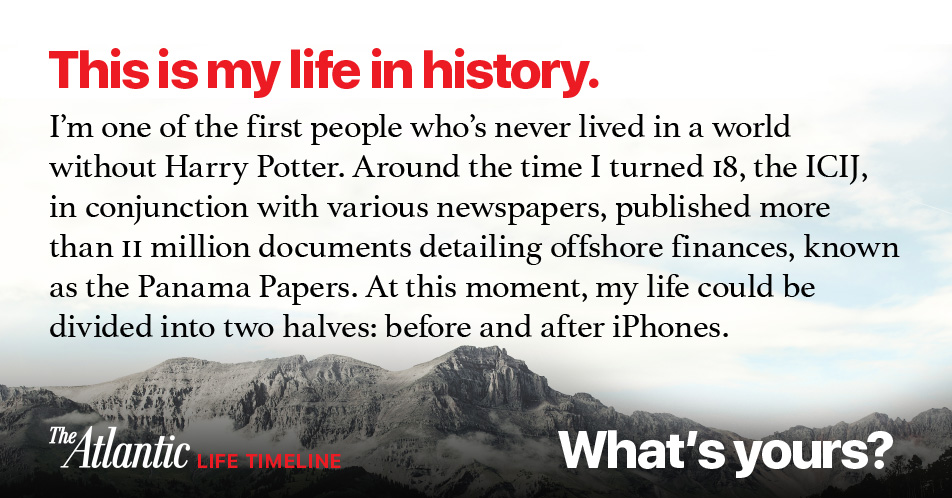
You're one of the first people who's never lived in a world without Harry Potter.
In November 2010, Alyssa Rosenberg wrote about why it was so difficult for readers who grew up reading the series to say goodbye to Harry Potter.
You were born in April of 1998. This year, The Atlantic celebrates its 160th birthday, making it 6 times as old as you.
The year you were born, Edward G. Shirley wrote about how internal politics and a corrosive culture compromised the effectiveness of the CIA—and why reform might be impossible.
Around the time you were born, the Akashi Kaikyō Bridge opened to traffic in Japan, becoming the world's largest suspension bridge.
In June 2006, Charles C. Mann wrote about traveling in Japan.
Jason Redmond / AP
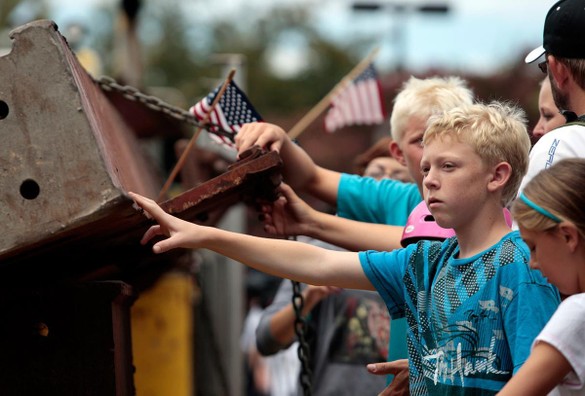
At 3 years old, you were part of the generation most shaped by 9/11.
The conflicts and displacements touched off around the world by the attacks have been reverberating for the majority of your life. “This ‘war’ [on terrorism] will never be over,” wrote James Fallows, a few years after the towers fell.
Your life can be divided into two halves: before and after iPhones.
In November 2016, Bianca Bosker described how a former Google product philosopher was working to redefine the relationship between consumers and technologies like the iPhone.

Goran Tomasevic / Reuters
When you turned 12, you witnessed the revolutionary fervor that transformed the Arab world in 2010, a movement led by your generation.
When 26-year-old Mohamed Bouazizi set himself on fire, he ignited a tinderbox of protests that continue to roil the Middle East, and kindled the beginnings of democracy in Tunisia.

Eric McCandless / Disney
This is what Hollywood thought teenagers looked like the year you became one.
A.N.T. Farm premiered in 2012.

Gary Gershoff / Getty Images for The Shorty Awards
In 2014, Jay Versace , who was born the same year as you, posted his first video to Vine. He went on to have more than 3 million followers on Vine and 1.8 million on Instagram.
In October 2016, Robinson Meyer wrote about the end of the social media app Vine.
Around your 18th birthday, the ICIJ, in conjunction with various newspapers, published more than 11 million documents detailing offshore finances, known as the Panama Papers.
In April 2016, Brooke Harrington wrote about the laws that enable tax havens and the international reactions to them.
By the time you turn 26, the World Bank predicts that the U.S. dollar will lose its global dominance.
In February 2012, Charles A. Kupchan wrote about the world's emerging economies, and how the world will look by 2050.
History is happening all around you, every day.
The Atlantic is here to help you process it, in stories like these:
Tell your story.