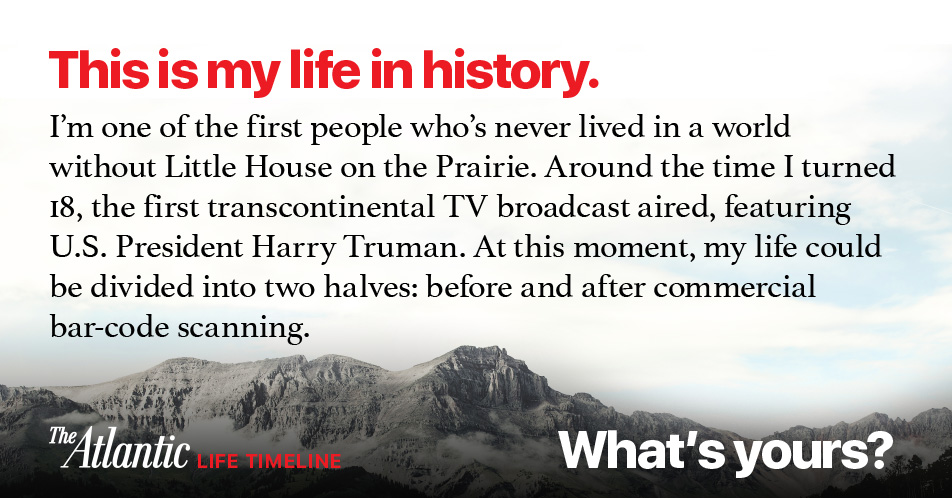
You're one of the first people who's never lived in a world without Little House on the Prairie.
In April 2011, Wendy McClure wrote about the enduring charm of Laura Ingalls Wilder's frontier stories.
You were born in September of 1933. This year, The Atlantic celebrates its 160th birthday, making it 1.8 times as old as you.
The year you were born, Edith Wharton wrote about her creative process, thirteen years after winning the Pulitzer Prize.
Around the time you were born, Leó Szilárd conceived the idea of the nuclear chain reaction.
In March 2011, Alexis C. Madrigal wrote about how scientists may have hampered the long-term prospects of nuclear energy in their rush to commercialize it.
Around your 18th birthday, the first transcontinental TV broadcast aired, featuring U.S. President Harry Truman.
In January 2011, George E. Condon Jr., in his analysis of how the State of the Union address has evolved over the years, discussed how Harry Truman was the first president to make use of television broadcasts.

NASA
At 35 years old, you were alive to behold people walking on the moon.
Over the years, the moon landing has come to be lauded as the pinnacle of human achievement, although it was often derided at the time. In 1963, NASA astronauts took to The Atlantic to plead the case for landing on the moon.
Your life can be divided into two halves: before and after commercial bar-code scanning.
In November 2014, Sarah Laskow described the decades-long development of the modern bar code.

J. Scott Applewhite / AP
In 1993, Ruth Bader Ginsburg, who was born the same year as you, was sworn in as a Supreme Court justice after being confirmed by a 96 to 3 vote in the Senate.
In January 2015, Ryan Park wrote about what Ginsburg taught him about being a stay-at-home dad.

NASA / JPL-Caltech / Space Science Institute
When you turned 73, you watched humankind reach the outer solar system.
With NASA's Cassini-Huygens mission in 2005, humans landed a probe in the outer reaches of the solar system for the first time, a moment Ross Andersen called the most glorious mission in the history of planetary science.
History is happening all around you, every day.
The Atlantic is here to help you process it, in stories like these:
Tell your story.