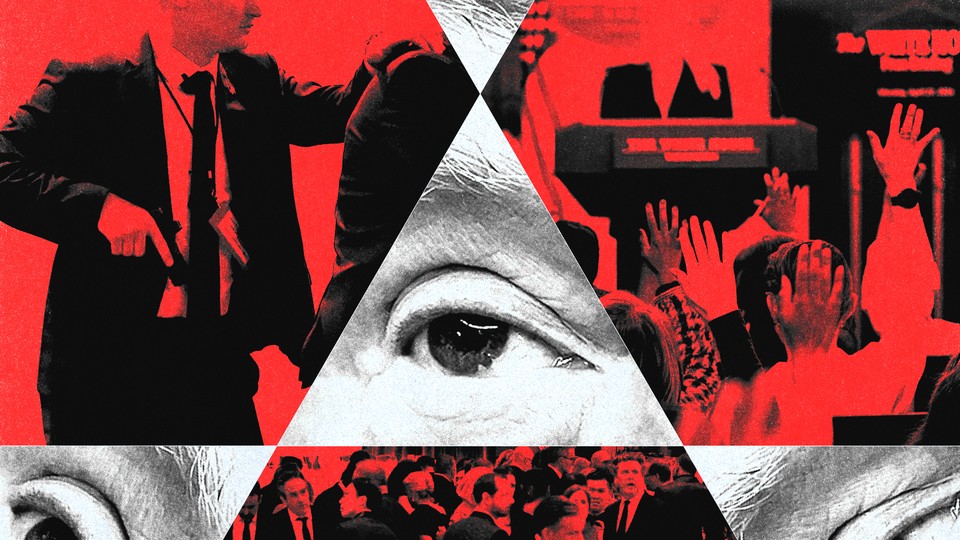
Within hours of the gunfire at the White House Correspondents’ Dinner on Saturday night—and initial, erroneous reports that the shooter had been killed—the usual swirl of misinformation and rumor was swirling in a particular direction. The event was staged, people said.
More than 300,000 posts containing the word staged were shared on X before midday on Sunday, according to an analysis cited by The New York Times. Some of those were probably saying that, actually, the event was not staged, but still: People with substantial social-media followings (including some celebrities) were raising questions. They drew attention to a clip of White House Press Secretary Karoline Leavitt from just before the dinner, laughing as she previewed her boss’s speech: “There will be some shots fired tonight in the room.” Others, in the style of pop-music stan accounts, grabbed photos of President Trump and other members of the administration, taken just before the shooting, in which one might find evidence of knowing smirks or other telling body language. Some of these posts were viewed millions of times.
The conspiracy theorists also latched on to a video pulled from Fox News’s live broadcast, in which the reporter Aishah Hasnie, calling from inside the Hilton hotel that hosted the event, told the anchor that she had been speaking with Trump right before the shooting started. “You need to be very safe,” she said he’d told her. “And he was very serious when he said that to me, and he kind of looked around the room and he said there are some—” Then the call dropped. Hasnie clarified in a post on X that cell service had been spotty in the ballroom, but her explanation, delivered at 1:30 in the morning, was not as widely viewed as posts suggesting that Fox had cut her feed before she could reveal what Trump had gone on to say. (“There are some … people in here who are going to fake an attempt on my life but with live ammunition”?)
A potential motive for a staged assassination attempt was quickly floated too. Less than two weeks earlier, a federal judge had ruled that Trump could not justify his plan to build a ballroom by saying it was necessary for security reasons. Now he had a perfect counterpoint: “This event would never have happened with the Militarily Top Secret Ballroom currently under construction at the White House,” he posted on Truth Social, his social-media platform, on Sunday. Some of the last large #Resistance Twitter accounts started circulating collages of all the posts from Trump allies who were arguing the same point, in suspiciously similar ways. Yesterday, three GOP senators pressed again for funding for the ballroom, and the Justice Department filed a bizarre motion backing the project with Trumpian rhetoric (asserting that any opponents must have “TRUMP DERANGEMENT SYNDROME”).
Among the highly online left, some stated as fact that the whole event had been a ploy to get the ballroom. To some MAGA influencers, it was equally clear that Trump’s enemies had been pushing back on the ballroom plans all along, with the intention of causing his death. “The Democrat judges who stopped the construction of a White House ballroom did so to enable an assassination of Trump,” the far-right internet personality Mike Cernovich wrote, apparently in earnest. I also saw one person with almost 300,000 followers try to tie the shooting to a recent, roundly debunked story about a bunch of scientists who were supposedly mysteriously “missing.”
All of this has echoes of the many conspiracy theories that surrounded an earlier attempt on Trump’s life in Butler, Pennsylvania, in July 2024. That incident left behind a long trail of speculation and rumor, including a debate over whether the president was lying about the fact that a bullet struck his right ear. (Some still post photos of the president and insist that his cartilage appears to be intact.) Then, as now, a contingent of observers claimed that the whole thing had been invented to help Trump—in that case, to make his polling numbers go up, which they didn’t. Now, apparently, the Trump administration was going back to the same playbook. Or maybe Saturday’s attempt was staged and the one in Butler wasn’t? Or vice versa? It was “highly possible” that the Butler shooting had been staged, the author Joyce Carol Oates said in a post on Sunday afternoon, but the previous night’s shooting seemed legit. Later that day, her perception had shifted: “He knew the script,” she wrote, in reference to one Cabinet official who was in attendance at the dinner.
Reached for comment, the White House spokesperson Davis Ingle said in an email, “Anyone who thinks President Trump staged his own assassination attempts is a complete moron.” But how many people fit into this category? Do a meaningful number of Americans actually believe that the president was part of a (successful) plot to fake one or more attempted murders in order to consolidate his power (and build a ballroom)?
Mark Fenster, a professor at the University of Florida’s law school who writes about government transparency and conspiracy theories, told me this would be hard to know. Social media makes conspiracy theories more visible, he said, but may not reflect their actual popularity. Public-opinion polls would provide a better view, but these can fail to capture how committed people are to the positions they claim to hold. “If you ask someone who isn’t particularly well informed or doesn’t care that much but doesn’t like or trust Trump, they might say, Yeah, it’s staged,” Fenster told me. “That doesn’t mean they’re a conspiracy theorist who really believes it.”
The historian Kathryn Olmsted, who surveyed the history of American paranoia in her 2009 book, Real Enemies: Conspiracy Theories and American Democracy, World War I to 9/11, told me that prior assassination plots have not all produced the same quantity of disbelief. (As Fenster noted to me, successful ones generally produce more.) In 1975, a time of notable distrust of government and widespread concern about the secret machinations of the state, two attempts were made on Gerald Ford’s life in the space of three weeks. “There was abundant media coverage of both attempts, but I don’t think I’ve seen evidence of anyone thinking he was responsible for the plots himself,” Olmsted said. In 1981, John Hinckley Jr. shot Ronald Reagan outside the same Hilton hotel that hosted Saturday’s dinner, but that incident didn’t produce many conspiracy theories either. People seemed to take Hinckley at face value when he said he’d acted to impress the young actor Jodie Foster.
Olmsted also pointed out that political assassinations used to be far more common in America than they are today, and that the Secret Service greatly improved its security measures in the 1980s. Given the frequency of these events in earlier eras, she said, people may have been less inclined to invest any one of them with secret meaning. “I think most Americans just assumed there were plenty of mentally ill people who wanted to kill someone famous.”
But that’s not all that’s different. Trump is different, too. He’s a prolific liar with a well-established love for spectacle, and from the day he entered the political sphere, he has repeated and encouraged conspiracy theories of many stripes. It comes as no surprise that he’s at the center of one.
