Editor’s Note: This article previously appeared in a different format as part of The Atlantic’s Notes section, retired in 2021.
This female reader wants women to fight back—literally:
I’ve argued with many newer feminists when debating the notion of self defense. Self defense and resistance as rape prevention are real and effective solutions supported by research[*]. Yet many newer feminists view even the very idea as victim blaming. I think this is a problem within many social movements today. In the interest of maintaining a united front, all nuance and subtlety is ignored!
And it completely ignores the historical significance of self defense in feminism from the ‘70s and ‘80s.
As young girls in the ‘80s, many of us had our first encounters with feminism through self-defense classes we took with our classmates and mothers. At the time, it was one of the most visible aspects of the movement, because the notion that a woman could protect herself, and was not dependent on a man for safety, was entirely subversive. After all, with increased freedom comes increased responsibility—and responsibility is not the same as blame.
New feminists, in my opinion, ignore this at the risk of becoming hypocrites and splintering the movement (all of the freedom, none of the responsibility). There is also an issue of choice at play here. As an autonomous, free-thinking woman, shouldn’t I be able to choose how I wish to respond to my own attack?!
And yet, the issue of rape culture still needs to be addressed. All things being equal, it should only be necessary to talk about the ways women can protect themselves in the rare instance when a crazed and violent perpetrator seeks to assault them.
We live in a society in which rape is ignored, victims are shamed and silenced, and a general climate persists in which otherwise normal young men and women are becoming perpetrators and victims because their view of consent and sexual agency is so incredibly skewed. Young men don’t know what they’re doing is rape, or feel so much pressure they don’t care. And young women don’t know they can say no and are afraid to speak up about assault if they do.
So society itself also needs to be addressed. I guess the full analysis leaves room for both aspects of the discussion.
* Below is some data to back up the assertion that “self defense and resistance as rape prevention are real and effective solutions.” From the National Institute of Justice:
In a 2005 report commissioned by NIJ, researchers examined a variety of sexual assaults and other physical assaults against women. The study did not focus specifically on college students. The researchers found that potential rape victims who resisted their attackers physically and verbally significantly reduced the probability that a rape would be completed and did not significantly increase the risk of serious injury.
Most self-protective actions significantly reduce the risk that a rape will be completed. In particular, certain actions reduce the risk of rape more than 80 percent compared to nonresistance. The most effective actions, according to victims, are attacking or struggling against their attacker, running away, and verbally warning the attacker.
In assaults against women, most self-protective tactics reduced the risk of injury compared to nonresistance. According to the researchers, the only self-protective tactics that appear to increase the risk of injury significantly were those that are ambiguous and not forceful. These included stalling, cooperating and screaming from pain or fear.
A separate study found that even when a rape was completed, women who used some form of resistance had better mental health outcomes than those who did not resist.[1]
A caveat:
Law enforcement officials, however, counsel caution against automatically using violence or other forms of resistance. People who are assaulted are advised to assess the situation and trust their own judgment about the best way to respond.
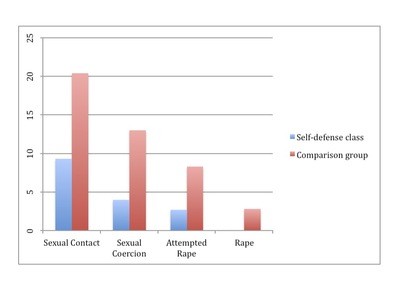
A UO sociologist finds that women who took a ten-week self-defense training were significantly less likely to experience unwanted sexual contact than those who didn’t. … Jocelyn Hollander [looked] at the outcomes for 117 college students who received this self-defense training versus a control group of 169 students who did not. Of those, seventy-five from the first group and 108 from the second agreed to take part in a follow-up survey or interview.
The results are clear: a much lower percentage of the women who took the self-defense class reported incidents of unwanted sexual contact than the women who did not take the class (see chart).
Something to add to the discussion? Drop us a note. And thanks for all the great ones so far, including the ones that don’t get posted because of space and pacing.