“This Is Not Justice”––In Cover Story, Jake Tapper Reports on a Philadelphia Teenager and the Empty Promise of the Sixth Amendment
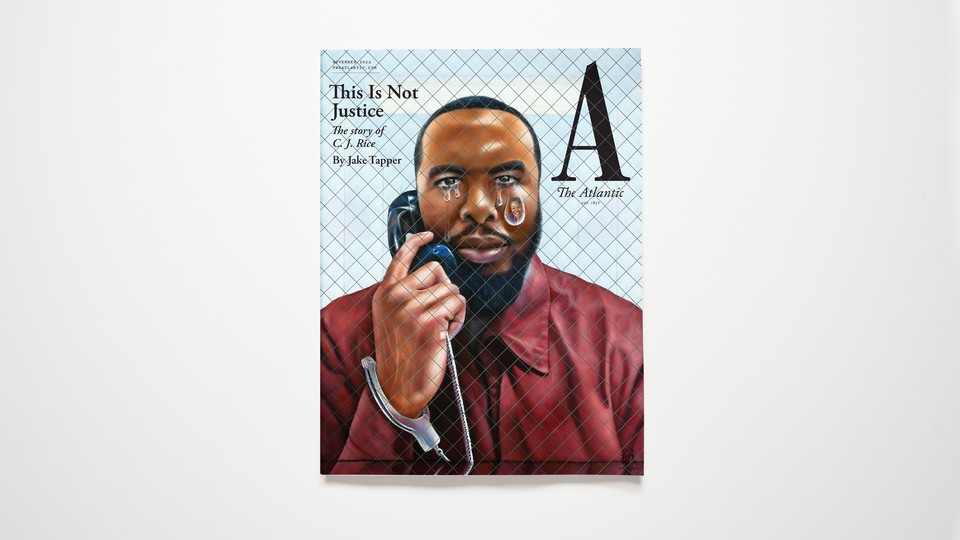
The story of C. J. Rice is accompanied by a commissioned portrait of Rice by the artist Fulton Leroy Washington, known as MR WASH
C. J. Rice was 17 when he and another teenager were charged with attempted murder for a shooting in Philadelphia in 2011. The court-appointed lawyer assigned to Rice’s case spent barely any time with her client, did not consult with witnesses for the defense, and committed a series of grave errors before, during, and after the trial. Despite thin evidence and a dubious eyewitness account, Rice was convicted and sentenced to at least 30 and as many as 60 years in prison. (His co-defendant, who had a different lawyer, was acquitted of all charges.)
Could Rice have been involved in the crime for which he was convicted? His former doctor does not believe he would have been physically capable––he’d examined Rice just a few days prior for major injuries sustained when he was shot while riding his bike. Rice could barely walk, the doctor testified at the trial, and yet he was convicted of a crime where the shooters were seen sprinting from the scene.
Rice’s former doctor is Theodore Tapper, a longtime pediatrician in South Philadelphia and the father of Jake Tapper, the CNN anchor and chief Washington correspondent. Jake Tapper has spent the past two years investigating Rice’s case and the larger story Rice’s fate tells us about justice and injustice in America––and particularly the emptiness of the constitutional promise of a right to counsel. Tapper’s report, “This Is Not Justice,” appears as the cover story of The Atlantic’s November issue and is online today. For media inquiries or interview requests, please contact [email protected].
Tapper and his father have come to their own conclusions about the question of Rice’s guilt or innocence. But the verdict for the legal system itself is damning. As Tapper writes, “There is certainly reasonable doubt—an excess of reasonable doubt—that Rice committed the crimes of which he was accused. But what happened after that night is not open to argument: Rice lacked legal representation worthy of the name. And as he has discovered, the law provides little recourse for those undermined by a lawyer. The constitutional ‘right to counsel’ has become an empty guarantee.”
In addition to the medical evidence, Tapper investigates the broader case against Rice, which was full of weaknesses––no guns were ever found; there was no physical evidence of any kind; and the sole eyewitness identifying Rice had originally said to police on multiple occasions that she did not recognize either of the two shooters, only later changing her story, for reasons she never explained, to identify Rice as one of them. Tapper revisits the police investigation and the trial, with particular focus on the legal representation available to Rice, which was at best inadequate and at worst a case study in incompetent legal practice. Rice’s counsel failed to nail down alibi evidence, failed to present medical records that could speak to his physical incapacitation, failed to explore the unreliability of eyewitness testimony, and failed even to familiarize herself with the crime scene.
Rice was too poor to hire a lawyer of his own. He relied not on a seasoned public defender––of which there are not nearly enough in Philadelphia or anywhere else in America––but on a court-appointed attorney working for flat fees and distracted by significant personal issues. The deficiencies in his legal representation are clear––but as many poor defendants have discovered, the legal bar for claims of “deficient counsel” is impossibly high. Rice has lost all attempts at appeal.
Rice is not alone. The only unique aspect of Rice’s story, Tapper writes, is that Rice had a doctor who is the father of a journalist, one who took a deep interest in what had happened to his father’s patient. In the matter of C. J. Rice, Tapper concludes: “There is no corrupt cop or evil prosecutor. There is only doubtful evidence, deficient counsel, and the relentless grind of the criminal-justice system itself. Rice’s story is meaningful precisely because it is not unusual. Change the details, and it is the story of tens of thousands of poor defendants and the accumulation of large and small injustices that define their lives … To examine his case is to watch a conveyor belt leading in a single direction, with escape routes slamming shut the moment each is glimpsed.”
“This Is Not Justice” is the cover story of The Atlantic’s November 2022 issue. For the cover, The Atlantic commissioned the artist Fulton Leroy Washington, known as MR WASH, to paint a portrait of Rice. Washington recognized much of his own story in Rice’s, having spent 21 years in prison for nonviolent drug convictions before his sentence was commuted in 2016 by President Barack Obama. After his conviction in 1997—a life sentence without parole—Washington began experimenting with oil paints in prison. He soon developed his signature style, which is reflected on the November cover: photorealistic subjects crying large tears, with smaller portraits of figures from his subjects’ lives within the teardrops. Associate creative director Oliver Munday interviewed MR WASH about his work and this cover; you can find that conversation here.