Republicans Might Regret Putting Emil Bove on the Bench
Even conservative judges might delay retirement rather than give Donald Trump more chances to appoint transparently partisan replacements.
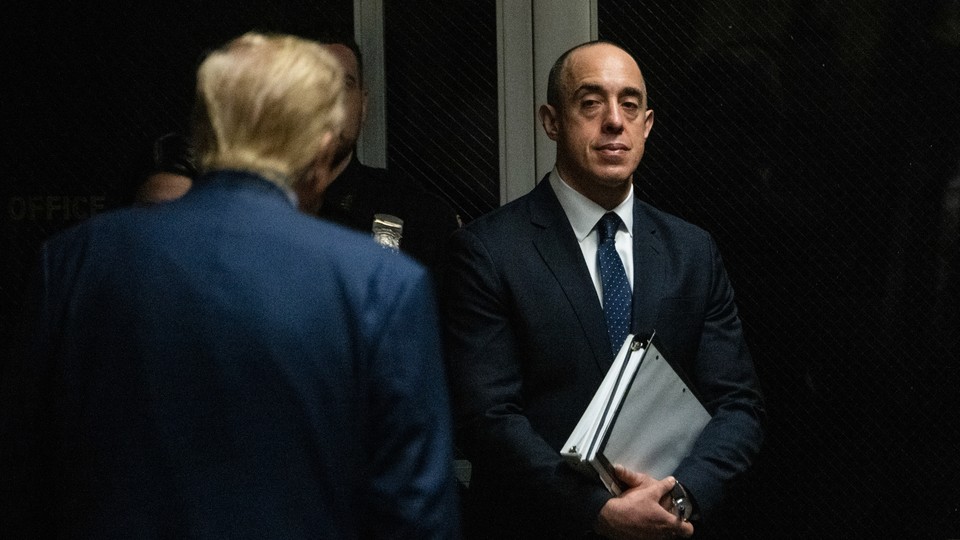

Donald Trump got his man. On Tuesday, the Senate voted to confirm Emil Bove, the president’s former criminal-defense lawyer, to a lifetime appointment as a federal judge on the Third Circuit Court of Appeals. During his brief tenure as a top Justice Department official, Bove behaved like someone who still believed that the president was his client: directing political purges, pushing out employees who refused to carry out unethical orders, and allegedly urging subordinates to defy court rulings that constrained Trump’s agenda.
But Trump and his allies might come to regret appointing such a transparent partisan to the federal bench.
A few weeks ago, a group of former Justice Department lawyers, including me, asked to meet with Republican senators to discuss the Bove nomination. We all had worked on prosecutions related to January 6; several members of the group were among the roughly two dozen lawyers whom Bove had fired for precisely that reason. Our argument was that even Republican senators eager to push the judiciary to the right should, out of their own self-interest, vote against confirming Bove. Unfortunately, staff for just one senator, Chuck Grassley, agreed to meet with us. Most offices never even responded. Because they were unwilling to hear us in private, I will make our argument in public.
Since he first took office, in 2017, Trump has maintained the support of Senate Republicans in part through a simple bargain: They put up with his obvious unfitness for office, and in exchange, he appoints reliably conservative judges to the federal courts. But by appointing Bove—whose only apparent loyalty is to his own ambition, not to any particular legal philosophy—the GOP might have limited its own ability to appoint judges in the future. This is because the president typically gets to appoint new judges only when old ones die, retire, or move into the quasi-retirement position of “senior status.” And some judges, even conservative ones who would otherwise be happy to let a Republican president pick their replacement, are likely to delay their retirement rather than hand Trump the opportunity to make more Bove-style appointments.
The evidence suggests that this is already happening. Many federal judges time their retirement based on which party is in power: Democrat-appointed judges are likelier to retire when a Democrat is president, Republican-appointed judges when a Republican is. So far through Trump’s second term, however, conservative judges aren’t retiring at the pace they typically do. An analysis by Bloomberg Law found that 26 judicial seats opened up from the beginning of the year through the first five months of Trump’s first term, as did 57 judicial seats during the same period of Joe Biden’s presidency. By contrast, through June 1 of his second term, Trump gained just 16 vacancies to fill. Ursula Ungaro, a retired judge appointed by George W. Bush, told Bloomberg Law that she’d heard a “hint or two” that her former peers “would stay beyond their eligibility for senior status to see what happens toward the end of the Trump administration.”
Even before Bove’s appointment, then, judges seem to have been worried about the type of person Trump would appoint to replace them. During Trump’s first term, they had likely been assuaged by the fact that the president relied on leaders of the conservative legal movement, especially the Federalist Society’s Leonard Leo, to help make his judicial picks. No longer. Frustrated that judges he appointed have occasionally ruled against his administration, Trump now calls Leo a “real ‘sleazebag’” who “probably hates America.” The president evidently feels free to pick his own judges, and he is picking people like Bove.
Bove is not the kind of lawyer who a traditionally conservative judge would want to be replaced by. He oversaw a purge of January 6 prosecutors despite the fact that he had once eagerly worked on January 6 cases himself. He pushed out career lawyers who refused to go along with an obviously unethical order to drop the corruption prosecution of New York City Mayor Eric Adams. And, according to two whistleblowers, he urged government lawyers to ignore a federal court order halting deportation flights. Bove allegedly told subordinates that they would need to consider telling judges “fuck you” if courts ordered the government to stop. As a practicing lawyer and former prosecutor, I find this astonishing. I have never heard a colleague or opposing counsel propose to ignore a court order; it runs counter to our entire profession.
For judges who care about the rule of law, even very conservative ones, Bove’s conduct offers a reason to reconsider retirement. Senate Republicans should keep that in mind the next time Trump nominates someone like him to the federal bench.