The Atlantic Politics Daily: Ukrainian Americans Recognize the Playbook
“I was not surprised, because I come from Ukraine, and it’s a corruptive system. It’s everywhere, even here [in America].” Plus, how the young American left forms a third party.
It’s Wednesday, December 11. Details about the deadly shooting at a kosher grocery store in New Jersey are still emerging: “Especially in the realm of politics, fear is extremely close to the surface,” Emma Green writes about the new realities of American Jews.
In today’s newsletter: What Ukrainians in America think about Ukraine in the American impeachment story. Plus: Are young American leftists their own party?

People dining at Streecha in New York City, a hub of Ukrainian American life. (Photographs by Devin Yalkin)
Ukrainian Americans recognize the playbook.
By now, the major impeachment plot points have been repeated enough that the story has become a blur of names and buzzwords: whistle-blowers, Ukraine, Volodymyr Zelensky, Bidens (Joe and Hunter), quid pro quo, Burisma.
In America, this political moment is a surreal, historic spectacle: President Donald Trump is on the verge of becoming the third president in U.S. history to be impeached.
For Ukrainians—in Ukraine and in America—this moment may feel even more surreal. Perhaps no Ukrainian has a stranger and more central role in the saga than President Volodymyr Zelensky, an actor known for his slapstick humor, now inextricably linked to the biggest story in American politics.
As my colleague Franklin Foer writes in his stunning profile: “To narrate Zelensky’s ascent is to slip into the plot of a postmodern novel that mocks the distinction between reality and entertainment.”
1. What does impeachment mean to Ukrainians in Ukraine? When it first came out, the story of Trump’s call with Zelensky didn’t receive a lot of attention in there. That changed once Democrats launched the impeachment investigation. Now, Ukrainian leaders are struggling with a delicate balancing act, Ian Bateson and Tom McTague write.
Even if Zelensky’s team wants to do something to appease Trump, it cannot risk alienating Democrats in case they win the presidential election. Seeming to favor either side risks turning Ukraine into a partisan issue in which it is seen to be an ally of one side or the other.
2. How do Ukrainians living in America feel about their home country being thrust into the political spotlight? My colleague Emma Green visited Streecha, a Manhattan restaurant that’s one of the hubs for the city’s Ukrainian American community, to try to get at that question.
She found that the impeachment story has made Ukrainians feel at home—though not in a comforting way. Accusations of corruption and self-enrichment, diners told her, remind them of the USSR’s kleptocratic style of politics. Here’s what one Ukrainian immigrant said about Trump’s alleged actions:
“I was not surprised, because I come from Ukraine, and it’s a corruptive system. It’s everywhere, even here [in America]. Now it’s more open.”

(Tom Brenner / Reuters)
Attendees of a White House Hanukkah reception where Trump signed an executive order focusing on anti-Semitism on college campuses.

(CHIP SOMODEVILLA / GETTY)
1. “[T]here is nothing slight about the abuses described in the Democrats’ two articles of impeachment.”
Democrats have put forward two articles of impeachment that leave no room for debate over facts, Kim Wehle argues. But the expected acquittal by the GOP bodes poorly for presidential accountability in the future.
More: Even if Republicans reject the facts that Democrats have settled on, members of Congress are still bound to follow these specific rules once the vote-taking begins, Robert Black argues: Very political processes still have legal boundaries.
2. “It might be most useful to think about young progressives as a third party trapped in a two-party system.”
There’s a reason so many young voters (under the age of 30) love Bernie Sanders’ message and reject Joe Biden’s, Derek Thompson argues. The divide might just be because they don’t vibe at all with either of America’s dominant political parties.
More: Baby Boomers and those in Gen X may have spoiled the hopes and dreams of millennial voters, Ben Judah argued earlier this summer, and that’s why this generation is organizing around a leftist movement.
3. “We are not the ones who are responsible for this, but we are the ones who have to live with these consequences, and that is so incredibly unfair.”
Those were the words of the youth environmentalist Greta Thunberg, who returned to the media spotlight as Time magazine’s Person of the Year. Our reporter Robinson Meyer spoke with Thunberg back in September, and has this theory on why she’s so captivating to adults.
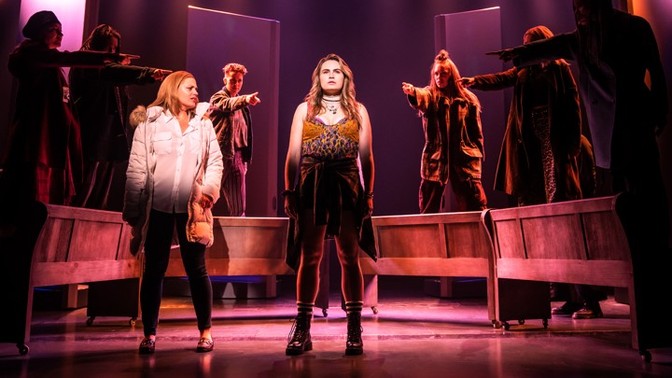
(Matthew Murphy)
90s Music for the 2020 Era
Our music critic Spencer Kornhaber talks to the creators of Jagged Little Pill, a musical based on the 90s hits of the pop-rocker Alanis Morissette.
“It’s a trope now: Are you woke?” the show’s director, Diane Paulus, told me when I met with her and the writer, Diablo Cody, at New York City’s Broadhurst Theatre in November, while the show was still in previews. “But 20-something years ago, she had a whole song about waking up.” ...
“I’m proud of the ‘woke’ designation,” Cody said to me. “I would rather have that than ‘the most tone-deaf, stuffy musical.’ When people say, ‘Wow, there are a lot of issues in the show,’ I say, ‘Thank you. Yes, there are. There are also a lot of issues in our lives.’”

One of our podcasts, a weekly, in-depth show for historic times, hosted by our campaign reporter Edward-Isaac Dovere, is currently called Radio Atlantic.
But we’re renaming it! Share with us your thoughts on these titles here.
Today’s newsletter was written by Saahil Desai and Christian Paz, and edited by Shan Wang. You can reply directly to this newsletter with questions or comments, or send a note to [email protected].
Your support makes our journalism possible. Subscribe here.