Editor’s Note: This article previously appeared in a different format as part of The Atlantic’s Notes section, retired in 2021.
As Nicholas Lemann observed in our January 1999 issue: “Donald Trump became a tycoon by making himself a celebrity first.” To take that formulation a step further: Trump became a politician—the most influential one in the U.S. right now—based on that tycoon status and thus celebrity status. And celebrities love cameos:
Other celebrity politicians with mass cultural appeal, such as Sarah Palin, Barack Obama, and Ronald Reagan, at least held some elected office before bursting on the national scene. But Trump’s celeb-centric ascension is unique. Only four U.S. presidential nominees in the 20th and 21st centuries had no experience in elected office, though three of them—Taft, Hoover, and Eisenhower—did serve in appointed roles within government. The fourth nominee—Wendell Willkie, a utility executive—had never served in government, but Willkie was nowhere near the level of celebrity as Trump’s. And Willkie became famous because he was a tycoon, not the other way around, a la Trump. (William D. Cohan has an excellent piece in our April 2013 issue detailing how Trump’s business clout is based on his celebrity brand; the mere perception of his exaggerated wealth is what gets Trump so many business deals. Cohan’s piece is basically an extrapolation of Lemann’s “celebrity before tycoon” and well worth a read.)
With that in mind, here are three mentions of Trump in our archives that underscore his iconic status prior to running for president:
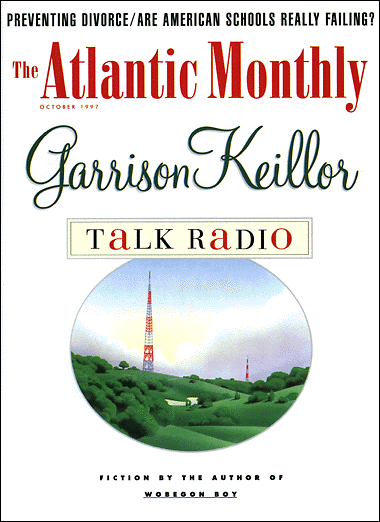
In an October 1997 interview with American storyteller Garrison Keillor, it’s revealing that Trump is the first name that comes to mind when Keillor is asked about American archetypes:
Oct ‘97 issue
The story of your rise to fame—from being a midwestern boy with big dreams to becoming a national icon—is terrifically American. What's it like to be an archetype? Is it all it's cracked up to be?
Every Arbor Day I get together with some of my fellow archetypes—Donald Trump and Sally Ride and Willard Scott and Martha Stewart—and we talk about what it's like. Frankly, it’s okay. None of us minds, particularly. It’s not a dignified life, the archetypal life, but we seem to serve a useful function as landmarks, like the Chrysler Building or the pier at Santa Monica.
Twelve years later, in our November 2009 issue, here’s how James Parker opened his piece “Retching With the Stars” (about the “addictive appeal” of Dr. Drew Pinsky’s reality show Celebrity Rehab):
AT THE MONUMENT to the Last Postmodern Philosopher, who was assumed into heaven after watching Season One of Laguna Beach, the celebrities are gathering to pay tribute: lumbering Donald Trump, with his volume always set wrong; tiny-footed Tila Tequila. There’s Paris Hilton, sleek as a seal; and a cartwheeling Flavor Flav! Applause greets them all, and shouted questions, the usual brouhaha.
Speaking of Trump’s volume, two years later for our July 2011 issue, Walter Kirn wrote the following entry (“The Maniac Will Be Televised”) for our list of “The 14 Biggest Ideas of the Year”:
In a news year dominated by manic ranters, from Charlie Sheen to Donald Trump to the Rent Is Too Damn High guy (and even, on the extreme end, Colonel Qaddafi), we are quickly learning that agitation pays when it comes to maintaining a high profile in our seething media environment. If the old advice to electronic communicators was to speak in sound bites and keep things simple, to cut through the noise by being straightforward and countering confusion with consistency, the new winning strategy is the opposite: embrace incoherence and become the noise. The cool self-control that was once considered the soul of telegenic behavior has been turned inside out, and the traits that people used to suppress when they appeared on television—the contortions and tics—are now the best way to engage an audience. Attention-deficit disorder, remember, responds to stimulants, not sedatives.
Sheen was the spilled beaker in the laboratory who proved that in an age of racing connectivity, a cokehead can be a calming presence. His branching, dopamine-flooded neural pathways mirrored those of the Internet itself, and his lips moved at the speed of a Cisco router, creating a perfect merger of form and function. Trump, though his affect is slower and less sloppy, also showed mastery of the Networked Now by speaking chiefly in paranoid innuendo [chiefly with his Birtherism that started early this year, in 2011]. The Web, after all, is not a web of truths; its very infrastructure is gossip-shaped. The genius of Sheen and Trump and other mediapaths (Michele Bachmann belongs on this list too) is that they seem to understand, intuitively, that the electronic brain of the new media has an affinity for suspicious minds.
The key thing about these three mentions of Trump in our archives—and all the mentions we are compiling in this Notes thread—is their brief, referential nature. These aren’t articles about Trump, or about real estate, or about New York moguls. The only mentions of Trump in our magazine from the ‘00s or earlier are basically metaphorical, to represent a certain kind of person and a certain kind of American. More examples to come.