Editor’s Note: This article previously appeared in a different format as part of The Atlantic’s Notes section, retired in 2021.
In our ongoing reader debate over third parties in 2016, Evan Dalley turns to the Libertarians:
I’m writing to concur with the argument made by your reader, Gary, that The Atlantic should expand its political coverage to the campaign of Jill Stein, but I’d like to add, in the nature of a free press in a democratic society, that the campaign of the Libertarian Party’s Gary Johnson is worthy of coverage as well.
Many Republicans are feeling like they’ve been left without a political home by Trump becoming the presumptive nominee, and many Sanders supporters are likely going to feel abandoned by the Democratic Party in the almost-inevitable event that Clinton clinches the nomination. It’s the job of a free press to show all of these people that they can vote for someone else, that it’s still worth voting at all.
Dale makes a simple case for the Libertarians:
I don’t agree with the platforms of the Green Party or the Libertarian Party, but I plan to vote Libertarian for the first time in my life. Why?
The entire political process is corrupted by money.
Both major parties have failed to represent their constituencies for decades.
I hold both major candidates in contempt for different reasons.
I regard my vote as a “none of the above” vote. Oh, how I wish that was a ballot choice. Refusing to vote implies indifference.
If you have a more comprehensive case for voting Libertarian, let us know. A good starting point is Nora’s look this week at the question, “Is this the Libertarian Party’s moment?” Her piece was partly spurred by long-time GOP operative Mary Matalin registering as a Libertarian last week, right after Trump became the presumptive nominee:
Money quote from Nora’s piece:
[W]hen it comes to polls, [Gary] Johnson said, the party is in a catch-22. He explains the problem this way: Polling companies do not test libertarian candidates because mainstream media does not cover them much, and the mainstream media will not cover them much because they say, “‘You’re not polling.’” Of course, Johnson is not polling because “I’m not in the poll!” He did see some encouraging numbers in one late-March Monmouth University survey, in which he was the only Libertarian tested in a hypothetical contest with Hillary Clinton and Trump. Johnson got 11 percent of the vote. In the 2012 election, he received roughly 1 percent of the vote nationwide, a record for the party.
A reader shakes his head:
“Is This the Libertarian Party’s Moment?” No. Nor will such a moment ever come. A libertarian government in nice in theory, but the reality is that the overwhelming majority of people want their government to do things. Many, many things.
But another reader argues that small-l libertarianism has actually been a big success over the past several decades:
Libertarianism (or a watered-down version of it) has actually been mainstream in America since Reagan. In that time, the country moved to a hyper-capitalist society where the rich and big corporations got all sorts of breaks, and they were constrained by fewer and fewer regulations and had no checks on their power. It also became harder for the poor: safety net slashed, social mobility virtually stopped.
We also got more socially liberal: women and minorities obtaining positions of power, legalizing same-sex marriage, recognizing transgender, becoming more secular, [and legalizing pot (highlighted in the beginning of the video seen above, featuring Gary Johnson).]
That’s the crux of a really enriching book I read a while ago, Age of Abundance, written by the Cato Institute liberaltarian Brink Lindsey, who argues that the U.S. since the 1950s has become more and more libertarian—socially liberal, economically conservative (i.e. free market). I hear echoes of that argument in Gary Johnson’s slogan from his previous presidential run, which Molly covered in our October 2012 issue:
Johnson has adopted the slogan “You Are Libertarian,” based on his contention that millions of Americans are already libertarians at heart, even if they don’t vote that way. The vaguely accusatory phrasing also suggests that he is urging people on a journey of self-discovery: you are libertarian, deep down, whether you admit it or not.
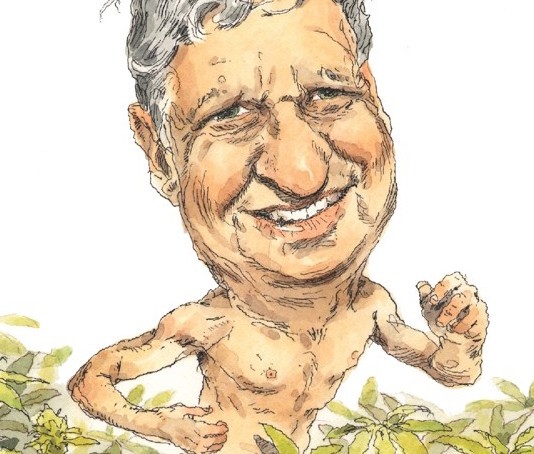
By artist John Cuneo for Molly’s piece, “Pipe Dreamer”
Johnson’s belief in his quixotic project has precedent: his experience backing drug legalization. He has been a vocal advocate since 1999, when, early in his second term as governor, he declared the drug war an expensive failure. Though New Mexico was by then accustomed to his unorthodox leadership style—he vetoed hundreds of spending bills and periodically left town to participate in grueling Ironman triathlons—his announcement came as a shock, and his approval rating quickly plummeted 30 points. By the time he left office in 2003, though, it had largely rebounded. His old supporters hadn’t come around; rather, he’d gained different ones—young people and liberals who had come to see him in a newly progressive light.
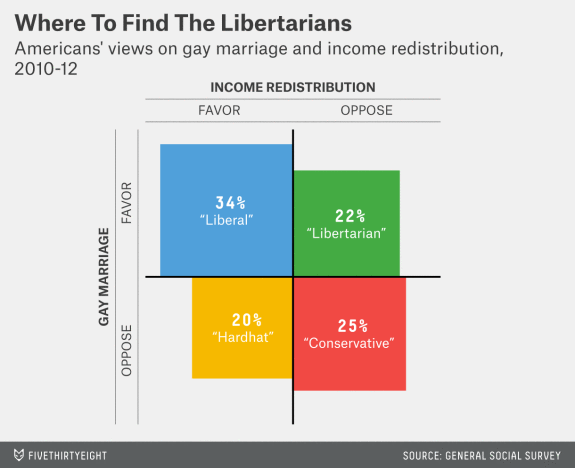
Does this make any sense? Why should views on (for example) gay marriage, taxation, and U.S. policy toward Iran have much of anything to do with one another? The answer is that it suits the Democratic Party and Republican Party’s mutual best interest to articulate clear and opposing positions on these issues and to present their platforms as being intellectually coherent. The two-party system can come under threat (as it potentially now is in the United Kingdom) when views on important issues cut across party lines.
That’s bad news for [libertarian-esque] candidates like Rand Paul. Nonetheless, the rigidly partisan views of political elites should not be mistaken for the relatively malleable and diverse ones that American voters hold.
Indeed, Rand Paul fizzled early in the GOP primaries. Nick Gillespie, the editor of the libertarian magazine Reason, contends that Paul “got his teeth kicked in” by Trump “because he refused to stick to [libertarian] principle.” And since then, Paul proved himself to be an embarrassment to libertarianism after endorsing Trump last week. Here’s Reason’s Robby Soave:
The libertarian-leaning Republican [Paul] isn’t wrong about Clinton’s awfulness. But Trump—a thin-skinned lunatic who peddles conspiracy theories, encourages violence and censorship, prefers big government, and loathes the free market—is just as bad, and arguably much worse, including and especially from a libertarian perspective. There is virtually no issue where Trump’s views align with libertarianism (his continued support for eminent domain, a policy that virtually no one else in the GOP or libertarian movement supports, is perhaps the best example of this). And while it’s true that some conservatives can be counted on to advance libertarian positions on a handful of issues, this doesn’t apply to Trump, because he isn’t even a conservative. He’s a member of the authoritarian populist right—a segment of the population that shares nothing in common with libertarianism.