Why the Postal Workers' Union Sided With Bernie Sanders Over Hillary Clinton
Within the movement, the pragmatists and purists are starting to take sides.
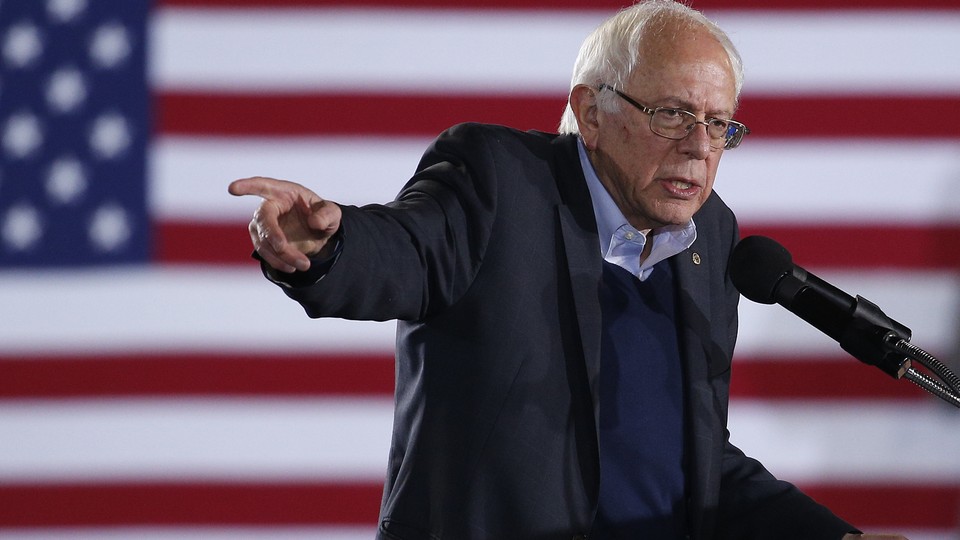
Bernie Sanders snagged the endorsement of the 200,000-member American Postal Workers Union on Thursday, giving the Vermont senator a much-needed boost in his insurgent bid to defeat Hillary Clinton, who leads the race for labor support.
On the surface, the union’s backing is hardly surprising: Sanders has been a longtime defender of the U.S. Postal Service and has used his perch in the Senate to fight cuts to mail service and block the confirmations of federal nominees who have supported privatizing the agency.
The endorsement is, however, revealing of a larger split in organized labor, driven, in part, by Clinton’s long and complicated relationship with unions. Now, as various factions of the movement weigh where to put their support in the Democratic primary, a wedge is appearing between the purists and the pragmatists.
Before Thursday’s announcement, Mark Dimondstein, president of the postal workers’ union, told me: “Myself and a lot of other people are sick of business as usual. And we interpret her history and her campaign as more business as usual. And business as usual isn’t helping the labor movement or the working class survive or thrive.”
On the other side of the debate are pragmatists who see Clinton as more electable and want to secure a seat at the table in a Democratic administration. As Randi Weingarten, head of the American Federation of Teachers, put it: “You actually have to have a plan to win, not just have great values.”
So far, the pragmatists are winning. A dozen national unions have endorsed Clinton, including the AFT and the American Federation of State, County, and Municipal Employees, each of which has 1.6 million members. Sanders, however, has the backing of two major unions—the postal workers and the 185,000-member National Nurses United—and his campaign touts scores of supporters within the ranks of labor groups who are either undeclared or backing Clinton.
Notably, neither side wants what is derisively referred to in labor circles as a “third term for Obama.” The president has infuriated many labor leaders by championing the Trans-Pacific Partnership; by instituting the so-called “Cadillac tax” on high-cost health care plans, the kind enjoyed by many union members; and by failing to pass card-check legislation, which would make it easier for labor to organize. (Some of those who have endorsed Clinton are eager to note they backed her in 2008 because they foresaw some of these issues with Obama.)
Perhaps recognizing this, Clinton has moved swiftly in the last month to draw distinctions with the president on labor’s top priorities, including opposing the TPP (which she supported as secretary of State) and supporting repeal of the health-plan tax. How labor interprets her history and her campaign pledges—and how much Sanders can capitalize on doubts about her sincerity—will color the coming weeks and months.
As I wrote last week, Clinton’s relationship with the labor movement has always been complex:
On the surface, Clinton and labor would appear to be strong allies. She would almost certainly be a more pro-union president than any of her plausible Republican opponents. And it’s therefore no surprise that at least 12 national unions have endorsed her. It’s also a near-certainty that she will win a majority of union voters next November.
Yet look a bit closer, and the politics get cloudier. Clinton’s record on labor issues, stretching back many years, is contradictory and difficult to decipher, and organized labor is very far from universally enthusiastic about her candidacy. Sure, most union members will vote for her, but it’s still an open question whether she can gin up the excitement and decisive margins she will need next November among this important constituency.
In recent weeks, Clinton has seemed to sense that she has work to do vis-à-vis organized labor. ... The question is whether these moves can overcome the baseline skepticism that I heard from many union members—especially in Ohio—and resolve what appears to be a split opinion about her within the world of organized labor.
That complexity is reflected in the range of opinions movement leaders express about the Democratic front-runner:
“People appreciate she has certain liberal beliefs and then is very practical and transactional,” said Andy Stern, former head of the Service Employees International Union, which could consider a formal endorsement as early as next week. “Part of changing lives is getting elected.”
Others take a more a skeptical view.
Officials with Unite Here, which represents 270,000 hotel and restaurant workers, say the union won’t consider an endorsement until January—and may not even back a candidate in the primaries. “People are really upset and they don’t think anybody’s really fighting for them,” said D. Taylor, the union’s president. “We want honesty, and we want to know you are going to fight for certain things.”