ExIm Redux: A Sign of Congress Stepping Back From the Brink?
From its creation 81 years ago as an early part of Franklin Roosevelt’s New Deal, through all the decades under Republican and Democratic administrations until about two years ago, the Export-Import Bank had been a presumptively necessary-and-beneficial part of U.S. economic and business strategy. Like the agencies that built highways or sponsored basic research, it was seen by both parties and all presidents as part of the public infrastructure that improved the conditions in which private businesses could operate. Its operating costs have been small and, by some calculations, it has been returning more money to the Treasury than it has cost.
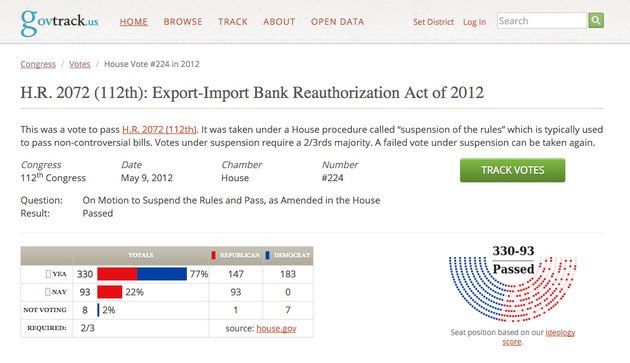
Even in 2012, a House of Representatives already held by the GOP gave landslide approval to ExIm’s three-year reauthorization. That’s what you see in the chart at the top of this page. But since then, an alliance of libertarian-absolutist think-tank figures and anti-government absolutist figures from the Tea Party have kept re-authorization from coming up for a vote in the House (which they knew ExIm supporters would win). That’s what has made the impossibly boring-seeming ExIm showdown actually an illuminating proxy for debt-ceiling fights, government shutdowns, and all other struggles between the radical-change faction of the GOP and its “well, there’s an actual government to run” wing.
And all that, in turn, is why the House vote last night on a “discharge petition” that will force an up-or-down vote on the bank’s itself, and that expected vote today, are markers that parallel the (apparent) agreements on the debt-ceiling and the overall federal budget, as signs that the “governing” wing of the GOP may be reasserting itself.
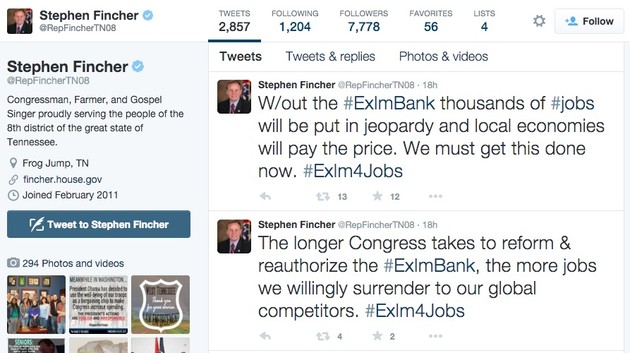
The lineaments of the struggle are laid out in the preceding items you’ll find collected in this Thread. What I find interesting is the recent upsurge in pro-ExIm action by conservative, but not nihilist, Republican leaders. For instance, a recent Twitter stream by the plenty-conservative Republican Rep. Stephen Fincher of Tennessee:
Or an op-ed in the plenty-conservative Orange County Register in California by the plenty-conservative Republican Rep. Mimi Walters, saying that the ExIm standoff was costing real people real jobs.
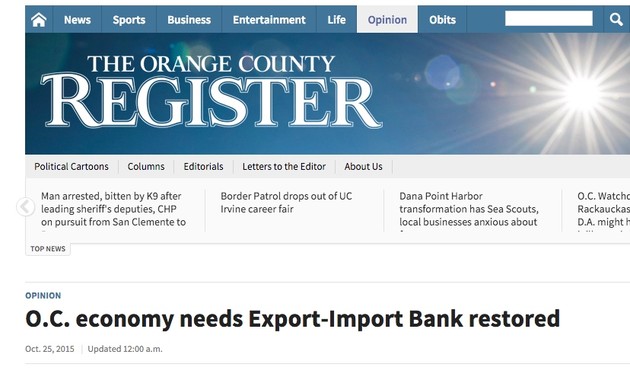
This paragraph from Rep. Walters’s op-ed gets to the heart of the whole dispute:
Some have argued that Ex-Im is unnecessary because the private market will step in to fulfill its role. This is simply a naïve view of export financing. Ex-Im functions in the areas where private financiers are unable to operate. For example, many large, foreign contracts require that the bidder have export credit agency support. Without Ex-Im reauthorization, U.S. companies will be excluded from competing for these contracts, to the detriment of U.S. jobs and economic growth.
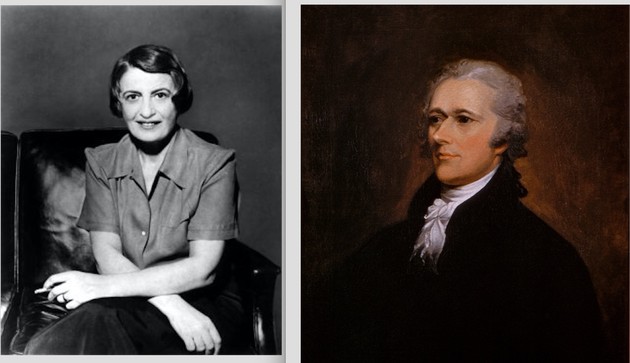
That is: you’ve got your Ayn Rand purist theory, and you’ve got your Alexander Hamilton let’s-cut-the-B.S. real-world practicality. Over the ages the practicality has usually prevailed on such basic operating matters as funding the government, honoring the debt, and providing infrastructure for business through tools ranging from FDIC to ExIm. For the past few years, the absolutists have hijacked their party and with it, sometimes, the nation as a whole.

So all this is why the ExIm fight matters. It’s worth watching to see whether this one little triumph of the reality-based governing faction stands as an outlier or as the start of a trend.