Pushback on False Equivalence and the Filibuster
In response to an item earlier today about the admirable clarity of an NYT story on the current state of the filibuster, two replies.
From a reader in New York:
Agreed that the NYT did a good job on not succumbing to the usual false equivalence problem. But even that story didn't quite convey the full insanity of the Senate's procedures.
The procedural vote on April 16 is to invoke cloture on the motion to proceed, i.e., to decide whether to stop debating and vote on whether to start debating the Buffet Rule bill. So it is not "a procedural vote on April 16 that will decide whether the Senate will even debate the bill," it's actually a procedural vote that will decide whether the Senate will even decide (i.e., vote) whether to debate the bill. World's Greatest Deliberative Body, indeed.

I appreciate that you are trying to bring sanity to the language of political reporting, insofar as the Senate's 60-vote supermajority is concerned, but I'm not sure why you given Mitch McConnell the dubious distinction of calcifying this undemocratic practice into custom. It seems to me that Harry Reid, [right] as Senate Minority Leader, institutionalized the threatened filibuster on various Bush 43 appointees and that when Trent Lott threatened to change the Senate rules, it was Reid and the Democrats who pronounced this as going "nuclear" (or, given the times, should I say "nukular.")?
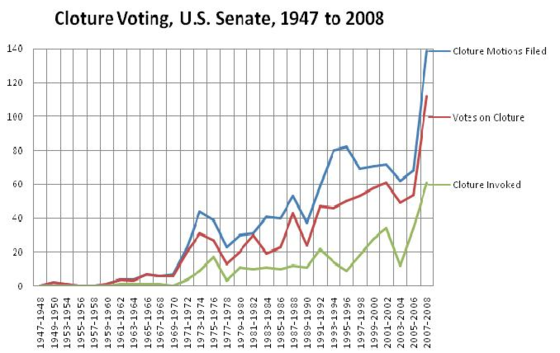 As a matter of sheer math, it's indisputable that the frequency and proportion of filibuster threats rose sharply starting in early 2007, when the Democrats regained control of the Senate and Mitch McConnell, rather than Harry Reid, became the minority leader. To think otherwise is ... wait for it ... false equivalence! That's what's shown in the graph on the left. But I recognize (a) that when the Democrats are back in the minority, they will re-apply the tactics that have been used on them these past few years, perhaps with a vengeance,* and (b) it doesn't help to make this about a particular politician. So I will continue referring to the de facto enactment of universal filibuster rules as "the 28th Amendment,"** but I won't refer to specific minority leaders any more, and will remove that reference from the preceding post.
 __
* A number of interesting messages have come in on whether the Democrats will, and whether in their own political interest they even should, re-apply these tactics whenever the Republicans regain control.
** For those joining us late: this is a little joke. There are 27 "real" amendments to the Constitution.
About the Author

James Fallows is a contributing writer at The Atlantic and author of the newsletter Breaking the News.