If Hungary Can Do It
Viktor Orbán offered a model for antidemocratic rule, one admired by Donald Trump and other world leaders. What does his stunning loss after 16 years in power mean?
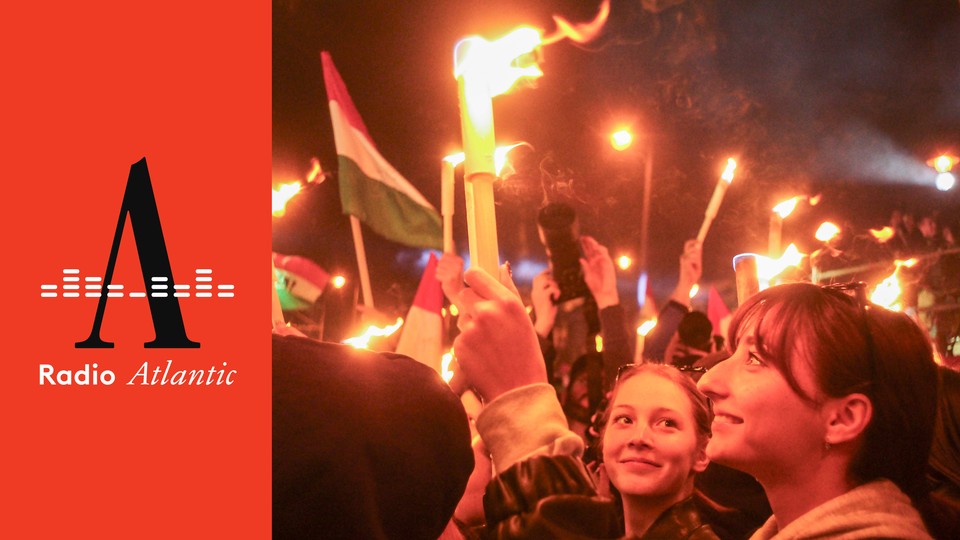

Subscribe here: Apple Podcasts | Spotify | YouTube | Overcast | Pocket Casts
The leader of a democracy overpowers many of the country’s institutions that could oppose him: the media, the universities, the courts. He encourages rich allies to buy big media companies and hobble independent journalism. In its place, he tells the population lies, about immigrants, the economy, and who their real enemies are. He does all of this openly and proudly, prompting other aspiring autocrats to emulate him.
This is a description of Viktor Orbán, the longtime prime minister of Hungary who lost reelection this past weekend. Besides being one of his key emulators, Donald Trump is also an enthusiastic supporter. Vice President Vance stumped for Orbán during the Hungarian election, and MAGA intelligentsia have pilgrimaged to Budapest for inspiration on how to reshape national institutions and the culture in their own image.
Until the day they voted, many Hungarians found it hard to believe that Orbán would be ousted, despite what independent polls showed. Autocrats have a way of seeming inevitable. Nonetheless, Orbán lost to opposition leader Péter Magyar by too large a margin to paper over with propaganda. Magyar had appealed to the people directly, traveling the country, avoiding culture-war issues, and talking mostly about economic hardship. Orbán swiftly conceded, and overnight, Hungarians were dancing in the streets.
Whatever happens next in Hungary, Orbán’s downfall contains obvious warnings for MAGA and Trump: Propaganda has its limits. Concerns about affordability are real. True democracy can reassert itself in a single election. Reality can bend only so far. In this week’s Radio Atlantic, the Hungarian journalist Veronika Munk shares her view from the streets of Budapest. And the Atlantic staff writer Anne Applebaum, who covers autocracy, democracy, and Europe, explains why the election is a turning point for world politics.
The following is a transcript of the episode:
[Music]
Hanna Rosin: Hi!
Veronika Munk: Okay. Nice to meet you! Hi.
Rosin: Nice to meet you.
Rosin: Last weekend, Hungarian journalist Veronika Munk—
Munk: —and I’m a journalist at Denník N.
Rosin: —was in Budapest covering the election between Prime Minister Viktor Orbán and the opposition leader, Péter Magyar.
Orbán had been in power for the past 16 years, had changed the country from the top down—
Munk: They changed everything in the country to favor themselves.
Rosin: —the media, universities, the courts—in a way that certain global leaders who aspired to that kind of grand power admired and marveled at.
President Trump: And he’s done a fantastic job, is a very powerful man within his country, but he’s also beloved. They love Viktor. And people that know him—
Rosin: Vice President J. D. Vance—
Vice President Vance: I got a good signal here.
Rosin: —had even come to the country to give a stump speech for Orbán.
Vance: It’s ringing. It’s progress.
Rosin: Trump phoned it in from home.
Vance: Hello, Mr. President, how are ya?
Trump (on speakerphone): Hi. Hey, J. D., could you give me a second to just—
[Sounds of crowd cheering]
Rosin: And then on Sunday night, as the election results started to roll in—
Munk: It was a record turnout, like, absolute historic high.
Rosin: —Veronika almost didn’t believe what she was seeing.
Munk: Even for me, who is a news junkie and this is my profession, it was super hard to believe that it can happen.
It felt like the Orbán regime will be always here and he will always be ruling the country.
But I was wrong.
George Stephanopoulos (from ABC’s Good Morning America): Back overseas, in a major defeat for President Trump’s closest ally in Europe, Hungarian voters ousted longtime Prime Minister Viktor Orbán, who was also close to Russia’s Vladimir Putin.
[Sounds of chanting]
Munk: I was on the streets of Budapest. I was in the middle of the mass. I’m sure that you saw the pictures, that thousands of Hungarians were dancing and celebrating and crying on the streets, hugging each other—
[Sounds of crowd]
Munk: —which itself was a really, really interesting experience because the Hungarian society is quite closed in a sense that it’s really hard to see people to dance and to hug each other.
I was 11 years old when the system change happened in 1990, and I still remember that the adults were really happy. But it was uncomparable on the streets of Budapest on Sunday night because I was walking with my microphone talking to people and I got so many hugs from people who I had never met.
[Music and sounds of crowd]
Munk: It was really something. Everybody was crying, and it was a really, really one-of-a-lifetime kind of experience.
[Audio from Petér Magyar’s speech]
Rosin: So you’re just walking around the streets, and people are just dancing and hugging and crying?
Munk: Yes, that’s correct. It was a festival feeling.
There were children and dogs and elderly people.
Rosin: (Laughs.)
Munk: So, yeah, it was like a really big happy festival. Even the future government members themselves were dancing while they were announcing they’re winning.
Rosin: There is this viral video of your health—
Munk: Yes. (Laughs.)
Rosin: —minister dancing. (Laughs.) And it’s totally out of context for us. We just see him sort of dancing across the stage.
Munk: Yeah.
Rosin: You know?
Munk: Yeah, but basically, he was reacting, I think, for the vibe that he was seeing from the thousands of people in front of him. But at the same time, he is a dance king, right?
Rosin: (Laughs.)
Munk: So our future health minister appears to have these very good moves.
[Sounds of cheering]
[Music]
Rosin: I’m Hanna Rosin. This is Radio Atlantic. The idea that a democratic country can be slowly co-opted by a leader with proud autocratic leanings and then one day, poof, it ends, there are obvious lessons for the U.S. in that.
We will have Atlantic staff writer Anne Applebaum on in the second half of the show to talk through those lessons. But we’ll start from the beginning.
One day, 16-plus years ago, Hungary was just a democracy and Veronika’s life was much like any journalist working in a free society.
Munk: Then it was very similar, like American journalists experience: When we ask questions, the leaders of the authorities or the politicians or the hospital directors answered. I did have all the important phone numbers in my phone as a political reporter, and I haven’t got any problems to get into a press conference or asking questions and getting answers for it. And that started to stop after 2010.
Rosin: That was the year Orbán came into power for a second time. He had blamed the media for his previous loss. So when he was elected as prime minister again in 2010—this would be the start of his 16-year reign—he was determined to do things differently.
Munk: First, the ministers started to stop answering their phones and even answering any questions by email. So generally speaking, access to information became extremely hard.
And the second thing was that they started to bought up media companies.
Rosin: They bought up media companies, people with a lot of money who were very pro-Orbán.
Munk: It was not like a red phone that they put some loyalist in every independent newsrooms, and they called on the red phone and said that you should always write nice things about Orbán. But they basically bought up the whole companies. (Laughs.) And actually, that was what happened with me.
Rosin: Veronika worked for 18 years at Index, which was one of the biggest independent news sites in Hungary. She was then its deputy editor in chief.
Munk: A new management came, and the new management started to restructure our independent operation. And they fired my boss, the editor in chief.
Reporter (from Al Jazeera English): Last month, he publicly raised the alarm over political interference in the outlet’s operations.
Munk: We thought that if we are not able to operate independently, if we are not able to work with those colleagues that we consider professionally qualified and someone from the outside would like to drive us to a direction that we don’t want, we decided to quit, all of us, on a single day on the summer of 2020.
Reporter (from Al Jazeera English): More than 80 journalists from the country’s most-read news site, called Index, have resigned from their jobs.
Munk: It was a very, very sad moment. It was the easiest and the hardest decision of my life.
Reporter (from Al Jazeera English): —Prime Minister Viktor Orbán, who once branded it a fake-news factory. One of his allies recently—
Rosin: Now, years later, Veronika saw Orbán’s defeat on Sunday as a lesson. As much as Orbán wanted to control the narrative—
Munk: He wanted to own the media, wanted to reshape the information provided about reality itself.
Rosin: —he just couldn’t do it anymore. The people had had enough: enough inflation, enough corruption, enough division, enough distorted reality.
Munk: And I think it is a valuable lesson for every political leader, every autocrat, that propaganda and democracy are incompatible. You can have one or the other, but never the both.
Rosin: It does seem like a beacon of hope for liberal democracies around the world that are worried about tipping into illiberal democracies. Does it feel that way to you?
Munk: I believe so, that it is a crucial moment for other similar populists or autocrats, because even 16 years of ruling can be demolished in a day.
[Music]
Munk: It’s a very good message for the other populists that people will raise their voices, especially new generation will raise their voices if they don’t like what they see.
[Sounds of chanting]
Munk: It seems that Hungarians started to feel that they need to raise their voices, they need to step up for themselves on a democratic way, casting their votes and sending out the autocrat from the country.
So I think the biggest lesson is, if you’re slightly not agreeing to the politics or it affecting your life badly, don’t stay silent. Be critical and step up for yourself.
[Sounds of cheering]
Rosin: So if a movement that spanned years, more than a decade, could crumble and fall in a single night, what might that mean for other countries that are teetering on the edge—particularly one that, say, has a big vote in November?
After the break, we talk to staff writer Anne Applebaum, an expert on the rise of authoritarianism, democracy, and European politics.
[Break]
Rosin: Anne, welcome back to the show.
Anne Applebaum: Thanks for having me.
Rosin: You’ve been reporting on Orbán’s Hungary for years. You called his election loss a “real turning point.” What do you mean by that—a turning point for what?
Applebaum: Although Hungary is a very small country, under 10 million people, in Central Europe, it came to have under Viktor Orbán an outsize significance. And that’s because Orbán, although democratically elected, although the leader of a member of the European Union and NATO, set out to build what he himself called an “illiberal” regime. So he became the first leader of a European democracy who said, I want to have a different kind of state.
And he then began to export this model—in other words, to say, This is the way to do politics going forward. He had a particular form of propaganda that he used to justify it: He told Hungarians they were under threat; they were in great danger. Initially, it was from immigrants, who were supposedly diluting the blood of the Hungarian nation. Later, it was from the degenerate gender policies of the West. And he created this idea that he was fighting against some kind of modernity.
And that model of doing politics spread and was copied and was emulated by a lot of other people, including by a lot of Americans.
Rosin: Right, so how did it influence the U.S.? I remember you wrote a story—I think it was last year—“America’s Future is Hungary,” which is a very strong statement. So what similarities were you noticing? I think that was in March, so that’s about a year ago.
Applebaum: The influence was very direct and specific. Hungarians came to Washington and Americans went to Hungary to learn how they did it.
The leader of the Heritage Foundation described Orbán not just as a model, but as the model for going forward. And many aspects of what the second Trump administration did were copied from the Hungarians.
And so for example, the most obvious one is the takeover of the bureaucracy, the firing of state employees, the conversion of state employees from neutral people who are promoted based on merit to party hacks, which is part of what Trump and his people are trying to do, most obviously in the Justice Department and the FBI, but in all branches of government. This was a direct copy of what Orbán did.
And so they see him as a model, and they talk about him as a model. It’s not a kind of secret or underground movement. He was an open source of ideas for the illiberal and even autocratic part of the American MAGA movement.
Rosin: I don’t think I realized the degree to which Orbán innovated some of these ideas, like even the term illiberal democracy, because it’s not exactly autocracy as we have in our imagination. It’s something in between. We spoke to a Hungarian journalist who described it wasn’t exactly like a takeover of the Hungarian media. It wasn’t literally controlling what people can and can’t see on the internet. A lot of it was more rich allies buying up media companies. Because I think when you understand that gray zone, you start to see the similarities between what’s happening here more closely.
Applebaum: Absolutely, and the media is another area where I am 100 percent certain they are directly copying what Orbán did. They’re using their friends in business to buy up media—whether it’s CBS or whether it’s CNN—in order to shape it so that it’s more aligned with what the Trump administration wants it to be.
That’s the Hungarian model. And you’re right. I didn’t know that Orbán was the very first to do that. In some ways, it’s not that different to what Putin did. But he was the first person to do it from within a democracy and to do it while bragging about it.
Rosin: So let’s move on to the campaign. I remember this phrase—you called Orbán’s campaign the first “post-reality” campaign. What did you mean by that?
Applebaum: Orbán, as I said, tried for many years to create some kind of scare, some kind of threat, an existential fear in Hungarians that was so important that it would justify his attempts to overthrow or change the political system, the political order.
By this year, he’d run out of threats. And so the threat that he was using this year was the threat of Ukraine: a Ukrainian invasion, Ukrainian sabotage, some kind of Ukrainian influence inside Hungary. But the idea that Ukraine was going to invade Hungary was crazy. So Ukraine is not going to invade Hungary. Ukraine is fighting a war with Russia. Ukraine does not wanna invade another country.
And so in order to create this idea, they built this whole world of AI videos with [Ukrainian President Volodymyr] Zelensky snorting cocaine on a golden toilet; also posters of him all over Budapest, all over the country with the headline Don’t let him get the last laugh; sort of sinister versions of him and Ursula von der Leyen, who’s the leader of the European Union, with Péter Magyar, who’s the leader of the Hungarian opposition: They’re the risk. Fidesz, Orbán’s party, we represent safety.
In other words, they were building up this huge threat. And if you took one step back and thought about it for five seconds, you realize that this was nuts. It was not a real threat; it was invented by Orbán. And so when I was there a few weeks ago, the real question that people were asking was: Will people believe in it? Can you invent a completely fictional threat online and in your rhetoric and in your political campaigning? And by the way, he was using the institutions of the state to do it as well, so he sent Hungarian soldiers to guard Hungarian energy installations, supposedly against Ukrainian sabotage.
So they were using the state; they were creating these actions in order to make people afraid. And the question is: Would people believe it? And now we know the answer, which is that they didn’t—or at least not all of them did.
Rosin: Then we see the news that Orbán loses the election and concedes to Péter Magyar, which is not inevitable. It’s certainly not the way it happened here in the 2020 election, so smoothly. What did you think when you saw that?
Applebaum: I was extremely surprised. Even on the day of the voting, people around Orbán in the government were warning of terrorism. They were talking about threats. They were talking about violence. They were talking about the election being stolen. They were preparing verbally, and in terms of propaganda, to announce that the election was false or would be falsified. And that was another topic that came up a couple of weeks in advance of the election as well.
People were ready for all kinds of different outcomes—that the election would be challenged—and there were lawyers who were prepared for that. Just like in the U.S., people were prepared for a challenge, and they were prepared to fight it.
My guess is that Orbán resigned because the gap between the parties was so large and the number of seats in Parliament that the opposition won was so incontrovertible that there was nothing to challenge and that he thought he would’ve lost by challenging it. And my guess is that he and his party will try and make a comeback in other ways. That’s maybe another conversation.
Rosin: Right. I know it’s only been a few days, but it’s impossible not to start asking all the questions of what does this mean. A light went on, and what you want to believe is that a whole lot of things are gonna change. So I just wanna try and talk through with you what this victory actually means.
So we start with a post-reality regime. Did you get a sense of reality reasserting itself? How far do you believe in that?
Applebaum: I do think this election was about reality reasserting itself. Magyar’s campaign was about the Hungarian economy; health care, which is very poor; education, which has deteriorated; corruption, which people feel is everywhere; the poor fiscal status; the bad condition of the government in many different ways.
And the opposition know that the first thing they have to do is begin to address the real problems. One of the things Orbán was famous for was he had these annual television appearances where he would talk about the economy, and he would lie, year in and year out. He would say how great everything was and growth is gonna be very high. He used false statistics. I know economists in Hungary who knew they were false and could show that they were mismeasuring all kinds of things.
And so this is an opposition which says that it will go back to using real statistics and trying to solve problems that are real. And if they just do that, they’ll have an enormous amount of political success, and that by itself would be transformational. Of course, there are a lot of other issues they’re gonna face, which is a captured judiciary, captured intelligence services. All these things have been captured by Orbán’s political party and movement, and they will now have to find a way to pick those things apart. And I know from Poland, which had a similar experience after eight years of rule by the Law and Justice party, who are also a populist authoritarian party, that picking those things apart can be very difficult.
Rosin: I guess where we land is it’s, like, a narrow miracle. There are moments when I think that when a population’s mind is distorted by misinformation, it’s not reversible. So maybe there’s just something about knowing, well, people can actually see reality right in front of them. It can be reversible. People can believe actual data and statistics. And that’s just good to know, even if not everything else is fixed.
Applebaum: Yes, and that was actually one of the themes of the campaign. And one of the ways in which Magyar and his team campaigned, because they didn’t have access to media, they went around the country. And so he went to hundreds of towns and villages. He went to many of them over and over again. He made sure to travel outside of the big cities. And the purpose of that grassroots campaign was to reach real people in real life because he couldn’t necessarily reach them any other way.
Rosin: Another battle of ideas in this turning-point election: the traditionalism versus, I guess what you could call progress, some people would call “wokeness.” Was the election about that—people turning away from that strong clinging to traditionalism, anti-LGBTQ rights, all of that?
Applebaum: The election was absolutely not about that. The point was to walk away from those divisions; don’t get caught in the trap of these culture-war arguments.
He also stayed away from arguing about Ukraine. Even though Ukraine was the main subject of the Orbán campaign, he almost didn’t talk about it, or he tried not to talk about it. Towards the end, especially after there had been all these leaked conversations between Orbán and his foreign minister with their Russian counterparts, then people began to chant at his rally, “Russians, go home.” And that became very important towards the end of the campaign, but mostly Magyar stayed away from that. He stayed away from these polarizing issues. And again, he focused on health, the economy, corruption.
So these are issues that unify people and they don’t divide people, and that was how he ran the campaign.
Rosin: Right. Okay, this has been implicit in a lot of our conversation; now I just wanna make it explicit, which is: What does this mean for the U.S.? How does this reverberate over here, in a country which, as you said, has used Orbán as a model? J. D. Vance went to Hungary; Trump supported Orbán. Do you have a sense of what this might mean for their project of cultural overhaul, which is modeled on Hungary?
Applebaum: I think this offers an important corrective. They believe that what they are doing is inevitable—in other words, they will win, and then nobody will be able to challenge them again. And what the Hungarian election shows is that these systems can end and they can be overthrown by enough people voting, enough people caring, enough people being involved. And I think that will inspire people who dislike what Trump is doing to the American state, whether those people come from the center right or the center left.
It shows that these changes don’t have to last forever. It’s a reminder that nothing is forever. You don’t get to change the American political system and say, Right, we won. It’s over. Democracy ended. And now we run the show indefinitely.
And the Hungarian election, I think, reminds people of that. And that will affect both people in power, and I think it will affect people who are campaigning in the midterms this year and in the presidential election a couple of years down the road.
Rosin: Well, what about, at one level broader, the momentum? One way to tell this story is this election kind of halted the momentum of what seemed like a fast-growing rise of autocracy, illiberal democracy. What do you think about that?
Applebaum: I think this election absolutely halted this sense of forward motion that you had from the European far right, as well as the American MAGA movement. They were acting like this was their time and their moment, and it was just a matter of days and weeks or months before they took control and before they changed everything.
I think that Trump’s war in Iran was a breaking point for a lot of them. It’s very, very unpopular in Europe. Suddenly, it made closeness or proximity to Trump or to MAGA seem less attractive to a lot of European leaders, including on the far right.
And this will serve as a further reminder that you can get too far away from the ideals of democracy and the rule of law that people still believe in in Europe. And I think it will definitely have a chilling effect on the language and maybe even the political momentum of the European far right.
Rosin: I’m so happy to hear this, Anne. (Laughs.) I feel like in the last two years that we’ve had these conversations, this is maybe the first time I’ve heard you feel genuinely optimistic.
Applebaum: (Laughs.)
Rosin: You’re still sounding very professional, but this is a much more positive view than I often get from you, so I’m glad to hear it.
Applebaum: Well, many, many things can still go wrong, but—
Rosin: (Laughs.) Yes, yes.
Applebaum: —we don’t have to talk about them today.
Actually, I saw some Hungarians on social media who, just having these kinds of conversations, people were beginning to say, Well, what if Magyar turns out to be no good, and what if Orbán comes back? And all the Hungarians were saying, Let us have 10 minutes, 24 hours to be happy. Give us this little space and time before we start to worry about what bad things might happen next.
Rosin: Exactly. I wish the same for you, Anne.
Well, thank you so much for joining us today.
Applebaum: Thank you.
Rosin: This episode of Radio Atlantic was produced by Jinae West and Rosie Hughes. It was edited by Kevin Townsend. Fact-checking by Genevieve Finn. Rob Smierciak engineered and provided original music. Claudine Ebeid is the executive producer of Atlantic audio, and Andrea Valdez is our managing editor.
Listeners, if you enjoy the show, you can support our work and the work of all Atlantic journalists when you subscribe to The Atlantic at TheAtlantic.com/Listener.
I’m Hanna Rosin. Thanks for listening.