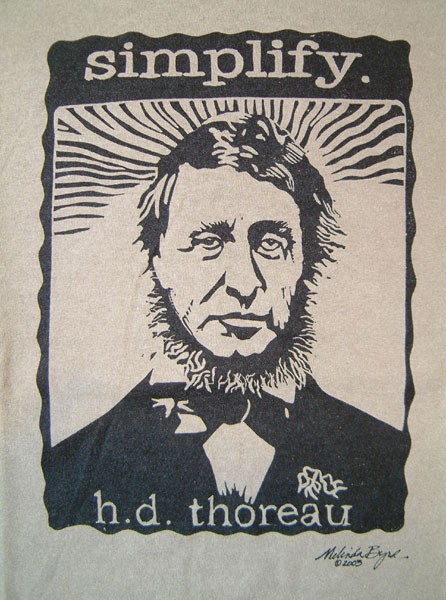
In reply to the ongoing discussion about Thoreau and his contradictions, I’d like to highlight his Journal. When most of us think of Thoreau, we think of Walden and Civil Disobedience and perhaps an essay such as “Walking.” What all those texts have in common, in fact, is his journal—the two million words he wrote over 20-some years and mined continually as he wrote his more formal essays and lectures. There are numerous abridged versions of the journal, which has never been published in its entirety, the latest and, I believe, the best was published by New York Review Books and edited by Damion Searls.
As to Thoreau’s contradictions, which other readers have rightly noted are often our own internal contradictions, I can offer two examples nearly at random, thumbing through my underlined copy of the Journal. On the one hand, we have this (from p. 257, April 13, 1854):
On the evening of the 5th the body of a man was found in the river between Fair Haven Pond and Lee’s, much wasted. How these events disturb our associations and tarnish the landscape! It is a serious injury done to a stream.
And then this (from p. 418, December 3, 1856):
How I love the simple, reserved countrymen, my neighbors, who mind their own business and let me alone, who never waylaid nor shot at me, to my knowledge, when I crossed their fields, though each one has a gun in his house! For nearly twoscore years I have known, at a distance, these long-suffering men, whom I never spoke to, who never spoke to me, and now feel a certain tenderness for them, as if this long probation were but the prelude to an eternal friendship. What a long trial we have withstood, and how much more admirable we are to each other, perchance, than if we had been bedfellows!
I am not only grateful because Veias, and Homer, and Christ, and Shakespeare have lived, but I am grateful for Minott, and Rice, and Melvin, and Goodwin, and Puffer even. I see Melvin all alone filling his sphere, in russet suit, which no other could fill or suggest. He takes up as much room in nature as the most famous.
It would seem that Thoreau, like all of us, could be a moody fellow.
Another reader and Thoreauvian, Corinne H. Smith:
Thanks for asking for responses to the recent Thoreau article printed by The New Yorker. I’ve been a fan of Thoreau ever since I read Civil Disobedience and Walden in high school in the mid-1970s. I put it aside for a while, as real life intervened. But Thoreau was always in the back of my mind.
He returned to the forefront for me in the late 1990s and I began writing about him. I became a licensed tour guide of Concord in 2006. I was the first person do research and travel the route of Thoreau’s 1861 trip to Minnesota. My book Westward I Go Free: Tracing Thoreau’s Last Journey was published in 2012. My forthcoming biography and activity book for middle-graders, Henry David Thoreau for Kids: His Life & Ideas, With 21 Activities, will be released by Chicago Review Press in February 2016, as part of their long-time running “For Kids” series. I give house tours of Thoreau Farm, his birthplace, and contribute to its blog. I’m ALWAYS thinking of Thoreau and his relevance to us and to our world today.
For these reasons, I deliberately did not click on and read the article in The New Yorker. Oh sure, I’ve witnessed its fallout among Thoreauvians on social media—enough to know that it would be a wasted effort to give Ms. Schulz any more of my time than she’s already taken up.
When I was researching Thoreau’s Midwestern trip, I stopped and looked up information in libraries along the route. I found great local resources about the times in these places. In most instances, the people didn’t know Thoreau had passed through their towns. At one specific library, I had a mini-confrontation. I had contacted the special collections person ahead of time. Her name was Maureen. When I walked in, I saw her sitting behind her desktop nameplate. I introduced myself and reminded her that I was here to do some research on Thoreau. Maureen narrowed her green eyes at me, and her thick auburn hair seemed to flare out and fairly ignite into flames.
“I don’t like what he said about the Irish,” she growled. [CB note: background on those Irish comments here.] I expected her to quickly recant and smile at me instead, since I was not him. She didn’t. Oh my. She was serious. And I was her enemy’s representative.
“I can’t apologize for Henry,” I said. “He was merely a man of his times.” I certainly didn’t want to get into a big discussion about how Americans always look the lowest upon the last ethnic group of immigrants to come ashore. In Thoreau’s day, it happened to be the Irish.
We dug into the files together. For the next hour or more, I kept Maureen’s attention on the history and culture of her city in the 1850s-1860s. I didn’t dwell on Thoreau at all. And I got great information that day, in spite of her surly greeting.
Only after I left, did I think back to her comment, “what he said about the Irish.” What was she referring to? Did she even know? If I had been quicker of thought, I could have told her that Thoreau had a good relationship with the Irish railroad workers. He even bought one of the leftover rail-side shanties from one of them, and used it as the framework for his Walden house.
But no. Nothing I would have said would have changed Maureen’s mind. Her ties to her ancestry wouldn’t allow it.
Those of us on the Thoreauvian frontlines encounter such attitudes on a regular basis. We do our best to correct or to contextualize the stereotypical fallacies—no, he wasn’t a hermit (he was an introvert, let him alone, please); no, Emerson didn’t go to the jail and ask him why he was in there, etc. (that’s only an excerpt from the 1971 fictional play “The Night Thoreau Spent in Jail”); and yes, he probably DID take his laundry home for his mother or their servants (perhaps, young Irish girls) to do. What 19th-century man would have done otherwise? And why should we care WHO did his laundry? Who did Hemingway’s? Twain’s? Fitzgerald’s? Or today, Garrison Keillor’s, for that matter?
“Never waste your time trying to explain who you are to people who are committed to misunderstanding you.” ~ Dream Hampton
A final reader is Michael Berger, PhD, a member of the Thoreau Society Board of Directors:
Something is askew in Kathryn Schulz’s readings of Walden and of Thoreau. To see what it is, let us consult the person who knew Thoreau as well as anyone, Emerson.
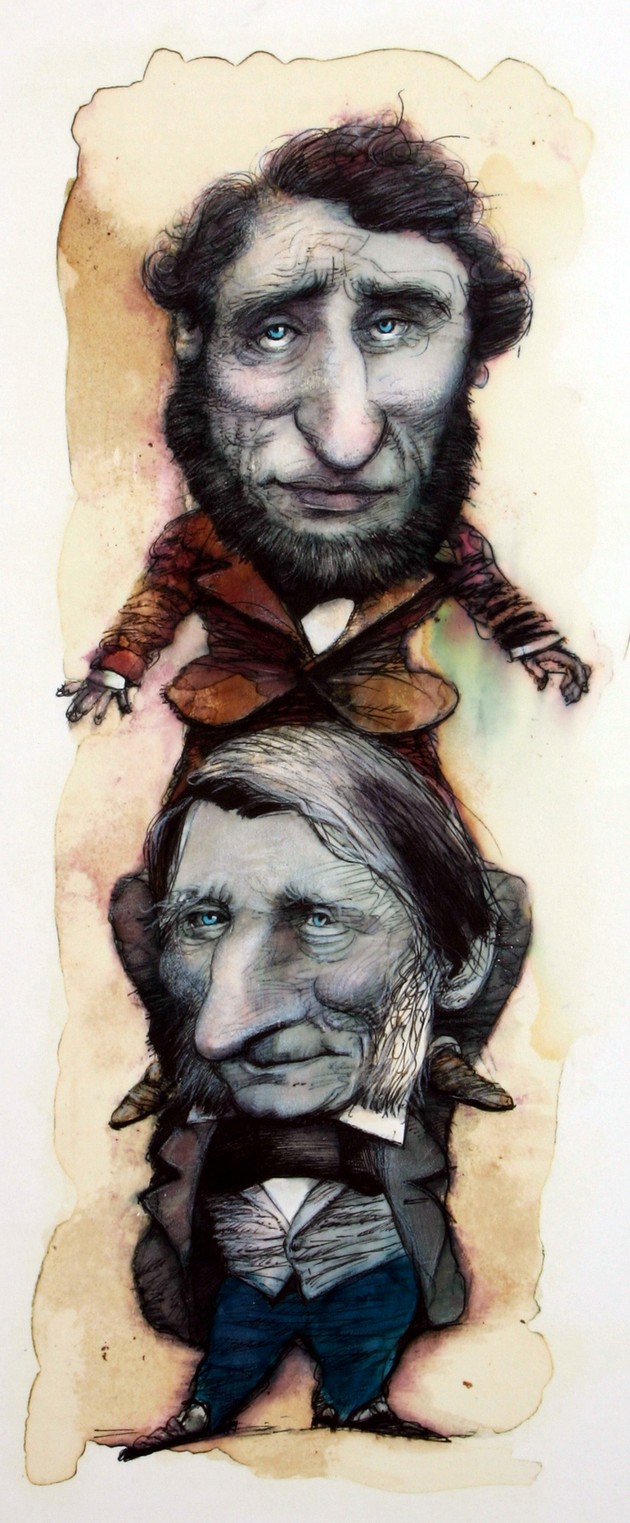
The illustration for Schulz’s piece, depicting Thoreau neck deep in pond water, is a perfect one around which to turn both her story and this rebuttal, for Emerson in his journal did vent in exasperation, “My Dear Henry, A frog was made to live in a swamp, but a man was not made to live in a swamp.” Yet, Emerson, in his senile dotage, also inquired of his wife Lydian, “What was the name of my best friend?” And she knew who he meant.
Likewise, moving accounts of Thoreau’s last days show that his friends and townsfolk gathered to him in affection. The schoolchildren of Concord, many of whom knew him as a dear mentor, were given the day off from school on the day of his funeral, and, as Walter Harding has noted, “more than three hundred of the town’s four hundred school children walked in [the funeral] procession.” Daniel Shattuck, who was a local critic of Thoreau, estimated his life as “one of singular purity and kindness.” Wherefrom comes the sense of the man’s kindness, which is absent in Schulz’s portrait? The affection that accompanied Thoreau to the grave would have been impossible toward the mere misanthrope Schulz paints. There must have been something else to draw such warm regard.
The topper that shows how far Schulz has missed her target is her claim that Thoreau was without humor. Such a characterization would have seemed strange to many an interlocutor who met the sauntering surveyor and spent an afternoon’s interlude cracking wise and joking with him, such as his friend the local farmer Edmund Hosmer. Her remark also would have befuddled the audience at Thoreau’s January 1850 lecture on Cape Cod before the Concord Lyceum, when, in Emerson’s words, people in the audience “laughed until they cried.”
What Thoreau’s townsfolk knew about the heart of the man, crabbed in some aspects though he may have been, readers have plumbed in his writings as well, leading me to wonder whether Schulz might not be missing an essential something more warmly human in both the man and the book. Contrary to Schulz’s assumption that Thoreau’s sojourn at Walden Pond was a gesture of feigned primitivism, Thoreau did not represent his outpost as a wilderness redoubt; he acknowledged his ongoing connection to the village. The cabin was a writer’s retreat, where Thoreau drafted his first book, A Week on the Concord and Merrimack Rivers, as an elegy to his beloved brother John, who died in Henry's arms, and whose death so traumatized Thoreau that he experienced sympathetic lockjaw symptoms.
After leaving the pond, Thoreau continued to live a deliberate life according to principles articulated in Walden. Living in his Main Street home, he developed a craft as the preeminent local surveyor, working only several weeks out of the year, to subsidize his deliberate daily reading, writing, and walking, which resulted in, among other things for which one can be grateful, the several hundred charts of phenological data now being relied upon to measure the exact number of days by which Concord area flora are budding and flowering earlier in the Spring. As our globe warms, Thoreau’s data are helping to measure the problem, and a fairer reading than Schulz gave of his call to deliberate living can also help us to chart solutions.