



 Go to "As I Ebb'd with the Ocean of Life," with readings by Frank Bidart, Marie Howe, and Galway Kinnell recorded specially for Atlantic Unbound.
From The Atlantic's archives:
"Bardic Symbols," by Walt Whitman (April, 1860)
The earliest published version of "As I Ebb'd with the Ocean of Life."
"Leaves of Grass" (January, 1882)
An unsigned review of the 1881 edition.
"Reminiscences of Walt Whitman," by John Townsend Trowbridge (February, 1902)
A memoir of the author's friendship with the bard from Brooklyn, which considers Whitman's unique place in American literature.
From Atlantic Unbound:
Flashback: "America's Bard"
A collection of writings by and about Walt Whitman, the free-spirited poet who championed democracy and America.
Discuss this feature in the Books & Literature conference of Post & Riposte.
Go to Atlantic Unbound's Poetry Pages.
 |  |
At some point in late 1855 or early 1856, Walt Whitman wrote this terse, disheartened note to himself:
Everything I have done seems to me blank and suspicious. -- I doubt whether my greatest thoughts, as I supposed them, are not shallow -- and people will most likely laugh at me. -- My pride is impotent, my love gets no response. -- The complacency of nature is hateful -- I am filled with restlessness. -- I am incomplete.
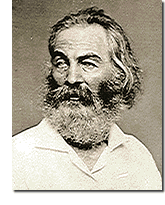 |
| Whitman, c. 1862 |
In "As I Ebb'd with the Ocean of Life" (1881) -- first published in The Atlantic Monthly (in April, 1860) as "Bardic Symbols" -- Whitman confronts the sickening prospect that in publishing Leaves of Grass he has made a fool of himself. Chastened references to Leaves -- especially "Song of Myself" -- abound in the poem. The poet who had extolled "the blab of the pave" is "aware now that amid all that blab whose echoes recoil upon me I have not once had the least idea who or what I am." The ambidextrous lover once "mad to be in contact" with the world's body now stands "baffled, balked, bent to the very earth." And in lines so visceral James Russell Lowell would not have them in The Atlantic, the Whitman who had insisted that "to die is different from what any one supposed, and luckier" now invites his readers to face death's rotting iridescence: "See, from my dead lips the ooze exuding at last,/ See, the prismatic colors glistening and rolling."
A telling contrast between "Song of Myself" and "As I Ebb'd" emerges in the latter poem's conclusion. Everyone who has absorbed and been absorbed by "Song of Myself" remembers the eerie intimacy its last passages convey: "Listener up there," says a voice that grows more confidential as it bids us adieu, "Look in my face while I snuff the sidle of evening." The concentration of direct address and imperative in these last sections creates the sense that the book in our hands is speaking to us. And then there's Whitman's insouciant see-you-later: "I bequeath myself to the dirt to grow from the grass I love,/ If you want me again look for me under your boot-soles." Compare these lines to the last of "As I Ebb'd," in which the Whitmanian "I" disperses into a bewildered "We, capricious, brought hither we know not whence, spread out before you,/ You up there walking or sitting,/ Whoever you are, we too lie in drifts at your feet." As ruthlessly as Yeats in "The Circus Animals' Desertion," Whitman interrogates his poetry, and finds it wanting.
There is another emotional source to this poem -- less immediately apparent but no less authentic. Whitman's father died just days after the publication of Leaves of Grass, and one of its poems (later titled "There Was a Child Went Forth") included these tense lines: "The father, strong, self-sufficient, manly, mean, angered, unjust,/ The blow, the quick loud word, the tight bargain, the crafty lure." In the third section of "As I Ebb'd," Whitman personifies and calls out to "Paumanok" (Algonquian for Long Island) as the paternal counterpart to the maternal ocean:
I throw myself upon your breast my father,These are among the poem's more awkward lines, yet they're also among its most resonant, creating a kind of flashpoint for Whitman's obsessions: his nostalgia for the terra firma of his birthplace; his awe before the erratic, sometimes dangerous "self-sufficiency" of his father; his desperate cry for rescue from the wreck of the hopes he'd invested in Leaves of Grass (a failure doubly painful because of its proximity to his father's death). "Answer me something," the speaker demands, directing his plea to that absent father and -- also in the figure of Paumanok -- to the nation that had met his embrace with indifference.
I cling to you so that you cannot unloose me,
I hold you so firm till you answer me something.
Kiss me my father,
Touch me with your lips as I touch those I love,
Breathe to me while I hold you close the secret of
the murmuring I envy.
Of course, "As I Ebb'd" isn't just a poem of personal desolation. If its more willful statements don't manage to universalize Whitman's emotional nadir, its densely textured images do, culminating in one of his most powerful visions: Paumanok as the compost heap on which that "fierce old mother" deposits her sea drift. There is, perhaps, an affirmative undertow in the sheer variety of the final stanza's catalogue of "little corpses," not to mention in its intricate braiding of detail and abstraction:
Tufts of straw, sands, fragments,So perfect is the pitch here that one might persuade oneself that these lines embody the athletic Whitman who could make one song out of many songs -- of life, of sex, of freedom, of death. But go back to the lines missing from the version published in The Atlantic: "As I Ebb'd" is a poem of dying, not of death. When Whitman's imagination went so far as to picture the deliquescence of his own body, it was too much for James Russell Lowell. The greatness of those lines is that, after 150 years, they're almost too much for us.
Buoy'd hither from many moods, one contradicting
another,
From the storm, the long calm, the darkness, the swell,
Musing, pondering, a breath, a briny tear, a dab of liquid or soil,
Up just as much out of fathomless workings fermented
and thrown,
A limp blossom or two, torn, just as much over waves
floating, drifted at random
--Steven Cramer
Steven Cramer is the author of three books of poetry, most recently Dialogue for the Left and Right Hand (1997). He teaches literature and writing at Bennington College.
Copyright © 1998 by The Atlantic Monthly Company. All rights reserved. Whitman photo by Mathew Brady, used courtesy of the Walt Whitman Hypertext Archive at the University of Virginia.
 |
 |
 |
 |
 |
 |