

98.10.21
Liberty and Linux for All
Microsoft's worst nightmare may not be a courtroom in Washington, D.C.
98.10.15
Everything for Sale
In the world of online auctions, anything (and everything) goes on the block.
98.10.08
The Numbers Game
Baseball's days as our national pastime may be numbered.
98.09.30
Neurodiversity
On the neurological underpinnings of geekdom.
98.09.23
It's the Medium, Stupid
Amidst all the clamor over the Starr Report, one Webzine reminds us what journalism on the Net was supposed to promise.
98.09.16
Psychotherapy on the Net
Boldly going where Freud never went.
98.09.10
Celebrity Trades
With the market in turmoil, the only safe bets may be at the box office.
For more, see the complete Web Citations Index.
From The Atlantic's archive:
"Denmark Vesey," by Thomas Wentworth Higginson (June, 1861)
An account of the "Denmark Vesey conspiracy" of 1822, a planned insurrection that, had it not been betrayed, would have been the most extensive uprising of slaves in American history.
"Reconstruction," by Frederick Douglass (December, 1866)
"Slavery, like all other great systems of wrong, founded in the depths of human selfishness, and existing for ages, has not neglected its own conservation. It has steadily exerted an influence upon all around it favorable to its own continuance."
"The Freedmen's Bureau," by W.E.B. Du Bois (March, 1901)
"The problem of the twentieth century is the problem of the color line; the relation of the darker to the lighter races of men in Asia and Africa, in America and the islands of the sea."
From Atlantic Unbound:
Flashback: Black History, American History (February, 1997)
Classic essays by Booker T. Washington, W.E.B. Du Bois, and Martin Luther King Jr., originally published in The Atlantic Monthly.
October 28, 1998
 If you've ever been to the site of a great battle -- Gettysburg, say, or the Normandy beaches -- and tried to imagine the carnage that took place where you stand, you know the gulf that exists between the lived experience of a terrible historical reality and the ability of later generations to envision it and feel it. This past week I was reminded of this gulf as I watched two of the latest envisionings of America's most prolonged (and by now nearly unimaginable) national trauma: the ordeal of slavery.
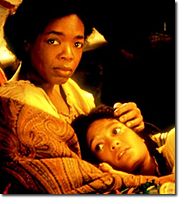 |
| From Beloved |
It seems notable that some of the most disturbing images seen on movie screens in the past year -- scenes of intense human suffering and violence -- were the results of two filmmakers' serious attempts to convey the visceral, physical reality of American slavery and its effects. Spielberg's depiction of the Middle Passage in Amistad and Demme's nightmarish visions of slavery's brutality in Beloved will outlast the strong individual performances in both films. Such is the power of the medium that the nuances of language and character are overwhelmed by the sheer visual force of what appears on screen. And yet in both cases, the knowledge that what we're watching is historical fiction, however faithful to its sources, undermines the immediacy of the images. We feel them, but do we believe them?
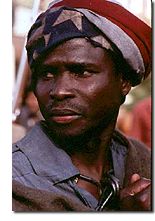 |
| From Amistad |
The Africans in America Web site, on the other hand, manages something that neither feature films nor television documentaries can achieve -- it brings readers into direct contact with the primary texts of American slavery. With its enormous "resource bank" of historical documents and personal narratives, the site adds to (and in many cases overlaps with) the large number of primary sources documenting slavery that now exist on the Internet. Substantial collections of slave narratives, for example, can be found at the University of North Carolina's Documenting the American South site, the University of Virginia's online anthology of WPA interviews with former slaves from the 1930s, and a useful collection at the University of Houston. In addition, the Museum of America and the Sea, in Mystic, Connecticut, has put together an impressive site exploring the Amistad revolt, with a library of more than 500 documents. These sites are just the beginning.
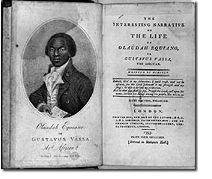 |
| Olaudah Equiano's autobiography, 1789. |
--Wen Stephenson
Join the discussion in the Technology & Digital Culture conference of Post & Riposte.
Wen Stephenson is the editorial director of Atlantic Unbound.
Copyright © 1998 by The Atlantic Monthly Company. All rights reserved.
 |
 |
 |
 |
 |
 |