


Return to the Table of Contents.
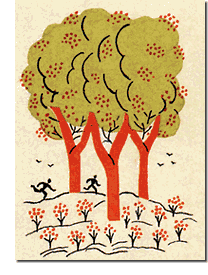
 NCIENT nomadic cultures tended to leave organic wastes behind, restoring
nutrients to the soil and the surrounding environment. Modern, settled
societies simply want to get rid of waste as quickly as possible. The potential
nutrients in organic waste are lost when they are disposed of in landfills,
where they cannot be used to rebuild soil; depositing synthetic materials and
chemicals in natural systems strains the environment. The ability of complex,
interdependent natural ecosystems to absorb such foreign material is limited if
not nonexistent. Nature cannot do anything with the stuff by design:
many manufactured products are intended not to break down under natural
conditions.
NCIENT nomadic cultures tended to leave organic wastes behind, restoring
nutrients to the soil and the surrounding environment. Modern, settled
societies simply want to get rid of waste as quickly as possible. The potential
nutrients in organic waste are lost when they are disposed of in landfills,
where they cannot be used to rebuild soil; depositing synthetic materials and
chemicals in natural systems strains the environment. The ability of complex,
interdependent natural ecosystems to absorb such foreign material is limited if
not nonexistent. Nature cannot do anything with the stuff by design:
many manufactured products are intended not to break down under natural
conditions.If people are to prosper within the natural world, all the products and materials manufactured by industry must after each useful life provide nourishment for something new. Since many of the things people make are not natural, they are not safe "food" for biological systems. Products composed of materials that do not biodegrade should be designed as technical nutrients that continually circulate within closed-loop industrial cycles -- the technical metabolism.
In order for these two metabolisms to remain healthy, great care must be taken to avoid cross-contamination. Things that go into the biological metabolism should not contain mutagens, carcinogens, heavy metals, endocrine disrupters, persistent toxic substances, or bio-accumulative substances. Things that go into the technical metabolism should be kept well apart from the biological metabolism.
If the things people make are to be safely channeled into one or the other of these metabolisms, then products can be considered to contain two kinds of materials: biological nutrients and technical nutrients.
Biological nutrients will be designed to return to the organic cycle -- to be literally consumed by microorganisms and other creatures in the soil. Most packaging (which makes up about 50 percent by volume of the solid-waste stream) should be composed of biological nutrients -- materials that can be tossed onto the ground or the compost heap to biodegrade. There is no need for shampoo bottles, toothpaste tubes, yogurt cartons, juice containers, and other packaging to last decades (or even centuries) longer than what came inside them.
Technical nutrients will be designed to go back into the technical cycle. Right now anyone can dump an old television into a trash can. But the average television is made of hundreds of chemicals, some of which are toxic. Others are valuable nutrients for industry, which are wasted when the television ends up in a landfill. The reuse of technical nutrients in closed-loop industrial cycles is distinct from traditional recycling, because it allows materials to retain their quality: high-quality plastic computer cases would continually circulate as high-quality computer cases, instead of being downcycled to make soundproof barriers or flowerpots.
Customers would buy the service of such products, and when they had finished with the products, or simply wanted to upgrade to a newer version, the manufacturer would take back the old ones, break them down, and use their complex materials in new products.
FEW years ago we helped to conceive and create a compostable upholstery
fabric -- a biological nutrient. We were initially asked by Design Tex to
create an aesthetically unique fabric that was also ecologically
intelligent -- although the client did not quite know at that point what this
would mean. The challenge helped to clarify, both for us and for the company we
were working with, the difference between superficial responses such as
recycling and reduction and the more significant changes required by the Next
Industrial Revolution.For example, when the company first sought to meet our desire for an environmentally safe fabric, it presented what it thought was a wholesome option: cotton, which is natural, combined with PET (polyethylene terephthalate) fibers from recycled beverage bottles. Since the proposed hybrid could be described with two important eco-buzzwords, "natural" and "recycled," it appeared to be environmentally ideal. The materials were readily available, market-tested, durable, and cheap. But when the project team looked carefully at what the manifestations of such a hybrid might be in the long run, we discovered some disturbing facts. When a person sits in an office chair and shifts around, the fabric beneath him or her abrades; tiny particles of it are inhaled or swallowed by the user and other people nearby. PET was not designed to be inhaled. Furthermore, PET would prevent the proposed hybrid from going back into the soil safely, and the cotton would prevent it from re-entering an industrial cycle. The hybrid would still add junk to landfills, and it might also be dangerous.
The team decided to design a fabric so safe that one could literally eat it. The European textile mill chosen to produce the fabric was quite "clean" environmentally, and yet it had an interesting problem: although the mill's director had been diligent about reducing levels of dangerous emissions, government regulators had recently defined the trimmings of his fabric as hazardous waste. We sought a different end for our trimmings: mulch for the local garden club. When removed from the frame after the chair's useful life and tossed onto the ground to mingle with sun, water, and hungry microorganisms, both the fabric and its trimmings would decompose naturally.
The team decided on a mixture of safe, pesticide-free plant and animal fibers for the fabric (ramie and wool) and began working on perhaps the most difficult aspect: the finishes, dyes, and other processing chemicals. If the fabric was to go back into the soil safely, it had to be free of mutagens, carcinogens, heavy metals, endocrine disrupters, persistent toxic substances, and bio-accumulative substances. Sixty chemical companies were approached about joining the project, and all declined, uncomfortable with the idea of exposing their chemistry to the kind of scrutiny necessary. Finally one European company, Ciba-Geigy, agreed to join.
With that company's help the project team considered more than 8,000 chemicals used in the textile industry and eliminated 7,962. The fabric -- in fact, an entire line of fabrics -- was created using only thirty-eight chemicals.
The director of the mill told a surprising story after the fabrics were in production. When regulators came by to test the effluent, they thought their instruments were broken. After testing the influent as well, they realized that the equipment was fine -- the water coming out of the factory was as clean as the water going in. The manufacturing process itself was filtering the water. The new design not only bypassed the traditional three-R responses to environmental problems but also eliminated the need for regulation.
In our Next Industrial Revolution, regulations can be seen as signals of design failure. They burden industry, by involving government in commerce and by interfering with the marketplace. Manufacturers in countries that are less hindered by regulations, and whose factories emit more toxic substances, have an economic advantage: they can produce and sell things for less. If a factory is not emitting dangerous substances and needs no regulation, and can thus compete directly with unregulated factories in other countries, that is good news environmentally, ethically, and economically.
 OMEONE who has finished with a traditional carpet must pay to have it removed.
The energy, effort, and materials that went into it are lost to the
manufacturer; the carpet becomes little more than a heap of potentially
hazardous petrochemicals that must be toted to a landfill. Meanwhile, raw
materials must continually be extracted to make new carpets.
OMEONE who has finished with a traditional carpet must pay to have it removed.
The energy, effort, and materials that went into it are lost to the
manufacturer; the carpet becomes little more than a heap of potentially
hazardous petrochemicals that must be toted to a landfill. Meanwhile, raw
materials must continually be extracted to make new carpets.The typical carpet consists of nylon embedded in fiberglass and PVC. After its useful life a manufacturer can only downcycle it -- shave off some of the nylon for further use and melt the leftovers. The world's largest commercial carpet company, Interface, is adopting our technical-nutrient concept with a carpet designed for complete recycling. When a customer wants to replace it, the manufacturer simply takes back the technical nutrient -- depending on the product, either part or all of the carpet -- and returns a carpet in the customer's desired color, style, and texture. The carpet company continues to own the material but leases it and maintains it, providing customers with the service of the carpet. Eventually the carpet will wear out like any other, and the manufacturer will reuse its materials at their original level of quality or a higher one.
The advantages of such a system, widely applied to many industrial products, are twofold: no useless and potentially dangerous waste is generated, as it might still be in eco-efficient systems, and billions of dollars' worth of valuable materials are saved and retained by the manufacturer.
 URRENTLY, chemical companies warn farmers to be careful with pesticides, and
yet the companies benefit when more pesticides are sold. In other words, the
companies are unintentionally invested in wastefulness and even in the
mishandling of their products, which can result in contamination of the soil,
water, and air. Imagine what would happen if a chemical company sold
intelligence instead of pesticides -- that is, if farmers or agro-businesses paid
pesticide manufacturers to protect their crops against loss from pests instead
of buying dangerous regulated chemicals to use at their own discretion. It
would in effect be buying crop insurance. Farmers would be saying, "I'll pay
you to deal with boll weevils, and you do it as intelligently as you can." At
the same price per acre, everyone would still profit. The pesticide purveyor
would be invested in not using pesticide, to avoid wasting materials.
Furthermore, since the manufacturer would bear responsibility for the hazardous
materials, it would have incentives to come up with less-dangerous ways to get
rid of pests. Farmers are not interested in handling dangerous chemicals; they
want to grow crops. Chemical companies do not want to contaminate soil, water,
and air; they want to make money.
URRENTLY, chemical companies warn farmers to be careful with pesticides, and
yet the companies benefit when more pesticides are sold. In other words, the
companies are unintentionally invested in wastefulness and even in the
mishandling of their products, which can result in contamination of the soil,
water, and air. Imagine what would happen if a chemical company sold
intelligence instead of pesticides -- that is, if farmers or agro-businesses paid
pesticide manufacturers to protect their crops against loss from pests instead
of buying dangerous regulated chemicals to use at their own discretion. It
would in effect be buying crop insurance. Farmers would be saying, "I'll pay
you to deal with boll weevils, and you do it as intelligently as you can." At
the same price per acre, everyone would still profit. The pesticide purveyor
would be invested in not using pesticide, to avoid wasting materials.
Furthermore, since the manufacturer would bear responsibility for the hazardous
materials, it would have incentives to come up with less-dangerous ways to get
rid of pests. Farmers are not interested in handling dangerous chemicals; they
want to grow crops. Chemical companies do not want to contaminate soil, water,
and air; they want to make money.Consider the unintended design legacy of the average shoe. With each step of your shoe the sole releases tiny particles of potentially harmful substances that may contaminate and reduce the vitality of the soil. With the next rain these particles will wash into the plants and soil along the road, adding another burden to the environment.
Shoes could be redesigned so that the sole was a biological nutrient. When it broke down under a pounding foot and interacted with nature, it would nourish the biological metabolism instead of poisoning it. Other parts of the shoe might be designed as technical nutrients, to be returned to industrial cycles. Most shoes -- in fact, most products of the current industrial system -- are fairly primitive in their relationship to the natural world. With the scientific and technical tools currently available, this need not be the case.
LEADING goal of design in this century has been toachieve universally applicable solutions. In the field of architecture the International Style is a good example. As a result of the widespread adoption of the International Style, architecture has become uniform in many settings. That is, an office building can look and work the same anywhere. Materials such as steel, cement, and glass can be transported all over the world, eliminating dependence on a region's particular energy and material flows. With more energy forced into the heating and cooling system, the same building can operate similarly in vastly different settings.
The second principle of the Next Industrial Revolution is "Respect diversity." Designs will respect the regional, cultural, and material uniqueness of a place. Wastes and emissions will regenerate rather than deplete, and design will be flexible, to allow for changes in the needs of people and communities. For example, office buildings will be convertible into apartments, instead of ending up as rubble in a construction landfill when the market changes.
The third principle of the Next Industrial Revolution is "Use solar energy." Human systems now rely on fossil fuels and petrochemicals, and on incineration processes that often have destructive side effects. Today even the most advanced building or factory in the world is still a kind of steamship, polluting, contaminating, and depleting the surrounding environment, and relying on scarce amounts of natural light and fresh air. People are essentially working in the dark, and they are often breathing unhealthful air. Imagine, instead, a building as a kind of tree. It would purify air, accrue solar income, produce more energy than it consumes, create shade and habitat, enrich soil, and change with the seasons. Oberlin College is currently working on a building that is a good start: it is designed to make more energy than it needs to operate and to purify its own wastewater.
Equity,
Economy, Ecology
 HE Next Industrial Revolution incorporates positive intentions across a wide
spectrum of human concerns. People within the sustainability movement have
found that three categories are helpful in articulating these concerns: equity,
economy, and ecology.
HE Next Industrial Revolution incorporates positive intentions across a wide
spectrum of human concerns. People within the sustainability movement have
found that three categories are helpful in articulating these concerns: equity,
economy, and ecology.Equity refers to social justice. Does a design depreciate or enrich people and communities? Shoe companies have been blamed for exposing workers in factories overseas to chemicals in amounts that exceed safe limits. Eco-efficiency would reduce those amounts to meet certain standards; eco-effectiveness would not use a potentially dangerous chemical in the first place. What an advance for humankind it would be if no factory worker anywhere worked in dangerous or inhumane conditions.
Economy refers to market viability. Does a product reflect the needs of producers and consumers for affordable products? Safe, intelligent designs should be affordable by and accessible to a wide range of customers, and profitable to the company that makes them, because commerce is the engine of change.
Ecology, of course, refers to environmental intelligence. Is a material a biological nutrient or a technical nutrient? Does it meet nature's design criteria: Waste equals food, Respect diversity, and Use solar energy?
The Next Industrial Revolution can be framed as the following assignment: Design an industrial system for the next century that
* introduces no hazardous materials into the air, water, or soilAlbert Einstein wrote, "The world will not evolve past its current state of crisis by using the same thinking that created the situation." Many people believe that new industrial revolutions are already taking place, with the rise of cybertechnology, biotechnology, and nanotechnology. It is true that these are powerful tools for change. But they are only tools -- hyperefficient engines for the steamship of the first Industrial Revolution. Similarly, eco-efficiency is a valuable and laudable tool, and a prelude to what should come next. But it, too, fails to move us beyond the first revolution. It is time for designs that are creative, abundant, prosperous, and intelligent from the start. The model for the Next Industrial Revolution may well have been right in front of us the whole time: a tree.
* measures prosperity by how much natural capital we can accrue in productive ways
* measures productivity by how many people are gainfully and meaningfully employed
* measures progress by how many buildings have no smokestacks or dangerous effluents
* does not require regulations whose purpose is to stop us from killing ourselves too quickly
* produces nothing that will require future generations to maintain vigilance
* celebrates the abundance of biological and cultural diversity and solar income
William McDonough is the Dean and Edison Professor of Architecture at the University of Virginia. He and Michael Braungart are the founders of McDonough Braungart Design Chemistry, in Charlottesville, Virginia.
Illustrations by Brian Cronin
Copyright © 1998 by The Atlantic Monthly Company. All rights reserved.
The Atlantic Monthly; October 1998; The NEXT Industrial Revolution; Volume 282, No. 4; pages 82 - 92.
 |
 |
 |
 |
 |
 |