


Go to this issue's Table of Contents.
S E P T E M B E R 2 0 0 0


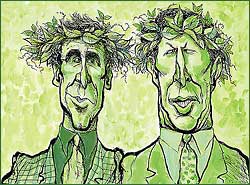
How Bush or Gore, as President, might pull a "Nixon goes to China" on environmental issues
More on politics and society in The Atlantic Monthly and Atlantic Unbound.
More on the environment in The Atlantic Monthly.
From the archives:
"The NEXT Industrial Revolution," by William McDonough and Michael Braungart (October 1998)
"Eco-efficiency" is the current buzzword in industry -- but all it really promises to do is to slow down the rate of environmental destruction. Two prominent designers propose a radical new strategy.
"A Good Climate for Investment," by Ross Gelbspan (June 1998)
Reducing reliance on carbon for energy -- to safeguard our atmosphere and our climate -- could bring about not personal deprivation but a worldwide economic boom.
"Can Selfishness Save the Environment?" by Matt Ridley and Bobbi S. Low (September 1993)
Conventional wisdom has it that the way to avert global ecological disaster is to persuade people to change their selfish habits for the common good. A more sensible approach would be to tap a boundless and renewable resource: the human propensity for thinking mainly of short term self-interest.
Elsewhere on the Web
Links to related material on other Web sites.
George W. Bush for President Official Site: Environmental Issues
A thorough rundown of where Republican presidential nominee George W. Bush stands on environmental issues.
Gore 2000: The Environment
An explanation of Democractic presidential candidate Al Gore's environmental views.
Environmental Protection Agency
The official Web site of the EPA.
Environmental News Network -- Election 2000
The Environmental News Network, a leading news outlet for environmental issues, reports from an environmental perspective.
|
WEB ONLY
Coming in September: |
GEORGE W. Bush has been widely portrayed as an environmental villain. Sierra Club ads depict Texas as an ecological hell; editorialists cry that Houston has replaced Los Angeles as the nation's smog capital; Gore rarely misses a chance to point out that "under Governor Bush, Texas has ranked number one in America for carcinogens in the air, number one in America for toxic releases." Yet Texas's environmental problems long pre-date Bush, who has been governor less than six years. And the state's weak-executive constitution, widely mentioned in the press, means that he has little direct power on environmental issues. What's more, the indicators themselves can be misleading. For instance, Houston became the smog capital during a period in which its pollution levels declined.
Last year Houston did indeed beat Los Angeles in the number of days it was in violation of the federal ozone-alert standard (fifty-two days to L.A.'s forty-two). Yet according to Environmental Protection Agency statistics, overall smog readings for Houston declined over the past two decades. So how did Houston become the "smog capital"? Simple: pollution in southern California declined much more rapidly than pollution in Houston. Last year was the "cleanest summer smog season on record" for Los Angeles, according to the South Coast Air Quality Management District. For the first time since monitoring began, in the 1950s, Los Angeles did not experience a single "stage one" ozone alert. Owing to extremely aggressive anti-smog programs run by the Air Quality Management District and other public agencies, progress against L.A. smog has been just short of breathtaking -- or, rather, breath-giving: the city had 191 ozone-alert days in 1979, 157 in 1989, and forty-two last year.
Los Angeles's battle against smog -- even as its population, its car population, and its economy keep booming -- is a remarkable success story, one rich in hopeful messages about the power of local initiatives and the feasibility of protecting the environment and expanding the economy at the same time. But because that story is positive, the national media have paid it no heed; the misconception persists that L.A. smog is growing thicker. And because hardly anyone knows that L.A. air pollution is in striking decline, when it is announced that Houston outdoes Los Angeles in smog, people assume that Texas air has gotten much worse. Gore and the environmental groups are only too happy to let this false assumption stand.
By other measures Texas air quality reflects numerous problems, but the trend is in a mainly positive direction. A study by Steve Hayward, of the Pacific Research Institute, a California think tank, shows that during the first half of Bush's governorship (according to the most recent statistics available) emissions of "volatile organic" compounds (the main component of smog), nitrogen oxide (a secondary smog factor), sulfur dioxide (the main cause of acid rain), and carbon monoxide ("winter smog") have all declined more rapidly in Texas than in the nation as a whole -- even though Texas has had a faster population growth than most other states in those years. By EPA-monitored air-quality yardsticks, Hayward found, Texas lagged behind the rest of the nation only in emissions of "particulates" (fine soot), and those, too, have declined during the Bush years -- just not as rapidly as they have elsewhere.
Figures for toxic emissions in Texas show a similar "yes, but ..." pattern. Texas has the unhappy distinction of being at or near the top of every category in the EPA's Toxics Release Inventory database. But there is a reason for this: 60 percent of the nation's petrochemical output is in Texas, and petrochemical plants are the chief source of toxic emissions from manufacturing. Texas's toxic emissions are proportionally somewhat lower than its share of petrochemical manufacturing, suggesting that the state does a better job of policing its toxins than some others. And in most recent years toxic emissions have fallen in Texas. From 1988 to 1997 toxic releases from manufacturing declined by 43 percent nationally and by almost exactly the same percentage in Texas. (Toxic emissions declined by only 29 percent in Gore's home state of Tennessee during that period.) Because of the size of the state's petrochemical industry, toxic emissions constitute a serious public-health issue for Texas. The statistical picture is one not of environmental calamity, however, but of positive trends that need to be accelerated.
Bush deserves to be faulted for effectively canceling a state auto-inspection program designed to cut smog. But this seems to be his only outright blunder on environmental policy; other things for which he has been roasted by activists and columnists, including one program in which industries agree to cut pollution voluntarily and to "self audit" to disclose toxic leaks and other problems, can be defended. Many environmentalists really don't like voluntary programs, in part because they cut activist litigation out of the picture; yet some 324 companies have disclosed pollution violations under the Texas self-audit system -- violations the companies would otherwise have had legal incentives to conceal. And if the idea of informal negotiations between government and industry is ill-conceived, then the Vice President is as suspect as the governor: one of Gore's initiatives at the EPA has been Project XL, in which business and regulators informally negotiate voluntary compliance agreements.
Stereotyping Bush as anti-environmental also overlooks the complicating fact that last year he supported legislation requiring most Texas power plants to reduce nitrogen-oxide emissions by 50 percent and acid-rain compounds by 25 percent -- greater reductions than are required by most other states. The main credit for this bill goes to a state representative named Steve Wolens, who originated the idea, but Bush backed the measure. Critics tend to dismiss Bush's support of the power-plant bill on the grounds that he did it "only" to appeal to the national electorate. But what's wrong with that motive? Conservation is not traditionally a leading concern of Texas voters -- one reason that Bush's predecessor, the liberal Democrat Ann Richards, had a modest environmental record. When Bush was getting ready to seek the nomination, he seemed to sense that he had to buff up his environmental credentials, and so he supported a progressive bill. That is a good sign for his attentiveness to voters' concerns.
Bush's advisers know that polls now consistently show that wide majorities of U.S. voters, including Republicans, support environmental safeguards. The Republicans learned in 1995 that there is no national constituency for anti-environmentalism, when Congress, under Newt Gingrich, attempted to roll back EPA rules and the effort exploded in party faces everywhere. For example, Gingrich effectively proposed to repeal the Clean Water Act, though it's safe to say that not one single voter, even on the far right, favors unclean water. Bush's advisers also know that important Republicans, including New York Governor George Pataki, who came to office with a weak environmental record, have improved their public standing by tacking in the direction of conservation. One of Bush's early decisions as governor of Texas was to appoint a former chemical-industry official as one of the heads of a state environmental commission. It is a sign of Bush's waking up on this issue that the environment subcommittee advising his presidential campaign is composed of moderates, academics, and former EPA officials.
For that matter, in all the father-son psychoanalyzing of the Republican candidate, it has been missed that the elder Bush's Administration was mainly pro-environment. The Bush White House proposed the 1990 Clean Air Act, a sweeping bill that led to declines in air pollution nationally. President Bush also imposed a ban on tuna caught without dolphin-safe nets, placed a moratorium on most offshore oil exploration, and took other ecology-friendly steps. In 1992 many of Bush's advisers believed that the President was leaning toward a commitment to greenhouse-effect reform. But the President took the spectacularly bad advice of his adviser Richard Darman, who hates environmentalism, and began to act like an anti-environmentalist, making light of global-warming concerns and giving testy speeches about how people matter more than owls. Bush's seemingly invincible poll numbers in the 1992 race with Clinton began their downturn almost to the day he went anti-environment, and the tactic did not even win him the Pacific Northwest owl states in the election. Surely father and son have discussed this.
During the 1988 presidential race George Bush memorably humiliated Michael Dukakis by standing at the edge of a filthy Boston Harbor and talking about how a governor who couldn't clean up his own state did not deserve to run the nation. To film their renowned "love that dirty water" commercial, Bush consultants had to frame out of the background the evidence of a large construction project -- the Boston Harbor cleanup plant, already rising in 1988, and spectacularly successful today, with Boston Harbor once again safe for fishing and swimming. In 1988 it was true that Massachusetts had serious environmental problems; it was also true that Dukakis was doing something about those problems. No matter. With Bush's eager help, Dukakis was damned for the bad and got no credit for the good.
This year Gore consultants may play turnabout, hitting George W. Bush for environmental problems in Texas without mentioning his already-enacted reforms. But should Bush win, the environmental perspective he would bring to the White House would surely be more progressive than expected, raising the question of whether he would commit his Administration to a big ecological initiative of its own.
(The online version of this article appears in two parts. Click here to go to part two.)
Gregg Easterbrook is a contributing editor of The Atlantic and a senior editor of The New Republic and Beliefnet.com. His most recent book is Beside Still Waters: Searching for Meaning in an Age of Doubt (1998).
Illustration by Patrick Oliphant.
Copyright © 2000 by The Atlantic Monthly Company. All rights reserved.
The Atlantic Monthly; September 2000; Green Surprise - 00.09;
Volume 286, No. 3; page 17-24.