




Introduction by Steven Cramer
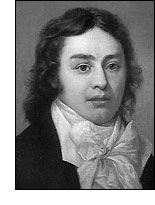 |
 Samuel Taylor Coleridge Samuel Taylor Coleridge |



(For help, see a note about the audio.)
See the complete text of "This Lime-tree Bower My Prison."
Previously in Soundings:
Elizabeth Bishop, "Sonnet" (March 29, 2000)
Gail Mazur, Robert Pinsky, Lloyd Schwartz, and Mark Strand read Elizabeth Bishop's haunting late poem. With an introduction by Lloyd Schwartz.
John Clare, "I Am" (December 8, 1999)
David Barber, Carolyn Kizer, and Christopher Ricks read the underappreciated English Romantic poet John Clare's greatest poem, "I Am." With an introduction by David Barber.
William Shakespeare, "Sonnet 116" (October 27, 1999)
Mark Doty, Linda Gregerson, W. S. Merwin, and Lloyd Schwartz read Shakespeare's famous sonnet ("Let me not to the marriage of true minds..."). With an introduction by Linda Gregerson.
Emily Dickinson, "I cannot live with You" (April 14, 1999)
Lucie Brock-Broido, Steven Cramer, and Mary Jo Salter read Dickinson's poem of hopeless love. With an introduction by Steven Cramer.
Robert Frost, "The Wood-Pile" (February 3, 1999)
Peter Davison, Donald Hall, and Maxine Kumin give voice to this poem by Robert Frost. With an introduction by Peter Davison.
Thomas Hardy, "During Wind and Rain" (January 6, 1999)
Donald Hall, Philip Levine, and Rosanna Warren give voice to this poem by Thomas Hardy. With an introduction by Philip Levine.
Ben Jonson, "My Picture Left in Scotland" (November 25, 1998)
Robert Pinsky, Gail Mazur, and David Ferry read aloud this great poem of unrequited love. With an introduction by Robert Pinsky.
Walt Whitman, "As I Ebb'd with the Ocean of Life" (October 8, 1998)
Frank Bidart, Marie Howe, and Galway Kinnell read Whitman's stunning poem of self-doubt. With an introduction by Steven Cramer.
W. B. Yeats, "Easter 1916" (February 4, 1998)
Richard Wilbur, Philip Levine, and Peter Davison give voice to one of the century's greatest poems. The first installment in a series of classic-poetry readings by contemporary poets, with an introduction by David Barber.
More on poets and poetry in Atlantic Unbound and The Atlantic Monthly.
Join a conversation on poets and poetry in the Books & Literature conference of Post & Riposte.
Elsewhere on the Web
Links to related material on other Web sites.
The Lyrical Ballads Bicentenary Project
View the full text and images of Lyrical Ballads (1798), by William Wordsworth and Samuel Taylor Coleridge. The Lyrical Ballads Bicentenary Project was created in 1998 by Ronald Tetreault of Dalhousie University and Bruce Graver of Providence College to celebrate the two hundredth anniversary of the original publication of Lyrical Ballads.
What do conversation poems sound like? In his Biographia Literaria, the exhuastive history of his life and mind written roughly two decades later, Coleridge described the manner he was after: "There are not a few poems ... replete with every excellence of thought, image, and passion -- yet so worded, that the reader sees no reason either in the selection or the order of the words, why he might not have said the very same in an appropriate conversation." He also knew the antecedents to the mode. He admired the "divine chit-chat" of William Cowper's "The Task," as well as its ease with natural description and direct emotion. The gravity of the conversation poems comes in large part from Milton. Yet Coleridge's choices of subject and rhetoric convey an intimacy of expression peculiar to him -- adapted, appropriately enough, from a series of verse letters composed to friends.
More important to a claim for its lasting effect, What does a conversation poem do? How does it shape imaginative thought? Typically, a conversation poem begins in a precisely visualized, usually domestic location -- the fire-lit nursery in "Frost at Midnight," where Coleridge watches over Hartley as he sleeps; or just outside the "pretty Cot" in "The Eolian Harp," where the Coleridges spent the first idyllic weeks of their ultimately dreadful marriage. Fortified by the sense impressions of its locale, the conversation poem then sets off on a journey -- into memory, introspection, metaphysical projection, and finally toward a vision of divinity -- before circling back, the poet profoundly changed by that epiphany, to the spot from which it embarked.
While remaining true to the pattern involving a journey and a homecoming, "Lime-tree" gently subverts the circular structure, postponing detailed description of the bower itself until late in the poem. Coleridge establishes the poem's "home" in a brief preamble:
In the June of 1797 some long-expected friends paid a visit to the author's cottage; and on the morning of their arrival, he met with an accident, which disabled him from walking during the whole of their stay. One evening, when they had left him for a few hours, he composed the following lines in the garden-bower.He also tactfully refrains from telling his readers that the accident involved Sara, who'd spilled a skillet of boiling milk on his foot. Nor does he identify the friends as the Wordsworths and Lamb. Still, the poem's disarming opening phrase announces the informality of the conversational mode:
Well, they are gone, and here must I remain,Clustered references to absence and blindness articulate the poem's motivating wish: a yearning for "beauties and feelings" out of sight. But in the poem's canniest strategy, Coleridge shuns the sensory pleasures offered by the bower, laying the groundwork for the eventual admonishment of that wish. At this early point, he simply resolves to imagine the natural scenes he knows his friends will observe first-hand, drawing on his memory of previous excursions:
This lime-tree bower my prison! I have lost
Beauties and feelings, such as would have been
Most sweet to my remembrance even when age
Had dimm'd mine eyes to blindness!
They, meanwhile,The exactitude of the details here is glorious, but there's more to admire. Maintaining a delicate balance between conjecture and certainty -- "perchance" versus "of which I told" -- Coleridge adjusts diction, phrasing, and rhythm to bring those details and their emotional shadings into clearer focus. He doubles sensory adjectives and nouns, qualifies assertions ("ne'er tremble in the gale, yet tremble still"), and orchestrates mimetic syntax and enjambment, most dramatically when the ash tree "its slim trunk ... from rock to rock/ Flings arching like a bridge." To appreciate how scrupulously arranged are the elements in that line and a half, normalize the word order and notice what's lost.
Friends, whom I never more may meet again,
On springy heath, along the hill-top edge,
Wander in gladness, and wind down, perchance,
To that still roaring dell, of which I told;
The roaring dell, o'erwooded, narrow, deep,
And only speckled by the mid-day sun;
Where its slim trunk the ash from rock to rock
Flings arching like a bridge; -- that branchless ash,
Unsunn'd and damp, whose few poor yellow leaves
Ne'er tremble in the gale, yet tremble still,
Fann'd by the water-fall! and there my friends
Behold the dark green file of long lank weeds,
That all at once (a most fantastic sight!)
Still nod and drip beneath the dripping edge
Of the blue clay-stone.
When in the next stanza the friends "emerge/ Beneath the wide wide Heaven," the poem ascends with them from the physical to the metaphysical, Coleridge's "swimming sense" of their perceptual ecstasies unveiling the presence of an "Almighty Spirit." Still, "Lime-tree" never loses touch with the earth out of which it grows. And once more it's not only the details, good as they are, that root the poem in the human world. Carefully placed interjections and asides -- "perhaps," "Yes!" "Ah!" -- remind us that a single and singular imagination improvises its way into fuller empathy. Moreover, Coleridge chooses this most speculative stanza to address "gentle-hearted Charles" directly -- alluding mysteriously to a "strange calamity" in Lamb's past. (Annotators explain that Lamb's sister had recently killed their mother in a fit of insanity. More gossipy commentators inform us that Lamb detested the epithet "gentle-hearted" and suggested "drunken-dog," "ragged-head," "seld-shaven," "odd-eyed," or "stuttering," as alternatives.)
When Coleridge finally glances back to the bower, the previous stanza's epiphany permits him now to see what's right before his eyes; really, to see into it. He no longer needs to invoke "the Almighty Spirit"; it inheres in words carefully chosen to denote both concrete perceptions and divine essences -- "blaze," "transparent," "shadow," "radiance," "mass," and "gleam":
Pale beneath the blazeGiven writing as persuasively visionary as this, readers may forgive what follows -- the poem's one moment of moral platitude: "Henceforth I shall know/ That Nature ne'er deserts the wise and pure." Immediately after this lapse Coleridge's expert ear returns to rescue him:
Hung the transparent foliage; and I watch'd
Some broad and sunny leaf, and lov'd to see
The shadow of the leaf and stem above
Dappling its sunshine! And that walnut-tree
Was richly ting'd, and a deep radiance lay
Full on the ancient ivy, which usurps
Those fronting elms, and now, with blackest mass
Makes their dark branches gleam a lighter hue
Through the late twilight; and though now the bat
Wheels silent by, and not a swallow twitters,
Yet still the solitary humble-bee
Sings in the bean-flower!
No plot so narrow, be but Nature there,In the first two lines, parallel construction, a strong pause at the line ending, and two midline pauses create a see-saw rhythmic balance that reinforces nature's promise to show its benign face wherever one turns. After the second pause, the alert ear reasonably expects the pattern of paired-off phrases to continue. Instead, a new rhythmic principle takes over as Coleridge syncopates line with syntax, and energizes the active parts of speech by breaking "employ" against "each faculty" and "heart" against "awake." The total effect of these four lines is one of beautiful fluidity developing out of symmetry.
No waste so vacant, but may well employ
Each faculty of sense, and keep the heart
Awake to love and beauty...
This poem constructed out of bridges -- its chronology extending from evening to nightfall, its apostrophe from friend to friend, that exquisitely rendered span of the ash tree's branch -- concludes with a final arc:
My gentle-hearted Charles! when the last rookThat closing line could stand by itself as a manifesto for the conversational aesthetic: harmony derives from the real in conjunction with the ideal, and colloquial speech has its music too. But it's the passage as a whole, a sinuous nine-line sentence, which enacts the poem's last and loveliest homecoming. The crow's flight "homewards" retraces and refigures the link between Coleridge and Lamb, as the poet's mind projects outward again to imagine one more instance of two visions coinciding.
Beat its straight path along the dusky air
Homewards, I blest it! deeming its black wing
(Now a dim speck, now vanishing in light)
Had cross'd the mighty Orb's dilated glory,
While thou stood'st gazing; or, when all was still,
Flew creaking o'er thy head, and had a charm
For thee, my gentle-hearted Charles, to whom
No sound is dissonant which tells of Life.
"Visions coinciding" is Elizabeth Bishop's phrase, from Geography III's "Poem." Anyone wishing to trace Coleridge's legacy should turn now to that modern conversation poem. The circling movement from home (a painting of Bishop's Nova Scotia hometown) through a retrospective and imaginative journey, then back home; the exclamation as memory and imagination fuse (Coleridge's "Yes!" and Bishop's "Heavens!"); and the human-to-human bond ("I never knew him," Bishop says of the Sunday painter whose work she examines with deepening affection, but "we both knew this place") -- these parallels between the two poems astonished me when I first noticed them. Even more startling, when read together they interact in an elegant counterbalance: what Coleridge remembers becomes what he imagines; what Bishop imagines becomes what she remembers.
Many other contemporary American poems -- Richard Wilbur's "The Writer," Robert Hass's "Letter," Ellen Bryant Voigt's "Blue Ridge," Jon Anderson's "In Autumn" -- adopt a version of the journey-and-homecoming pattern Coleridge perfected in the late eighteenth century. Were these poets aware of his influence? I can't say, although it's a safe bet that each has read Coleridge with care. Of course, the structure these poems share may transcend a single through-line of influence. Is the shape of the conversation poem simply one of the forms an introspective mind takes when engaged in introspection?
Steven Cramer is the author of The Eye That Desires to Look Upward (1987), and The World Book (1992), and Dialogue for the Left and Right Hand (1997). He is currently teaching at MIT and Boston University.
Stanley Plumly is a Distinguished University Professor at the University of Maryland at College Park. He is the author, most recently, of Now That My Father Lies Down Beside Me: New and Selected Poems (2000).
Tom Sleigh teaches at Dartmouth College. His most recent book of poems is The Dreamhouse (1999).
Copyright © 2000 by The Atlantic Monthly Group. All rights reserved.
 |
 |
 |
 |
 |
 |