




Basic Boiled and Buttered String Beans
Pasta Salad with Mushrooms and Fennel
Tomato and Herb Gratin
July 9, 1998
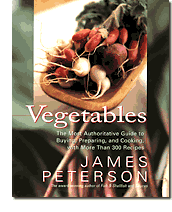 James Peterson knows everything about cooking. Or at least I'm convinced that
he does. After training at French schools and in French restaurants, Peterson
moved back to the United States in 1979 and opened his own restaurant, which he seems to have run as something of a
laboratory for furthering his research into ingredients and techniques.
James Peterson knows everything about cooking. Or at least I'm convinced that
he does. After training at French schools and in French restaurants, Peterson
moved back to the United States in 1979 and opened his own restaurant, which he seems to have run as something of a
laboratory for furthering his research into ingredients and techniques. In two definitive, encyclopedic books -- Sauces (1991) and Fish & Shellfish (1996) -- Peterson has given readers the benefit of his years of experimentation and observation. He presents what he learned with a rare common sense that I treasure. In reading his new Vegetables, a subject close to my heart, I kept nodding in agreement and thinking, "Right -- that's just what I always thought." No wonder I want to read every word of this typically long, comprehensive book.
A masterly teacher, Peterson has the voice of hard-won pragmatic realism. On the endless arguments over what's a vegetable and what's a fruit: "While botanists claim that tomatoes are actually fruits and not vegetables (a fruit is formed from a fertilized flower and has seeds, a vegetable is the plant itself such as the leaves or roots), the only meaningful differences for the cook is that vegetables are savory and fruits are sweet." Think about what tastes good, that is -- not tomato ice cream, something I have encountered on a dismaying number of dessert menus.
In the long and invaluable first part of the book, Peterson takes up individual vegetables. He can be offhand on the names and differences between varieties -- for instance, the many heirloom potatoes and tomatoes -- or the distinctions between mustard greens and their relation to the various vegetables called Chinese broccoli. Sometimes he is wrong on certain names: what he calls radicchio di Verona, the expensive red Italian lettuce shaped like a small head of iceberg, is more commonly called chioggia. This can be frustrating for those in search of exact information, but will be no impediment to shoppers who just want to know how to buy and prepare what they find at the market.
 |
| James Peterson |
For years I have relied on Marian Morash's Victory Garden Cookbook to tell me the best ways to shop for, trim, and cook vegetables. Peterson's is the first guide that will get as much kitchen use. I'm including here a recipe by Peterson for something he can do with typical authority: sauté potatoes so the slices are individual, cooked all the way through, and crisp on the outside instead of turning into unintended hash browns. I've also included his recipe for basic boiled and buttered string beans, in which he describes a technique that will prevent for every kind of buttered green vegetable the usual sodden, fatty mess at the bottom of the bowl; a simple pasta salad dressed with balsamic vinegar and cream, which will likely become your knock-em-dead-with-little-effort offering at a pot luck; and a minimalist tomato gratin -- just sliced ripe tomatoes baked for an hour or more with parmesan cheese until they turn thick and crusty -- that will make you question whether fast cooking is the panacea for garden-fresh vegetables. Come September, I plan to stain Vegetables' pages.
Previously in Corby's Table:
Jasper White gets up close and personal with lobster claws, tails, and tomalley.
A rare book that shows Italy unromanticized -- and more appetizing.
New reasons not to get out of bed in the morning.
In Ruth Reichl's new memoir, Tender at the Bone, food is about more than eating.
South America's well-traveled cuisine.
Just in time for the holidays, a look back over the year's best.
A book to help one get wise to the whys of cooking.
More by Corby Kummer in Atlantic Unbound
Excerpts from Vegetables, by James Peterson (Morrow)
Basic Sautéed Potatoes
This dish is the simplest and most complicated of potato recipes: simple because all you need is potatoes, some kind of cooking fat, and a sauté pan; complicated because the potatoes can stick to the pan, not brown evenly, or fail to take on that just-right golden and delicately crunchy crust. The sticking problem is easy to eliminate by making sure the potato slices are perfectly dry by using a nonstick pan or a well-seasoned iron skillet or sauté pan. Use a pan with a heavy bottom -- so the potatoes cook evenly -- but not one that's so heavy that you'll have trouble tossing the potatoes. If you're dead set against tossing the potatoes (tossing instills terror in the most seasoned cooks), stir them instead with a wooden spoon or spatula (don't ever use a fork), or turn them with wooden tongs. In any case, be very careful not to break the crust that has formed on the potato slice's outer surface. Otherwise the potatoes will release starch and you'll have a sticky and solid mass. I almost always cook these potatoes in butter because I like its flavor. Some cooks use clarified butter, which can be heated to a high temperature without burning, but if you're careful not to get the pan too hot, especially at the beginning, plain butter will work fine. Olive oil also works well and some people prefer it. You can also use rendered bacon fat, duck fat, or most sublime, goose fat. If you want these potatoes to be perfect, use two of your largest sauté pans so you can cook all the potatoes in a single layer -- and then turn the potato slices one by one with tongs.
| 2 pounds white or red waxy potatoes, Yukon Gold, or Yellow Finn | 6 tablespoons butter, olive oil, goose fat, duck fat, or bacon fat |
| coarse sea salt | freshly ground black pepper |
Peel the potatoes and slice them into 1/8-inch-thick rounds with a mandolin or plastic vegetable slicer. Put the slices in a bowl and cover with cold water. Swirl the potatoes around in the water to rinse off some of their starch. Drain in a colander, spin in a lettuce spinner, about a fourth at a time, and pat dry on cloth towels. (Don't be tempted to use paper towels; they tear and stick to the potatoes.)
Heat the butter or other fat in one or two 12- or 15-inch sauté pans over medium heat. When the butter starts to froth or the other fats begin barely to ripple, slide in the potatoes. Turn the heat up to high and immediately start shaking the pan back and forth to keep the potatoes from sticking to the pan. When the potatoes are golden brown on the bottom, after about 5 minutes, toss them or gently turn them over, one by one, with tongs. Brown on the other side for about 5 minutes more or -- if you're cooking more than a single layer of potatoes in one pan -- until all the potatoes are evenly browned on both sides. Sprinkle the potatoes with salt and freshly ground pepper. Gently transfer them to plates or a platter with a slotted spoon so excess butter or oil is left behind in the pan and serve immediately.
Basic Boiled and Buttered String Beans
A mistake that a lot of cooks make when serving string beans, or for that matter any green vegetable, is to heat the cooked beans in melted butter in a sauté pan so that the butter turns oily and gives the beans a greasy look and feel in the mouth. A better approach is to cook the beans in boiling water, drain them, and reheat them in the pot they were boiled in, without any butter. This last reheating dries the beans and evaporates moisture that would dilute the butter and leave it in a puddle at the bottom of the serving dish. When the beans are dry, toss them with cold butter, off the heat.
| 2 tablespoons salt (for boiling beans) | 2 tablespoons butter |
| 1 pound string beans, ends snapped off and beans cut in half or quartered crosswise if large | salt and freshly ground black pepper |
Bring 4 quarts of water to a boil in a large covered pot. Toss in the salt and as soon as the water returns to the boil, toss in the beans. Don't recover the pot. Boil over high heat from 4 to 10 minutes or until the beans are cooked but retain an almost imperceptible crunch -- you'll have to spoon one out and bite into it. Drain the beans in a colander -- don't rinse them -- and put them back in the pot. Toss or gently stir the beans over high heat for about 1 minute to dry them. Turn off the heat, add the butter, and sprinkle with salt and pepper. Toss until the butter coats the beans. Serve immediately.
Pasta Salad with Mushrooms and Fennel
I guarantee you're going to amaze if you serve this pasta salad at a meal or party. It looks rather ordinary -- the balsamic vinegar and mushrooms make it a bit dark -- but it tastes like no other pasta salad your guests are likely to have encountered. Here I call for cremini mushrooms, which look almost identical to regular mushrooms except that cremini are darker and have twice the flavor. If you can't find cremini, use regular mushrooms -- the salad will still be great -- or better yet, wild mushrooms.
| 1 small fennel bulb | 3 tablespoons balsamic vinegar or sherry vinegar, or more to taste |
| 2 tablespoons olive oil | 3 tablespoons finely chopped basil, mint, or parsley (chopped at the last minute) |
| 1 pound mushrooms, preferably cremini or wild mushrooms | salt and freshly ground black pepper |
| 1 cup heavy cream | 1 pound pasta, such as penne, elbow macaroni, or orecchiette |
Save a handful of the green feathery fennel fronds and cut off the stalk (you can save the fennel stalks for making broth or dry them for grilling). Chop the bulb coarsely so the chunks are about 1/4 inch on each side. Heat the olive oil over medium heat in a wide sauté pan and add the fennel. Stir the fennel every few minutes, until it just begins to soften, for about 10 minutes. Finely chop the fennel fronds and reserve. Rinse and dry the mushrooms. If the bottoms of the stems seem dirty, trim off about 1/4 inch and discard. Slice the mushrooms 1/8 inch thick.
Bring about 4 quarts of water to a boil for cooking the pasta. Add the heavy cream and the mushrooms to the fennel and simmer over medium heat until the mixture thickens slightly, about 10 minutes. Remove from the heat and let cool for 15 minutes. Stir in the vinegar, chopped herbs, chopped fennel fronds, and salt and pepper to taste. Pour the pasta in the pot of boiling water. Check the pasta after about 5 minutes -- just bite into a piece -- to see if it has softened without losing its texture. Keep checking every couple of minutes until the pasta is al dente and then drain into a colander. Immediately toss the hot pasta with the sauce in a mixing bowl and let cool. Just before serving, add more salt, pepper, and vinegar to taste if needed.
Tomato and Herb Gratin
| 2 pounds ripe tomatoes, peeled | Optional toppings: |
| 1 teaspoon coarse salt | 8 anchovy filets, soaked for five minutes in cold water and drained on paper towels |
| About 20 basil leaves | 1/4 cup chopped olives (pit and chop the olives yourself, don't use canned olives) |
| 2 tablespoons extra-virgin olive oil | 2 red or green bell peppers, charred, peeled, and seeded, then cut into 1/4-inch strips |
| 1/4 cup finely grated Parmesan cheese | 2 tablespoons capers, drained |
Cut the tomatoes in half from top to bottom and cut each of the halves into 4 wedges. Use your thumb and forefinger to push the seeds out of each of the wedges. Toss the tomato wedges with the coarse salt and drain in a colander set over a bowl for 30 minutes.
Preheat the oven to 350° F.
Sprinkle the basil leaves with a teaspoon of the olive oil and chop coarsley. (The oil helps keep the leaves from turning black.) Immediately combine the basil in a small bowl with the remaining olive oil.
Spread half the basil mixture in an oval gratin dish or square baking dish just large enough to hold the tomatoes in a single layer. Arrange the tomatoes in the dish, overlapping them slightly, if necessary. Spoon the rest of the basil mixture over the tomatoes and sprinkle over the Parmesan cheese. If you're using any of the other toppings, arrange them on top. Bake for 1 to 1 1/2 hours. If the cheese or toppings start to become too brown, turn down the oven and bake somewhat longer. The gratin is done when there is no liquid left in the baking dish and a light crust has formed on top. Serve immediately.
Corby Kummer is a senior editor at The Atlantic Monthly and the author of The Joy of Coffee.
Copyright © 1998 by Corby Kummer.
Recipes from Vegetables by James Peterson. William Morrow and Company: New York 1998. Hardcover, 429 pages. ISBN: 0688146589. $35.00. Copyright © by James Peterson.
 |
 |
 |
 |
 |
 |