

Autumn Tapestry
The traditional art of weaving -- in code.
97.08.27
Bibliocity
What better place for bibliophiles, bibliopoles, bibliotaphs, and bibliomaniacs to congregate?
97.08.20
Car Talk
It's not just on NPR.
97.08.13
The Official Guide to Bedlam
The teeming, chaotic, utterly bizarre world of popular music on the Web -- brought to you by MTV and Yahoo!.
97.08.07
Shakespeare's Theatre
A multimedia tribute to the reopening of the Globe.
97.07.30
Classically Inclined
A refreshingly fundamental approach to classical music.
97.07.23
The Museum of Jurassic Technology
"Um, what exactly is this place?"
97.07.16
Women's Health Online
As soothing as a pastel-painted clinic, as informative and helpful as your favorite clinician.
97.07.09
McSpotlight
Experience an "activist frisson" on the Web.
97.07.02
Hong Kong Diaries
Making history -- and living it -- on a personal scale.
For more, see the complete Web Citations Index.
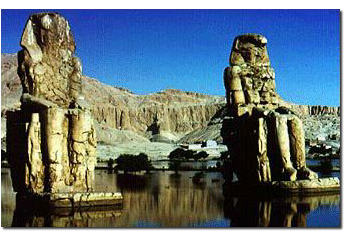
 In the years that follow floods from the Nile clog
the entranceway with rubble. Cut to 1989. An archaeological team led by an
American named Kent Weeks is feverishly searching for that same entrance. Time
is of the essence: in order to accomodate increasing tourist demand for access
to the Valley of the Kings, Egyptian engineers are planning to widen nearby
roads, in the process threatening to damage or bury Burton's discovery. After
ten days of frantic digging behind tourist kiosks Weeks's team locates the
portal -- and much more. Over the ensuing months, the team discovers more than sixty-seven corridors and chambers, a number that in the past several years has reached 108 and is still growing. Considered the most important discovery in Egypt since the unearthing of King Tut's burial site seventy-five years ago, and given the official designation "KV5," this quickly becomes the archaeological find of the late twentieth century.
In the years that follow floods from the Nile clog
the entranceway with rubble. Cut to 1989. An archaeological team led by an
American named Kent Weeks is feverishly searching for that same entrance. Time
is of the essence: in order to accomodate increasing tourist demand for access
to the Valley of the Kings, Egyptian engineers are planning to widen nearby
roads, in the process threatening to damage or bury Burton's discovery. After
ten days of frantic digging behind tourist kiosks Weeks's team locates the
portal -- and much more. Over the ensuing months, the team discovers more than sixty-seven corridors and chambers, a number that in the past several years has reached 108 and is still growing. Considered the most important discovery in Egypt since the unearthing of King Tut's burial site seventy-five years ago, and given the official designation "KV5," this quickly becomes the archaeological find of the late twentieth century.Archaeology buffs and tourists alike may well make some interesting discoveries of their own at the Theban Mapping Project's KV5 Web site.
 Take, for
example, the interactive QTVR image of a recently discovered buried skeleton:
visitors to the site can adjust the image to see the layers that archaeologists
had to dig through in order to uncover the remains. Another QTVR image allows
visitors to trace the progress of the excavation over the past nine years.
Take, for
example, the interactive QTVR image of a recently discovered buried skeleton:
visitors to the site can adjust the image to see the layers that archaeologists
had to dig through in order to uncover the remains. Another QTVR image allows
visitors to trace the progress of the excavation over the past nine years. Weeks and his staff promise regular updates to the Web site, along with an area devoted to kids, a question-and-answer page, and a chat room. The technology that would truly enhance this site is video, but given the primitive state of video on the Web, it may be a while before video can be put to effective use. Nonetheless, the Theban Mapping Project is clearly tapping into one of the most promising aspects of the World Wide Web: the ability to trace the evolution of a newsworthy event by integrating photographs, interactive images, maps, and text into a multimedia document, or "Webumentary," that can be updated instantaneously as new developments take place. The KV5 Web site, like the actual KV5 excavation, is a work in progress; check back in often to see what new things are opening up.
Copyright © 1997 by The Atlantic Monthly Company. All rights reserved.
 |
 |
 |
 |
 |
 |