

The Library of Congress Exhibitions
We introduced our weekly review with a look at one of the country's -- and the Web's -- most extraordinary resources.
For more, see the complete Web Citations
Index.

October 9, 1996
Marshall McLuhan, referring to television in the late
1960s, observed that content no longer matters. Too often, when looking at
innovative Web sites, it's tempting to concede the point. Before you do,
though, have a good look at "Witness: Roads to Refuge," the
first in a promised series of online documentaries co-produced by the
photographer Gary Matoso and World Media Live in conjunction with the United Nations High Commissioner for
Refugees. The site recently won a 1996 International EMMA
award for Interactive Approach in the category of Interactive Magazines.
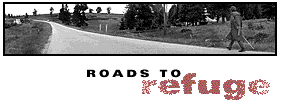
"Roads to Refuge" examines the plight of Bosnia's uprooted population in
the aftermath of the Dayton peace accords and the recent elections and asks
whether the country can now be mended. The documentary itself offers no
explicit answer, just the testimony of some of those who have survived the
war and are now struggling to rebuild their homes and their lives. These
stories alone are enough to make the site worth visiting. Presented as
they are, alongside Matoso's groundbreaking use of QuickTime Virtual
Reality (QTVR) photography, the site is a must see. QTVR gives viewers
the ability to pan 360 degrees, creating the sensation of standing at the
center of a scene and looking through the camera's lens as one turns in a
circle. The effect is profound, if somewhat dizzying. Enter a bombed-out
home in Mostar. Stand in the no-man's land between shattered apartment
blocks and the former Serb lines in Sarajevo. Station yourself with
American troops at an IFOR checkpoint near Brcko. The black-and-white QTVR
images are grainy and somewhat blurred, but they are no less powerful for
that. And lest the QTVR photography appear as a gimmick, Matoso has
provided an old-fashioned black-and-white photo essay along with the
documentary text. His sharply focused, unsentimental images are the most
memorable part of the presentation.
This first "Witness" documentary is a serious effort to live up to the humanitarian potential of the global communications network called the World Wide Web. It is online journalism straining at the limits of what the medium can do, reminding us that the content of our communication matters more than ever.
Copyright © 1996 by The Atlantic Monthly Company. All rights reserved.
 |
 |
 |
 |
 |
 |