


Return to this issue's Table of Contents.
J U N E 1 9 9 9
 F course, the fisherman was merely a transient woodcutter. A greater challenge had been posed by the permanent settlers, most of whom were squatters. Although Chilean law in theory allowed them to acquire their land, few of them had bothered with the required paperwork. Why should they have? They respected one another's homesteads, and cut wood and grazed their cattle where they pleased. They hated nature because there was so much of it to go around. Five hundred million trees? The forest was big enough for everyone until Tompkins came and took it away.
He was friendly while he did it. He offered to buy any small properties that the settlers were willing to sell, whether they held those properties informally or by law. In the cases where people lived on land that was already his, he offered to buy their "improvements." And because he paid well, some settlers did sell out and, thanking their good fortune, bought houses in town or simply drifted on. But many settlers chose stubbornly to stay, and that is how the complications began.
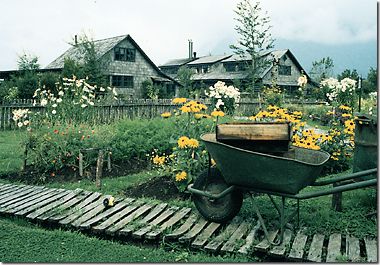 |
The hamlet at Re�ihu�, the heart of Tompkins's wilderness domain |
At the start there were abuses by Tompkins's men, who bullied the holdouts by exploiting their legal uncertainties and threatening to expropriate their land. When Tompkins found out, he fired the offenders and set to work, case by case and at great expense, to repair the damage. But there was another kind of bullying going on, which Tompkins was less able to stop. It was his own presence in the neighborhood, his intention to buy land, the mere proximity of his wealth. His money was a fright. The settlers started scrambling to secure clear titles, only to discover that the legal process was more difficult than they had thought -- that it required documents they lacked and advice they could not afford, and that for technical reasons some might have no claim to the land at all. It was their own fault, of course, but they were right to blame Tompkins, too. He was a good man who was doing them wrong.
In typical fashion, Tompkins responded to the problem directly by launching a team of property specialists whose job was to roam the forest and help the settlers to secure their titles. By the time Iarrived, the project had grown to involve dozens of claims and official surveys. Where ambiguities existed along the preserve's boundaries, Tompkins was ceding strips of land to his neighbors in order to avoid any quarrels. And in at least one case he had simply given away a piece of land in order to help a family. His purpose, of course, was to settle the settlers. But he also believed in the principles here -- that the clear delineation of property was in everyone's interest, and that the settlers must be given the full protection of Chilean law. This left the settlers with the problem of having no obvious reason to disagree with him. While Tompkins had gone about earnestly respecting their rights, they sensed that he was hemming them in, and they resented it. Despite the fall of Huinay, Tompkins believed he would continue to win over at least these local people, and that ultimately this would save the project. But they were aware of Endesa's victory, and it had encouraged them. They were small people, but their resistance to Tompkins had quietly grown stronger.
I got a ride up the coast in a wooden cargo boat operated by a man named Lolo M�ndez, who did business with Tompkins and thought of him as a friend. He was angry about the upsurge in the settlers' opposition, which he saw as the betrayal of an honorable man. He said, "Now it's even those who work at Re�ihu�! The moment they leave, they turn against him."
"Why, do you think?"
Lolo M�ndez spat derisively. "Why?" He used the characterization that Tompkins tended to use. He said, "Because they are stupid people -- you will see."
On the remote coast beyond Caleta Gonzalo I met two brothers so ornery that they had to beat off their own dogs with sticks. They lived in a clearing in primitive cabins, on land that backed onto the preserve. Tompkins had sent out a surveyor to measure an additional strip of forest for them, but they had pulled up the stakes and thrown them into the sea.
One brother said to me, "I don't believe any man will just give away his land."
I said, "But if Tompkins did, would you still have a problem with him?"
"Yes, still. Tompkins will always be a problem for us. The rich man will always take advantage of the poor."
I walked a mile up the coast and met their neighbor, a mostly toothless woman named Clementina, whose husband had drowned while returning on horseback from filing a claim against Tompkins in Chait�n. Clementina lived with her three grown sons in a cabin above a stone beach. The family survived by cutting trees on a mountainside deep inside Tompkins's land, in a patch of virgin forest which they insisted belonged to them. They dragged the heavy logs with oxen and chains to the cabin, where they sawed them into rough planks for shipment twice a year to Puerto Montt.
Clementina said, "Tompkins acts nice, but I know he's not. He dresses the way we do, but he has to, because he's an ecologista. Once he came over here and tried to buy my property. He stood where you are standing, in his wool cap, and he said, 'I can give you a house somewhere.' He waved his hand around, so I figured it would be a shitty house. Plus, he waved his hand toward Chilo�, and I don't want to live on Chilo�. I told him to go away."
I walked away thinking that Lolo M�ndez was perhaps right about the intelligence of these people. Certainly there was stupidity in the opposition, especially among the provincial fascist groups, who over the years had propounded any number of theories to explain Tompkins's hidden intent: he was an Israeli agent sent to create a new Jewish state, an Argentine agent sent to acquire a path to the Pacific, a CIA agent sent for God knows what, a drug lord, a lumber lord, an oil lord, a miner, an abortionist, an anarchist, or perhaps the Antichrist himself. This was the stuff of comedy, and it would not have posed a problem for Tompkins except that it had one unexpected consequence: it had encouraged him to underestimate the validity, and therefore the strength and endurance, of the more serious opposition in Santiago.
His confusion was in part linguistic. In the mid-1990s, as concern about Tompkins's presence deepened and matured, the issue was taken up by senior military officers -- a rigidly traditionalist group of men who, despite civilian rule, remained unapologetically involved in overseeing all aspects of the nation's affairs. Whether this was good or bad is beside the point -- they simply did not share the U.S. military's shyness about such things. And when they discovered that Tompkins had acquired a large part of Palena province in order to block development there, they voiced their objection to him in the language of "strategic interests" and "national security." To Tompkins, this sounded so outlandish that it could be laughed away. He tended already to picture South American soldiers as cartoonish. To me he said, "Hey, if they want to run their tanks through here, I sure can't stop them!" That was true. But he misunderstood the language that they used. As a North American, he thought they were speaking only about war.
In fact they were expressing legitimate civil concerns as well. Tompkins thought he should not get involved in Chilean politics, but with his disproportionate wealth and his development-blocking Parque Pumal�n, he inevitably had. Was it outlandish to believe that he might pose a threat to Chile's future -- if only by Chilean standards, and in one part of the country? Was it outlandish to be concerned that as a perpetual visitor on a tourist visa, he was operating outside the Chilean democratic process? Tompkins was indeed a foreign agent, though less intentionally than the fascists supposed. He represented a nation of such concentrated wealth that one of its worries was the very excess of success. And that nation was not Chile.
In Santiago I mentioned Tompkins's foreignness to a venerable senator named Gabriel Vald�s, who is widely respected for his integrity and the imprisonment that he suffered under the Pinochet dictatorship. Vald�s said, "We must find a way not to attack him personally, it is true. But that does not mean we must agree to his plans. There must be limits to foreign investment. Look, we are Catholics. Now comes this idea that humanity has to be controlled, that the earth has been overpopulated, that people are the moral equivalents of animals, plants, and even stone. I admit that this philosophy shocks us, our culture, ourselves, myself. Its criticism of the Occident is very strong.
"It can be discussed at the university, and it should be, but when you make a link in practice between the theory and a certain person who owns so much of your territory, you must ask yourself, 'What will happen to us now?' This idea does not come from Norway, as they say, but from the United States, a great power! What is our country compared with that? Look at the map. It is narrow and fragile, and very uncertain. Put yourself in our place. Is it not understandable that we would feel our sovereignty has been threatened? Tompkins says that only he will decide how the land is used. But what does he know? We don't want a desert in Palena either. But we will not be shoved aside."
The arguments Gabriel Vald�z made were strong, because they were considered. Tompkins had confused Palena with a human void, when in truth it was a nation's "empty place," not a wilderness but a mystical frontier that was heroic and hopeful, and into which any Chilean could flee, if only in the imagination. In that sense the settlers, however mindlessly, represented a national freedom. And Tompkins, with his global concerns and his reasonings and delineations, represented that freedom's end.
Vald�s put it this way: He had a friend in the Department of Forestry who returned from a visit to Re�ihu� and said, "I was so much impressed, it's true. Everything there was so nice, so perfect, so beautiful. But after a while I realized I was horrified, too. It was so ... uniform. It was overwhelming. I thought, 'Is this how we must be protected against our crazy civilization?'"
Antonio Horvath, a powerful senator from the south, said to me, "Palena is Patagonia, and Patagonia is a dreamland." Horvath was the settlers' defender, an ex-engineer and road builder with the soul and voice of a poet. He lovingly described a 400-year parade of dreamers in these forests, and he generously included Tompkins in it, although Tompkins was his opponent. He called the parade the search for El Dorado. He said that he himself dreamed of populating Patagonia with a million people -- not, I sensed, because he thought he could, but because the number sounded good. He was a very South American man.
Horvath savored the idea that Tompkins unwittingly had helped him. "Before Douglas Tompkins arrived here, Chile really had no development policy for Palena. The settlers there were neglected. The property lines were uncertain. And the province was slowly losing population -- the young people were leaving the forest for the cities. But Tompkins will have changed all that. By sticking his finger in the wound, he will finally have made Palena a part of Chile."
He was glad that Endesa had acquired Huinay, because the company had promised to support a pet project of his there -- an eccentric nation-building scheme that had been under way since 1987, three years before Tompkins's arrival. It consisted of regular visits by a group of idealistic architects who had built a station by the river and were now working with the Huinay settlers to construct a "research" boat for the symbolic "re-exploration" of the Patagonian coast. These architects were known throughout Chile as the Locos of Valpara�so. They came from the same Catholic University that had betrayed Tompkins, where they inhabited a free "town" of temporary structures whose explicit purpose was to work out the balance between man and nature. Their boatbuilding project in Huinay was part of a larger, long-term effort to undo the brutality of the Spanish Conquest and symbolically to refound America according to a new geographic sensitivity. For forty years the Locos had left Valpara�so and wandered from Tierra del Fuego to the Caribbean Sea, following roughly the pattern of the Southern Cross, erecting small structures and crosses, and performing spontaneous readings and ceremonies whose purpose was the "recolonization" of the continent in purely poetic terms. This sort of thing was of course difficult for North Americans to understand. It is said that when the Locos encountered Tompkins at Huinay, he cut short their explanation with a curt "I don't know anything about poetry." And as a result, they, too, had turned against him.
 FTER the fall of Huinay, Tompkins continued furiously to construct his defenses. His focus now was necessarily on building the demonstration farms -- the second half of his struggle to settle the settlers within the confines of property lines. The future he envisioned involved intelligent little subsistence farms of the sort one might expect to see in the valleys of coastal Oregon: well-composted, animal-powered, happy-to-barter organic produce, milk, and honeybee operations. To make it even tidier, there was the long-term payoff: if the right formula could be found, the very agents of the preserve's destruction might be converted into its defenders -- a ring of satisfied families facing outward to keep the apocalypse at bay. It was classic Tompkins. Parque Pumal�n was perhaps not a utopia, but it offered the appeal of a perpetual-motion machine.
But Tompkins had made a crucial mistake. In 1997, having seen the need for the demonstration farms, he had decided to build them in a rush, with an army of men and machinery. The problem this posed was not philosophical but practical: the way he was building his farms had nothing to do with the way the settlers would have to build theirs. Tompkins promised that later, for the actual operation of the farms, no machinery would be needed.
To me he said, "Having some capital, we can afford to invest in making this farm, which would take a family fifty years of blood, sweat, and tears -- we can make it in two years! You know, just get one, so we've got something to show that acts as the demonstration point within this small community. We can say, 'Well, look, this is what we learned here. Let's try this.'"
His implication, of course, was that the settlers would forget how the demonstration farms had been built. But they were among the men doing the work.
I asked one of the original Re�ihu� farmers about old times, before Tompkins arrived. We sat in his cabin at Pill�n, above the main demonstration farm, on a typical day of driving rain. He said, "We had only shovels. In all the years, through all that time, we had only one tractor on this whole fjord."
I said, "When you look at what Tompkins has done here, what do you think?"
He said brightly, "Money came."
"Sure, but do you think he has something to teach people about farming?"
"Oh, yes. He has tractors and bulldozers, so people can learn from that! Look down there -- all those machines!"
I sloshed through the mud and overflowing creeks to the big new barn at Pill�n -- the place where the honey will be gathered. The farm manager there was an athletic, black-bearded agronomist with long hair in ringlets and a gold earring. He was a tough, hard worker, used to speaking his mind. He distrusted the word "demonstration," because he had heard too many of the settlers' frank appraisals of the project. He said he wanted to call the farm "experimental," if anything, and to use less equipment, and to bother less with the aesthetics, and to plant the first crops. He was worried about Tompkins. He said he found it hard to take Tompkins's environmentalism seriously. I assured him that he should. He said if this farm was truly meant to be the preserve's defense, it was going in too fast and too late.
McDivitt had left on a business trip to Los Angeles. I said good-bye to Tompkins with regret. Huinay now stood within his project like a Trojan horse. He had written a bitter public denunciation of his enemies, threatening to take back the promised gift of a park -- which his attorney Guti�rrez had wisely managed to kill before its release. The good that had come out of Huinay was that Tompkins perhaps had a better sense of his opposition. But he rejected the idea that he needed an image cleanup, a public-relations campaign. He preferred to argue the issues. His disagreement with the Chileans was genuine. He remained an absolute idealist.
The opposition, meanwhile, was feeding on itself in reinforcing cycles among the settlers, the governor, and Santiago. The pressure was beginning to cause cracks inside the project. McDivitt might have noticed them; I assumed that Tompkins had not. A sullen rebellion had broken out over at Pill�n, where the workers insulted Tompkins when he was not there. The details are not important: they threw the word "stupid" back at him, and laughed about his sense of beauty, and cursed his selfishness for having ploughed over their soccer field -- small things, it's true, but in an atmosphere that had gone wrong. Rather than preparing to learn from this farm, they were mentally tearing it down. And even at Re�ihu�, beneath its beautiful calm fa�ades, a sly resistance had sprung up. I had seen it here and there in discreet mockery of the rules, the use of boots on clean floors, the late-night whiff of marijuana, the sheen of waste oil dumped into a creek, the small, unexpected looks of defiance, as if people had been caught in a lie.
I left Re�ihu� in the evening, in a little boat that motored through the rain to Caleta Gonzalo. The rain stopped, and clouds broke open on a trace of dry sky. The ferry landing felt like a half step back to Chile. On a mound of landscaped ground above the concrete ramp, a tall wooden flagpole stood bare. I knew the story. The pole was made from the straight trunk of a tree. Tompkins had erected it as a gesture of his good will, but then the governor had forbidden him to fly the national flag there. "It's not a matter of putting our flag just anywhere," the governor had said. "There are places where the flag should not be."
I sat at the base of the flagpole and watched the coming of night. A north wind stirred the fjord, and entered the forest, and died there among the trees. The governor was, after all, a man of power. It was unlikely that Tompkins would ever leave, but over time the terms of his possession would have to change. His wealth would protect him from the need ever quite to face failure. But for the settlers who came by boat to Gonzalo and took the road to Chait�n, the flagpole, if it was still bare, would stand for the opposition to a stranger's presence. Travelers might admire the trappings of Tompkins's park. But the symbolism would be obvious to those who counted: a single perfectly shorn tree calling for a renewed assault on the forest -- if not immediately, then someday. The forest might survive if other Chileans came to disagree. But it hardly mattered whether Tompkins planned it that way.
William Langewiesche is a correspondent for The Atlantic and the author of Inside the Sky: A Meditation on Flight (1998).
Top illustration by Kevin Soderlund. Photographs by William Langewiesche.
Copyright © 1999 by The Atlantic Monthly Company. All
rights reserved.
The Atlantic Monthly; June 1999; Eden: A Gated Community (Part Four);
Volume 283, No. 6; page 84-105.