Reporter's Notebook

Trump Time Capsule
Show Newer Notes

This evening, in Miami, the Republican nominee for president referred to his opponent and said (emphasis added):

“I think that her bodyguards should drop all weapons,” Mr. Trump said at a rally in Miami. “I think they should disarm. Immediately. What do you think. Yes? Take their guns away. She doesn’t want guns. Take them. Let’s see what happens to her. Take their guns away, O.K. It will be very dangerous.”

I am aware of only one other case in which a major-party nominee has “joked” about bodily harm against his opponent. As it happens, that was from this same Donald Trump, five weeks ago saying (in installment #73) that “the Second Amendment people” might be able to do something about Hillary Clinton’s ability to appoint Supreme Court justices.

I’ll say it again: Nothing like this has ever happened before. It’s 52+ days until the election; the tax returns (and non-Dr. Bornstein health reports) still not forthcoming; and Republican leaders still saying: Sure, he’s fine!  

Donald Trump at his new hotel in Washington today, before a press conference at which he lied about the birther controversy. Mike Segar / Reuters

I think this day, 52 days before the election, is one that people will look back on. At his press conference /  hotel promo / endorsement spectacle just now in Washington, D.C., Donald Trump said this, and only this, about the long-running “birther” controversy that for years he led and whipped up:

Now, not to mention her in the same breath, but Hillary Clinton and her campaign of 2008 started the birther controversy. I finished it.  I finished it.  You know what I mean. President Barack Obama was born in the United States, period. Now we all want to get back to making America strong and great again.

In detail:

  1. Hillary Clinton and her campaign of 2008 started the birther controversy.” This is a flat lie. In an internal memo, people in the 2008 Clinton campaign considered applying an “othering” strategy against their rival Obama. It did not involve any challenge to Obama’s birth or citizenship, and in any case it was not put into effect. What Trump said is a flat lie. More here and here and here, with links to countless other sources.
                                                                                                                           
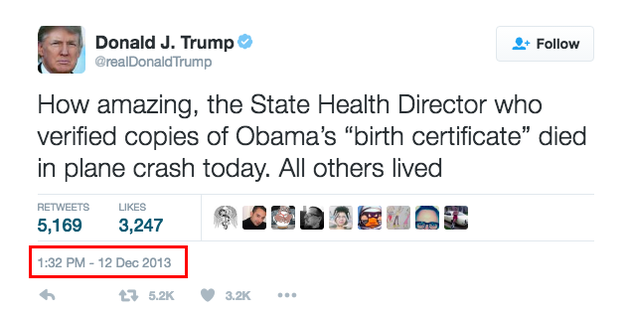
  2. I finished it. I finished it.” This is a flat lie. Trump started this phony and racist controversy [or: brought much more attention to what had been a fringe view] and kept it going. (Racist? Yes. As Bernie Sanders pointed out today, Sanders’s own father, like Obama’s, was born overseas. But Sanders said that no one has ever asked him to prove that he was a “real” American.) Even after Trump claimed to have “finished” it with the appearance of Obama’s birth certificate five years ago, Trump has continued to put out Birther tweets and innuendos. You can see a sample at the end of this Vox piece; also here and here. Below is one from December 2013, two years after Trump supposedly “finished” the issue. As of this moment this is still live in Trump’s Twitter feed:
    Trump on Twitter
  3. President Barack Obama was born in the United States, period.” Unlike the other two, this is not a lie. It was read in exactly the tone of a negotiated hostage statement.

***

An ongoing theme of these time capsules, and a major focus of the Primary Concerns podcast I did with Brian Beutler this week, is the difficulty the “normal” press has had in coming to terms with a man who simply and continually lies, without the normal internal checks that hold most people back.

In particular we discussed the differing arcs of the New York Times and the Washington Post in grappling with this issue. Over the past decade, the NYT has become more and more obviously the dominant American news organization, and the Post has coped with many constraints and cutbacks. But in the past few months the news page of the Post has seemed much more direct in calling out what is happening.

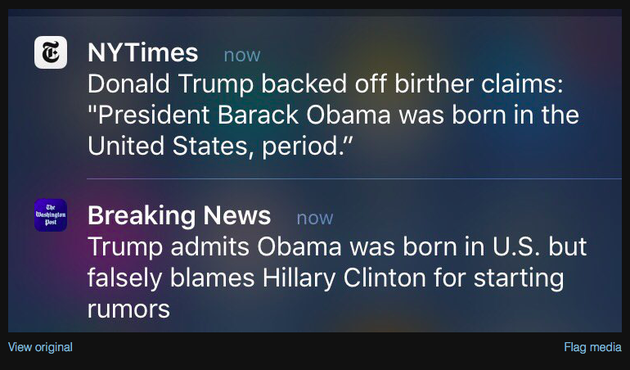
Beutler and I go into details of this in our discussion. But here is an example, the contrasting breaking-news notifications the two papers put out, with the Times at the top and the Post at the bottom.

The Post headline says “admits” and “falsely”; the NYT’s says “backed off.”  Via Dylan Scott on Twitter

And the polls continue to draw closer, and the Republican leadership continues to say: Sure, this guy is fine.

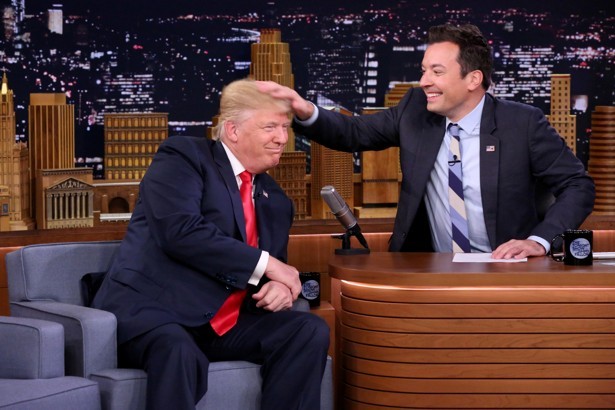
Jimmy Fallon "charmingly" mussing Donald Trump's hair. This will merely be amusing if Trump loses on November 8. It will be something worse if he wins. (NBC / Reuters)

Mainly because he’s talented, partly because of the similarity of our names, I’ve paid attention to Jimmy Fallon from the start.

Effective 53 days from now, he may have a lot to answer for. Performances like the one he put on this evening with Donald Trump, including a “charming” mussing of the candidate’s famous hair, are a crucial part of the “normalizing” process of a candidate who is outside all historical norms for this office.

In my current cover story I wrote:  

Trump’s rise through the primary debates, and his celebrations of successive victories at rallies in between, made it appear that one of his gifts was the ability to combine unvarying emphases and messages with a wide range of dramatic styles. One day he was egging on huge crowds by picking out scattered protesters and yelling, “Get ’em outta here!” The next day he was talking earnestly with sympathetic hosts on Fox News or conservative talk-radio shows—and then in the evening chatting urbanely, in a “we’re all New Yorkers here” style that was a less risqué version of his old radio exchanges with Howard Stern, to win over presumptively less sympathetic figures such as Jimmy Fallon and Jimmy Kimmel on their shows.

Last November, Trump served as host (and danced in a parody rap video) on Saturday Night Live. In February, just after the New Hampshire primary, Stephen Colbert allowed Trump to phone in to his Late Show—and Colbert, for once overmatched, ended up making Trump seem as if he was in on all the jokes rather than the object of them.

One reason for Trump’s rise has been the effective merger of the entertainment and political-campaign industries. Jimmy Fallon accelerated that process tonight. He did so on the same day in which Trump put out a crazy economic plan and still refused to say that the incumbent (black) president was a “real” American.

Fallon’s humoring of Trump was a bad move, a destructive and self-indulgent mistake, which I hope Fallon becomes embarrassed about but the rest of us don’t have long-term reason to rue.

Donald Trump Jr., at right, with his brother Barron and stepmother Melania at the Republican convention. Today he weighs in about taxes. Carlo Allegri / Reuters

This one is just a note for the record. Please recall the sequence:

  • Four years ago, Donald Trump said that Mitt Romney should release his tax returns. That’s hardly a surprising position: Every major-party nominee since Richard Nixon has been expected to do so, and has.

  • Through the past year, Trump has said repeatedly that he’d be happy to release his tax returns but can’t because they are “under audit.”

  • That excuse is bullshit. No lesser authority than the IRS has said so repeatedly and unmistakably. Whether or not the returns are actually being audited (as discussed here), there is no legal reason whatsoever to keep Trump from releasing them.

  • While Trump has stuck with his utter-bullshit rationalization, and while establishment Republicans from Paul Ryan on down have averted their eyes, reasons have mounted up to think that a disclosure expected of all previous nominees is especially important for him. These include: the shady operations of his Trump Foundation; the unsubstantiated nature of most of his claimed donations; and, significantly for a president, the extent of his reliance on foreign creditors and customers.

  • Even without any of these complications, tax returns are part of the “transparency” expected of a potential president. Michael Dukakis had no complicated wealth to speak of, nor Joe Biden or Barack Obama as nominees, but still all of them had to turn over the records. Donald Trump’s finances are more complex than those of any prior nominee and thus of greater potential public significance. But he has stonewalled, and his enablers in the party have allowed him to get away with it.

Finally today two campaign representatives shifted the rationale, as if the previous one had not existed, to one that is more completely indefensible.

First Donald Trump Jr., then campaign ally Jack Kingston said that that Trump Sr. couldn’t release the returns because people might find things in them. As Trump Jr., who tends to make his father’s points with less finesse, said in an interview with the Pittsburgh Tribune-Review:

When asked why his father has not released his tax returns as presidential candidates have traditionally done, Trump Jr. said, “Because he’s got a 12,000-page tax return that would create … financial auditors out of every person in the country asking questions that would distract from [his father’s] main message.”

Kingston, a former congressman who now works for one of D.C.’s biggest lobbying firms but is part of Trump’s “anti-insider” team, made a similar point today on CNN:

“If you put it on the table, you’re going to have 300 million Americans second-guessing what is this, what is that?”

Of course, asking what is that?, aka “second-guessing,” is why public officials have to make financial disclosures. It’s why both Kingston and Donald Trump Sr., and presumably Donald Trump Jr. as well, were hammering Hillary Clinton to release her emails. If all the information in medical records, financial reports, or official emails were flattering, no one would be required to release it. It’s only because it can lead to “second-guessing” that it’s expected of public officials.

***

I’m noting this in real time, at a moment when like so many other flaps it’s prominent on talk shows and news feeds. But like so many other “never before!” episodes in the Trump campaign, it’s likely soon to become “normalized,” and fade.

I note that with 53 days until the election, and with polls tightening, a nominee continues to defy a norm that his modern predecessors have all respected—and that his campaign has stepped away from his previous rationalized excuse and, out of nothing, invented a new alibi. And his party’s leaders say: That’s fine. People will look back on this time.

Pastor Faith Green Timmons speaking with the candidate yesterday in Flint. When he was no longer in the pastor's presence, Trump said that at the moment depicted here she was a "nervous mess." Evan Vucci / AP

We could be entering the Era of Hourly Time Capsules, in part because I need to make up for the past few days away from The Internet.

To note this for-the-moment highly publicized episode before it gets sandblasted from public memory by whatever is about to happen next: Yesterday, in Flint, Michigan, Donald Trump revealed a trait that is strikingly recurrent in his own behavior, and strikingly different from what I can recall from any other presidential nominee.

That trait is the combination of his bombast about women when they are not present, and his reluctance or inability to confront them face-to-face.

The man is a bully, and like most bullies he is a coward.

I don’t know of any other nominee in modern times of whom that was so clearly true. (Richard Nixon gave all the signs of not being physically courageous, but he rhetorically he did not show the stark contrast between being nasty-behind-their-back / polite-to-their-face that Trump does with women who challenge him.)

This is something I discuss in my current cover story, involving the three distinct moments in the primary season when Trump looked worst in live exchanges:

Donald Trump was made to look bad by one interviewer with the time, preparation, and guts to pursue a line of questioning, and by two women who discussed right in front of him the ugly things he has said.

If he shows up for this fall’s debates, he’ll encounter moderators with a lot of time to explore issues, and a woman with decades of onstage toughness behind her.

And it’s what you saw in this now-famous showdown in Flint, in which Trump meekly accepted correction in person from Pastor Faith Green Timmons, when she told him he was not supposed to be making a political speech—and then, once safely out of her gaze, flat-out lied about what had happened and had been captured on tape.

Here is what Trump told the never-disappointing Fox and Friends this morning:

“Something was up,” Trump told Fox and Friends on Thursday morning, calling the Rev. Faith Green Timmons a “nervous mess.”

“I noticed she was so nervous when she introduced me,” he said. “When she got up to introduce me she was so nervous, she was shaking. I said, wow, this is kind of strange. Then she came up. So she had that in mind, there’s no question.”

And here is what actually occurred:

***

Bonus travails-of-the-press point: NPR’s Scott Detrow did a very strong and pointed post contrasting the way Trump described the Flint episode and what actually occurred there.

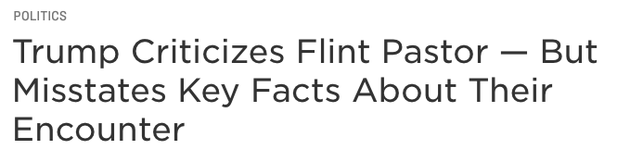
But here is the way NPR headlined his post:

“Misstates Key Facts”? What, exactly, would be wrong with the word “lies”?

More in the hopper.

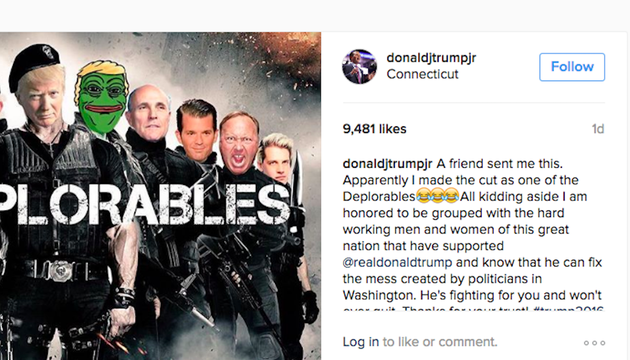
Mock 'The Deplorables' poster. From left: Roger Stone, Ben Carson, Chris Christie, Eric Trump, Mike Pence, The Man, Pepe the Frog, Rudy Giuliani, Donald Trump Jr., Alex Jones, and Milo Yiannopoulos. Trump Jr. said he was "honored" by the grouping. Donald J. Trump Jr. on Instagram, via Tina Nguyen in Vanity Fair

Remember the episode of “the Star,” reported back in installment #33? It was only two months ago, but it seems forever.

Remember this?

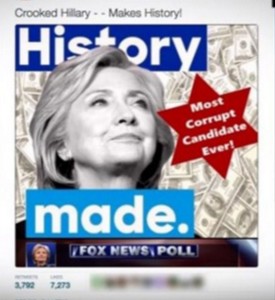
Way back in July, Donald Trump retweeted an item showing Hillary Clinton awash in a sea of cash, with the message “Most Corrupt Candidate Ever!” emblazoned on a six-sided star. Criticism quickly arose about the overlap with classic money-hungry anti-Semitic imagery, much as if Trump had used an image of blacks eating watermelon or Mexicans dozing under their sombreros. Fairly quickly Trump took the rare-for-him step of actually deleting his tweet. But even then his campaign’s reaction was outraged innocence. Anti-Semitic? What are you talking about?? Why would you think it’s a Star of David? It’s so obviously a sheriff’s badge! The real racists are the ones who think anything else!

That’s what this weekend’s “Pepe” episode reminds me of.

As a reminder: Hillary Clinton set the stage with her tin-eared comment about the “basket of deplorables.” Then the stylish and unembarrassable Trump ally Roger Stone responded with the Expendables-knock-off movie poster you see above, which Donald Trump Jr. then shared on Instagram, as shown below:

Donald J. Trump Jr’s comment on the poster, via Tina Nguyen.

Why is this like “the Star”? Because of Pepe the Frog.

For some people, what I’m about to say is old news and obvious. But for many, perhaps most, it’s important to have the whole context laid out.

If you’ve spent any time in the thickets of “alt-right” activism in recent years, you know perfectly well who Pepe is and what he stands for. In the “Deplorables” poster he is of course the figure with green skin and Trump-style hair standing alongside The Man. But to people who would actually fit “the deplorables” standard of racial animus, Pepe is also the wink-wink insiders’ symbol not just of racism but even of outright exterminationism.

From a typical day’s email.

You can read an account of Pepe’s recent history via the Daily Beast a few months ago here. He also has a pre-racist internet meme history, which you can see here. I’m not going to share the Pepe variants I keep getting in the mail, but they include:

Pepe as a sly smiling gas-chamber operator, inviting Jews to take a “shower”; Pepe working the crematoria, after the gas chambers have done their job; Pepe at the glorious new southern Wall, grinning at the plight of Mexicans trapped on the other side; Pepe as an Orthodox Jew, smirking (because of the “inside job”) as the World Trade Centers come down 15 years ago; Pepe with a lynch mob.

Again, it’s old news, and that is the point. If you’re involved in politics, you know this. You know exactly what the image of Pepe signifies in political uses these days. So for the son and namesake of the Republican nominee to share with pride a poster including Pepe necessarily means either that he does not know about Pepe, which indicates incompetence—or that he does, which indicates something worse.

***

The episode should be more disturbing than the conceivably misunderstood six-sided star. In that case, an innocent if unlikely alternative explanation was at hand: No, really, it is just a sheriff’s star! What’s wrong with you, that you would think anything else?

But in this case, there is no “nice” version of contemporary political Pepe to fall back on. (Oh, you thought we meant the one from the death camps? Not at all! We meant the one from the lynchings! Sorry for the confusion.) With eight weeks to go until the election, this is what Donald Trump Jr. has been “honored” to send out.

I am not aware of anything like this having happened before.  

Donald Trump in Baltimore, after his CNBC interview Mike Segar / Reuters

An uncatchable-up-with amount of news has happened in the three days since installment #99. So I’ll start the regrouping process with something simple: a single incredible interview.

Early this morning, Donald Trump did a long phone-in session with CNBC, which you can see in full below. The questioners made Matt Lauer look like the Grand Inquisitor, as you will see if you take a look.

For instance, one of the early questions, from Joe Kernan, starts with the premise that businesses and business leaders are unfairly maligned in America today. What does a successful business leader like Trump think about that?

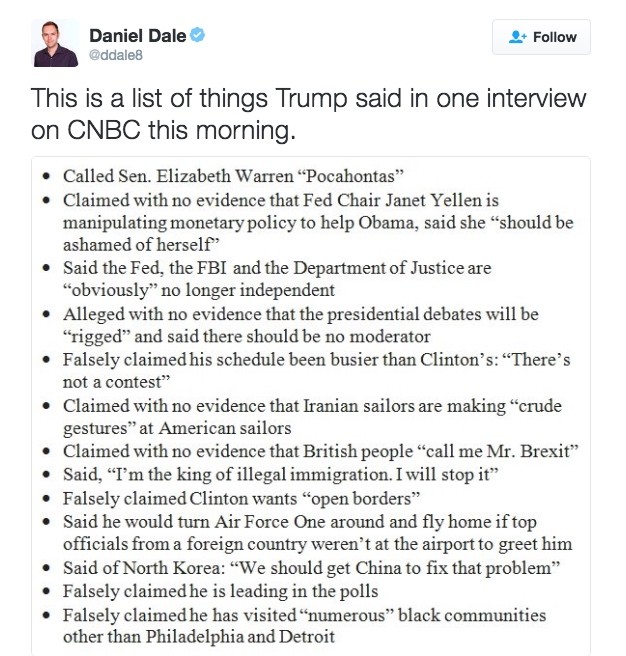
Through the rest of the interview, Trump reeled off several dozen surprising, unsubstantiated, completely wrong, and otherwise weird statements, none of which the interviewers challenged him on. Daniel Dale of the Toronto Star provided a convenient summary of a few:

Via Daniel Dale on Twitter

And that’s just the start. Beyond the ones Dale mentions were Trump’s (fantastical) claim that “China could solve the problem with North Korea in one day, if they wanted” (actually they couldn’t). Or that Matt Lauer had been much tougher in questioning him than he had with Hillary (unt-uh).

After the interview, Matthew Yglesias wrote an item in Vox with the headline “Donald Trump gave an interview this morning that should be shocking — but we’re numb.” Sample:

A few observations about all this:

  • In a normal election cycle, a candidate making an offhand racist remark about a sitting US senator would be a big news story.
  • In a normal election cycle, a candidate making an offhanded lie about the state of his personal finances would be a big news story.
  • To be totally honest, even in a normal election cycle a candidate exhibiting total confusion about the mechanics and merits of monetary policy probably wouldn’t be that big of a news story but it would at least get some attention.

***

It’s 56 days and a few hours until the election; one of the candidates is still stonewalling about his tax returns; both of them, who will be 69 (HRC) and 70 (Trump) on election day should be offering full health information, but at least what Hillary Clinton has offered so far is not a self-evident joke; and the race tightens up. Just noting for now an interview that in any other year for any other candidate would itself be the stuff of campaign-altering news. I am trying not to remain numb.

Florida Attorney General Pam Bondi, at a Trump rally. Scott Audette / Reuters

Through any campaign, candidates have ups and downs in their editorial-page treatment. The concentration of these four editorials in the past 24 hours seems unusual and is worth noting as a possible press recalibration.

1. Tampa Bay Tribune, “Feds should investigate Bondi-Trump connection.” This is of course about the apparent pay-to-play connection of Donald Trump’s donations to the Florida Attorney General’s campaign, and her then deciding against an investigation of Trump university. The editorial begins:

Federal prosecutors should investigate whether there is any connection between the decision by Attorney General Pam Bondi’s office not to pursue fraud allegations against Trump University and a $25,000 campaign contribution he gave her. Since Florida prosecutors will not touch this mess, the Justice Department is the only option. The appearance of something more than a coincidence is too serious and the unresolved questions are too numerous to accept blanket denials by Bondi and Trump without more digging and an independent review.

The Washington Post also has an editorial on this theme, “The Pam Bondi case shows that Trump is more hustler than businessman.” What is already known in this case—flow of money, favorable government treatment, exact cause-effect not yet proven—is so much starker than what is suspected in the many Clinton Foundation episodes that it is overdue for extra attention.

***

2. Washington Post, “The Hillary Clinton email story is out of control.” An editorial-page counterpart to Bernie Sanders’s “We’re sick of hearing about your damned emails.” It concludes:

Imagine how history would judge today’s Americans if, looking back at this election, the record showed that voters empowered a dangerous man because of . . . a minor email scandal. There is no equivalence between Ms. Clinton’s wrongs and Mr. Trump’s manifest unfitness for office.

Imagine indeed.

***

3. New York Times, “A debate disaster waiting to happen.” This is the lead editorial, about Matt Lauer’s unfortunate handling of the “Commander-in-Chief Forum.” Sample:

If the moderators of the coming debates do not figure out a better way to get the candidates to speak accurately about their records and policies — especially Mr. Trump, who seems to feel he can skate by unchallenged with his own version of reality while Mrs. Clinton is grilled and entangled in the fine points of domestic and foreign policy — then they will have done the country a grave disservice.

Whether or not one agrees with her positions, Mrs. Clinton, formerly secretary of state and once a member of the Senate Armed Services Committee, showed a firm understanding of the complex issues facing the country. Mr. Trump reveled in his ignorance about global affairs and his belief that leading the world’s most powerful nation is no harder than running his business empire, which has included at least four bankruptcies.

“Grave disservice.” “Reveled in his ignorance.” This is an editorial rather than a news item, but it marks a different tone from most campaign-year coverage of debates.

***

4. WaPo, “Gary Johnson’s Aleppo gaffe was bad. But Trump’s ignorance is worse.” The “gaffe” is of course Gov. Johnson’s “What is Aleppo?” question yesterday on the Morning Joe program. The significant word in this headline is “worse,” which sets up a distinction between, rather than the familiar “They’re all shading the truth!” false-equivalence grouping of, the errors and offenses of the candidates:

It’s refreshing, at least, to hear a national candidate [Johnson] acknowledge error and vow to do better.

Contrast that with Donald Trump, who in a televised national security forum Wednesday offered a staggering array of ignorant and mendacious assertions—and acknowledged no regrets about any of them.

***

One by one, sentiments like some of these have appeared in some outlets over the the weeks. Perhaps it’s a coincidence that they all appear at the same time. But perhaps it indicates how the unprecedented nature of the campaign has been provoking and requiring a different approach by the press. One way or another, it is worth noting with 59 days to go.

Now-retired Army general Michael Flynn, testifying as head of the Defense Intelligence Agency two years ago. He accompanied Donald Trump to the recent classified briefing. Flynn has kept quiet about what he heard there. Donald Trump has not. Gary Cameron / Reuters

Last night, at the “Commander-in-Chief” forum, Donald Trump characterized what he had heard from intelligence officials in a classified briefing, and said why he believed the briefers agreed with his political perspective and shared his disdain for the current administration.

I am not aware of any previous nominee ever having done anything of this sort.

(In the modern era, nominees have gotten classified briefings to keep them up to date on crucial issues. Some have deliberately delayed or declined the briefings, precisely so they wouldn’t need to constantly remember what information was classified and thus shouldn’t be mentioned in public, and what was safe to discuss.)

According to a story by NBC, two former heads of the CIA share the view that Trump has crossed yet another line. As Ken Dilanian and Robert Windrem report:

Former CIA and NSA director Mike Hayden, who opposes Trump, told NBC News that in almost four decades in intelligence “I have never seen anything like this before.” [JF note: Hayden, a retired four-star Air Force general, is no one’s idea of a political lefty, and is in the camp of national-security conservatives who oppose Trump.]

“A political candidate has used professional intelligence officers briefing him in a totally non-political setting as props to buttress an argument for his political campaign,” said Hayden. … “The ‘I can read body language’ line was quite remarkable. … I am confident Director Clapper sent senior professionals to this meeting and so I am equally confident that no such body language ever existed. It’s simply not what we do.”

Michael Morell, a former acting CIA director who was President George W. Bush's briefer and is now a Hillary Clinton supporter, said Trump's comments about his briefing were extraordinary.

“This is the first time that I can remember a candidate for president doing a readout from an intelligence briefing, and it’s the first time a candidate has politicized their intelligence briefing. Both of those are highly inappropriate and crossed a long standing red line respected by both parties,” he said.

***

Mike Lofgren, the longtime Senate staffer and defense expert turned writer (The Party Is Over, The Deep State) expands on an implication of Hayden’s and Morell’s comments. That is, Trump’s comments are not merely indiscreet; they are also almost certainly untrue. Lofgren writes:

Two points:

1. Employees of the intelligence community who give briefings to high-level officials do not, repeat, do not advocate for their pet policies. These people would not be presidential appointees but almost certainly career civil servants (or the foreign or intelligence equivalent of a civil servant) If they were asked, “what do we do about X?” they would demur on the basis of it not being their department. They know they are not there to advocate for policies. This applies doubly for personnel briefing presidential candidates because of the extreme political sensitivity. As for criticizing the policies of their bosses to a human megaphone like Donald Trump, it is inconceivable they are that stupid.

Of course the briefers didn’t actually advocate anything, as Trump first implied, so he fell back on what philosopher Karl Popper would have called a statement devoid of factual content, because it cannot be falsified: the briefers’ body language told him they disagreed with Obama’s policies. Sure, it did …

What he’s managed to do is put those briefers in an extremely embarrassing situation. In a Trump presidency, we could expect a lot more of that: generals and civil servants being nonchalantly thrown under the bus as if they were contractors or tradesmen being stiffed on the bill for their services at Mar a Lago.

2. So what if Putin has an 82 percent approval rating? We can argue about the validity of that figure, but let’s assume it’s true. It is completely irrelevant with respect to which policies are ultimately in the U.S. national interest. I dare say Xi Jin-ping is similarly popular in China, particularly with regard to his aggressive assertion of sovereignty over virtually all of the South China Sea. But that popularity has no bearing on what US policy towards the matter ought to be, particularly when an international tribunal has rejected China’s claim. The point Trump is making is a pretty ominous one when you deconstruct it: authoritarian populist leaders ought to get their way because of their alleged popularity.

***

Here we are, 60 days until the election, with the nominee discussing the classified information he’s heard, and the GOP establishment from Ryan and McConnell on down still saying: He’s fine!  

Libertarian nominee Gary Johnson, at a rally last month in Boston. A newspaper that almost always endorses Republicans has chosen him over Donald Trump. Brian Snyder / Reuters

A for-the-record note of developments in the past few days that, again, make this GOP nominee different from his predecessors:

1. Dallas. The Dallas Morning News is as reliably conservative and Republican an editorial-page operation as you will find anywhere in America. Never once in my entire lifetime, and long before that, has the paper ever endorsed a Democrat for president. The closest it came was in 1964, when it declined to pick a favorite between incumbent Lyndon Johnson, obviously a Texan himself, and Sen. Barry Goldwater, who was headed toward a crushing defeat.

Never once in my lifetime—until yesterday, when it came out with an editorial saying “We recommend Hillary Clinton for president.” That was the followup to the preceding editorial, “Donald Trump is no Republican.” If you don’t know Texas or the Morning News, it may be difficult to grasp what a huge step this is for the paper’s editors to take. But they took it, to their credit. I say “to their credit” because of the ongoing theme in this space, that people will look back to see who knew what about Donald Trump, at which stage of the campaign, and which stands they took in response.

How the DMN endorsement begins:

There is only one serious candidate on the presidential ballot in November. We recommend Hillary Clinton.

We don’t come to this decision easily. This newspaper has not recommended a Democrat for the nation’s highest office since before World War II—if you’re counting, that’s more than 75 years and nearly 20 elections. …

But unlike Donald Trump, Hillary Clinton has experience in actual governance, a record of service and a willingness to delve into real policy.

Resume vs. resume, judgment vs. judgment, this election is no contest.

Both installments are worth reading in full.

***

2. Richmond. The Richmond Times-Dispatch is nearly as reliable and Republican as the DMN. At least since Ronald Reagan’s first run in 1980 it has always endorsed a Republican for president.

Until this past weekend, when it officially endorsed the Libertarian candidate, Gary Johnson. Its editorial was not as reality-based as the DMN’s, in pretending that Johnson might win the election and ignoring the simple fact that either Hillary Clinton or Donald Trump will be the next president. But as a marker of unusual developments it again deserves note.

Bonus item on Trump-era politics: This morning Gary Johnson made a grievous error when he asked “What’s Aleppo?” on a TV show. This will probably hurt him quite a bit. Errors like this have hurt previous candidates from Sarah Palin to Rick Perry, and now presumably Johnson as well. Consider, then, how Trump racks up similar misstatements practically every day and just keep going.

***

3. D.C. The third item was published in the New York Times but has the D.C. dateline because its author, James K. Glassman, has long lived and worked here. I’ve been friends with Glassman since our time together on the college newspaper decades ago. I’ve known that since at least the Ronald Reagan era he also has been a dependable Republican voter. He was a senior State Department official under George W. Bush and then was founding director of the George W. Bush Institute, at the Bush center within SMU in Dallas.

In his op-ed for the NYT, Glassman extended the logic and real-worldism of the Dallas Morning News editorial by saying that Republicans who find Trump unacceptable should recognize the importance of actually supporting Hillary Clinton:

I have voted for every Republican nominee for president since 1980, but I will not this time. Mr. Trump’s appalling temperament renders him unfit to be president, and his grotesque policy formulations mock the principles of liberty and respect for the individual that have been the foundation of the Republican Party since Abraham Lincoln. …

This is, whether we like it or not, an election between Mr. Trump and Mrs. Clinton, period. And that means that if you want to stop Mr. Trump, you have no choice but to vote for Mrs. Clinton. There’s no sitting this one out.

Glassman mentions the many Republicans who have said “never Trump” without taking the next step of saying “therefore, Clinton”:

I have some sympathy with this position, but it is a cop-out. If you think Mr. Trump is so lacking in experience and judgment that he shouldn’t have his finger on the nuclear trigger, then you are saying he is not just a bad candidate; you are saying he is a threat to the nation. You have an obligation to defeat him, no matter what you think of Mrs. Clinton.

These developments are noted for the record, with 60 days and some hours until the election, with the polls tightening, and with ever-clearer evidence of the kind of man the GOP believes should become president. Congratulations on their intellectual honesty and civic courage to Republicans like Glassman and those at the DMN.

Donald Trump saying (falsely) "I was against the Iraq war," and Matt Lauer listening respectfully, in tonight's "Forum" Mike Segar / Reuters

I’ve just now watched the hour-long “Commander-in-Chief Forum” on NBC, moderated by Matt Lauer. Three points that deserve note for the record:

1. Iraq. Donald Trump led off by claiming, falsely, that he opposed the war in Iraq before it began, and that this is an important sign of his good judgment:

TRUMP: Well, I think the main thing is I have great judgment. I have good judgment. I know what’s going on. I’ve called so many of the shots. And I happened to hear Hillary Clinton say that I was not against the war in Iraq. I was totally against the war in Iraq. From a — you can look at Esquire magazine from ’04. You can look at before that.

This claim is false. It is not true. It is a fantasy or a lie. Donald Trump keeps saying it. It keeps being false.

There is absolutely no public evidence, whatsoever, of Donald Trump having given any caution about invading Iraq before the war began. By contrast, there is evidence of his saying before the war that the invasion might be a good idea. For reference, a piece I did back in February. And this damning one from BuzzFeed about the same time, with audio of Trump talking with Howard Stern about the war. See this from Vox too. Even NBC’s own fact-checking department called Trump out on the lie just after the forum.

First depressing aspect: that Trump is still just proudly blasting out a lie.

Second, more depressing aspect: that NBC’s Matt Lauer did not even pretend to challenge him—not even by saying, “Wait a minute, why should a 2004 Esquire article matter, when that was a year after the war began?” Lauer, what were you thinking? If you knew this and didn’t say anything, why on Earth not? And if you didn’t know it, what were you doing in this role?  

***

2. Russia. The exchange between Lauer and Trump about Vladimir Putin seemed even more jaw-dropping when seen on TV than it reads in print. Emphasis added:

LAUER: Let me ask you about some of the things you’ve said about Vladimir Putin. You said, I will tell you, in terms of leadership, he’s getting an A, our president is not doing so well. And when referring to a comment that Putin made about you, I think he called you a brilliant leader, you said it’s always a great honor to be so nicely complimented by a man so highly respected within his country and beyond.

TRUMP: Well, he does have an 82 percent approval rating, according to the different pollsters, who, by the way, some of them are based right here. Look, look…

LAUER: He’s also a guy who annexed Crimea, invaded Ukraine, supports Assad in Syria, supports Iran, is trying to undermine our influence in key regions of the world, and according to our intelligence community, probably is the main suspect for the hacking of the DNC computers…

(CROSSTALK)

TRUMP: Well, nobody knows that for a fact. But do you want me to start naming some of the things that President Obama does at the same time?

LAUER: But do you want to be complimented by that former KGB officer?

TRUMP: Well, I think when he calls me brilliant, I’ll take the compliment, OK? The fact is, look, it’s not going to get him anywhere. I’m a negotiator.

We’re going to take back our country. You look at what’s happening to our country, you look at the depleted military. You look at the fact that we’ve lost our jobs. We’re losing our jobs like we’re a bunch of babies. We’re going to take back our country, Matt. The fact that he calls me brilliant or whatever he calls me is going to have zero impact.

What is unprecedented here: a presidential nominee favorably comparing the autocratic leader of an increasingly aggressive and problematic power to the current commander in chief of the United States. Here’s why I’m acutely aware that this sort of thing just is not done:

Forty years ago right now, when I was working for candidate Jimmy Carter in his run against incumbent President Gerald Ford, I was grinding out one of the day’s 10 speeches, this one about the failures of the Nixon-Ford foreign policy. A newsmagazine photo had recently appeared of Richard Nixon and Leonid Brezhnev sitting chummily together at an informal session at a summit meeting. By this time Nixon was the resigned-in-disgrace former president, whose legacy was dragging down his successor, Ford. Brezhnev was in his final years at the top of the USSR.

As the impetuous young speechwriter, I had thrown in some line about how neither one of them, Nixon or Brezhnev, was that big a fan of real democracy, nor attuned to the real hopes of their people [etc etc]. What I threw in was about one percent as disrespectful as what Trump said tonight about Obama and Putin. But it was immediately cut out, and I was immediately brushed back, by everyone who had a chance, from Carter himself to Jody Powell to anyone else within earshot. Carter said words to the effect of, “We don’t talk about a president that way.” We could say Nixon had betrayed the public, yes. Liken him to, or place him below, a Soviet or Russian leader, no.

Other amazing fact from seeing tonight’s session: It obviously matters to Trump that Putin calls him “brilliant”! This is exactly what one-time CIA head Mike Morell meant when saying that Putin, an experienced intelligence operative, had very skillfully played to Trump’s vanities, and made him (in Morell’s words) “an unwitting agent of the Russian Federation.”

On the other hand, good followup by Lauer on this one.

***

3. Intelligence briefings. Remember the concern, when Donald Trump began getting classified briefings, that he would blurt out or misuse information he heard there?

How do his briefers feel after hearing this?

LAUER: Did you learn new things in that briefing?

TRUMP: First of all, I have great respect for the people that gave us the briefings. We — they were terrific people. They were experts on Iraq and Iran and different parts of — and Russia. But, yes, there was one thing that shocked me. And it just seems to me that what they said President Obama and Hillary Clinton and John Kerry, who is another total disaster, did exactly the opposite.

LAUER: Did you learn anything in that briefing—again, not going into specifics—that makes you reconsider some of the things you say you can accomplish, like defeating ISIS quickly?

TRUMP: No, I didn’t learn anything from that standpoint. What I did learn is that our leadership, Barack Obama, did not follow what our experts and our truly — when they call it intelligence, it’s there for a reason — what our experts said to do….

And I was very, very surprised. In almost every instance. And I could tell you. I have pretty good with the body language. I could tell they were not happy. Our leaders did not follow what they were recommending.

Forget the body-language part. If this is true, it’s an outright betrayal of the people who briefed him and the terms of confidentiality he accepted. If it’s not true, it’s just another lie. In either case, it is yet again something we haven’t seen from past nominees.

***

That’s all I can stand to note about this session, with 61 days to go.

Protestors in Washington this May, demanding that Donald Trump release his tax returns. James Lawler Duggan / Reuters
  1. Donald Trump has taken heat, and will take more, for refusing to release his tax information.
  1. It logically follows that whatever is in the tax returns would make him look worse than his stonewalling does.

No other conclusion is possible, unless you assume that neither Trump nor any of his advisors has any sense of what looks good and bad in a campaign. That’s a possibility, but it doesn’t ring true as the explanation in this case. And the “they’re under audit” excuse is bullshit, according to none other than the I.R.S.

This simple one-two logic has been underestimated in press discussion of the issue so far.

***

The premise of this series is to record, in real time, things about the Trump era that are outside previous norms. Here’s why the tax-return issue qualifies:

  • Post-Nixon presidential and vice-presidential major-party nominees who have agreed to release their tax returns before the election: Gerald Ford (summary statement), Bob Dole, Jimmy Carter, Walter Mondale, Ronald Reagan, George H.W. Bush, Geraldine Ferraro, Dan Quayle, Mike Dukakis, Lloyd Bensten, Bill Clinton, Al Gore, Jack Kemp, George W. Bush, Dick Cheney, Joe Lieberman, John Kerry, John Edwards, Barack Obama, Joe Biden, John McCain, Sarah Palin, Mitt Romney, Paul Ryan, Hillary Clinton, Tim Kaine, Mike Pence.
                                                                                                                                                        
  • Nominees who have refused: Donald Trump.
More Notes From The Atlantic
  • Notes Home