Reporter's Notebook

Track of the Day
Show Newer Notes

Not many people outside of jazz know Bob Cranshaw’s name—though they do know his playing, which I’ll get to in a moment—but if they do, it’s likely as a pioneering electric bassist and sideman with Sonny Rollins. Cranshaw, who died of cancer on Wednesday at age 83, spent more than five decades in the great tenor saxophonist’s band, providing the grounding presence in Rollins’s band from The Bridge in 1962 through his most recent studio album, Sonny, Please.

But the Cranshaw performance that springs to my mind most readily isn’t with Rollins, and it isn’t on the electric bass. It’s just a little four-note tag, but it ties the song together. During a 1963 recording session, trumpeter Lee Morgan in 1963 found himself one song short of an album. He disappeared off into a bathroom, and the other musicians, who knew he had a drug habit, thought he might be shooting up. But after 20 minutes or so, Morgan emerged with the sketch for a fast blues to fill out the session.

He asked Cranshaw to play a pickup—a little riff to kick the tune off—and Cranshaw picked out a quick descending pattern. The band played for more than 10 minutes, including a show-stopping Barry Harris piano solo, but when they neared the finish, Cranshaw panicked and nearly ruined the take. “When we got ready to take the tune out, to play the melody, I forgot what I played at the beginning,” he recalled.

It turned out not to be too hard for the band to stop, listen back, and then splice in a finish. That was a good thing, because the take turned out to be classic. “The Sidewinder” became the title track of the album, a fluke crossover hit—charting on the pop Top 100—and eventually into a jazz standard.

Cranshaw reached an even larger audience, if not great fame or glory, in 1969, when he played bass on the theme to Sesame Street. His lines on the tune, in keeping with his general M.O., are unobtrusively funky. He ended up playing bass for the show’s music for 30 years.

There’s a reason Cranshaw stuck around so long with Rollins, and with Sesame Street. He wasn’t a flashy player, and he liked to be in the background. But his name in the credits of any record is a good omen for the quality of the music, and there’s a long list of such records, with leaders from Grant Green to Jaki Byard and Wayne Shorter to Paul Simon. “I didn’t ask to be a star. I wanted to be a sideman. I wanted to be a super-sideman,” Cranshaw told Ethan Iverson in 2014. He succeeded.

(Submit a song via hello@. Track of the Day archive here. Pre-Notes archive here.)

Goodman with his Cubs hat in April 1983 Wikimedia

A reader in Oakland, Dave, emailed this entry prior to last night’s World Series finale:

I was tickled to see among your recent “Track of the Day” choices two songs by the late lamented singer/songwriter Steve Goodman. Before his tragically premature death from leukemia, my wife and I attended many Goodman sets at Somebody Else’s Troubles and other Chicago folk venues of the ’60s and ’70s. Thanks for introducing Steve’s work to a whole new generation of music fans.

An interesting footnote: As a lifelong, dogged Chicago Cubs fan, Goodman was locally famous for “A Dying Cub Fan’s Last Request,” but he also wrote a rollicking anthem called “Go, Cubs, Go,” which the club now plays as a fan sing-along after every Cubs home victory. It’s a shame he’s not around see his favorite team’s success this year.

The song has predictably seen a huge resurgence:

Goodman’s 1984 song never appeared on a Billboard songs chart, but it has been a staple at Cubs home games since 2007, playing after every home win at Wrigley Field -- and since the Cubs rarely advanced to the playoffs, where they play to a larger audience, “Go, Cubs, Go” didn’t gain much traction outside Chicago. [But the song] logged 1.19 million on-demand streams (audio and video combined) in the tracking week ending Oct. 27, according to Nielsen Music, a 412 percent increase from the week prior. It’s on track for a big gain in the week ending Nov. 3 (the day after the Cubs won the World Series), according to preliminary data. ...

Goodman, who died from leukemia in 1984 at age 36, is somewhat of a cult figure among die-hard Cubs fans. An article in Sports Illustrated says he would schedule his concert tours “around chemotherapy and the baseball season,” and some of his ashes were spread on Wrigley Field.

(Submit a song via hello@. Track of the Day archive here. Pre-Notes archive here.)

This song has been stuck in my head ever since I stumbled on a review of Polk’s diary in our August 1895 issue, in which James Schouler looked back on the legacy of the 11th U.S. president:

Whatever may be thought of Mr. Polk’s official course in despoiling Mexico for the aggrandizement of his own country, one cannot read this Diary carefully without an increased respect for his simple and sturdy traits of character, his inflexible honesty in financial concerns, and the pertinacious zeal and strong sagacity which characterized his whole presidential career. ... Both [George] Bancroft and [James] Buchanan, of his official advisers, have left on record, since his death, incidental tributes to his greatness as an administrator and unifier of executive action; both admitting in effect his superior force of will and comprehension of the best practical methods for attaining his far-reaching ends.

Indeed, Polk—who was born on this day in 1795—“met his every goal,” as TMBG puts it. Schouler also noted that John Quincy Adams had left a similar diary:

No two Presidents could have been more at the antipodes than were Polk and John Quincy Adams in political affiliations and designs. Yet each, after his peculiar fashion, was honest, inflexible in purpose, and pursuant of the country’s good; and both have revealed views singularly alike—the one as a scholar, the other as a sage and sensible observer—of the selfish, ignoble, and antagonistic influences which surge about the citadel of national patronage, and beset each supreme occupant of the White House.

Striking words for partisan times. Read a PDF of Schouler’s complete review here, and read more from my colleague Adam on those antagonistic influences here.

(Submit a song via hello@. Track of the Day archive here. Pre-Notes archive here.)

A reader, Tom Schroeder, tries to lift us up as we approach the end of this death march of an election:

Aretha Franklin’s cover of “What A Fool Believes” is the best thing you will hear today—a bright light in dark times. The original version is a breezy number with Michael McDonald [of The Doobie Brothers] on vocals and a fun little synth line going on. You all know this song; it’s planted firmly in anodyne soft-rock canon (even serving as the central plot anchor in the first episode of Yacht Rock, a proto-web-series devoted to lovingly lampooning that era and genre). It won Grammys. Wikipedia calls it “one of the few non-disco No. 1 hits on the Billboard Hot 100 during the first eight months of 1979.”

Let’s fix that, said the Queen of Soul the following year. And oh, does she. There’s brass. There’s a slap-bass solo. There’s an ostentatious sax entrance near the end. There are, of course, delightful vocal vamps punctuating the whole thing.

Best of all? Aretha managed to record a decidedly non-yacht-rock cover of a yacht rock song—with backing musicians from Toto.

If you can write a review of your favorite cover song as well as he can, please drop us a note: [email protected].

(Track of the Day archive here. Pre-Notes archive here.)
A reader dissents:

Your Track of the Day feature is opening me up to new music I appreciate, from the cover series to the locations series and all the rest. Notably lacking is any mention of Ry Cooder. This is a serious failing that really needs correcting.

I’m still especially fond of his first three albums (that’s what cool people say, isn’t it: “yeah, I like his old stuff”), but his work over several decades has been phenomenal, not least being The Buena Vista Social Club. I seem to recall him being referred to as a music archivist or curator as much of his opus involves his take on much older songs from Calypso to blues. One of the best guitarists of our time, it is his arrangements that make so many of his songs unique and identifiably Ry Cooder’s.

Among his many covers, it’s really difficult choose a favorite, but I’ll offer up Lead Belly’s “On a Monday.” The mix of slide, electric and Dobro is superb.

My favorite cover of a Lead Belly song is from Nirvana—“In the Pines,” embedded below—and it’s a bit more transformative than Cooder’s cover due to the grunge/blues genre-bending, so it’s a tad more fitting for this series. Enjoy both! (And for tomorrow, enjoy “Tuesday,” because it’s the day after Monday.)

(Submit a song via hello@. Track of the Day archive here. Pre-Notes archive here.)

A reader has trouble picking one song for the series:

I like Beirut’s “Santa Fe” and Weird Al’s “Albuquerque.” (I grew up in New Mexico.) There are so many good answers to this, but I think most of Sufjan Stevens’ album Illinois is amazing, even if I have no personal ties to that region.

Sufjan’s other state-based album, Michigan, is nearly as good as Illinois, and I do have personal ties to Michigan—I was born in Alma and my dad now lives in East Tawas—but I haven’t live there much at all, let alone Flint. So if any Flint natives want to reflect on your city, especially in light of the horrible water crisis, drop me a note and I’ll update.

(Submit a song via hello@. Track of the Day archive here. Pre-Notes archive here.)
A reader in Massachusetts writes, “As a displaced Angeleno in New England, this song takes me back to L.A. in every way.”

The video below presents a version of the song remixed by Diplo and illustrated with various scenes from Wattstax. What’s Wattstax?

It was a benefit concert organized by Stax Records to commemorate the seventh anniversary of the 1965 riots in the African-American community of Watts, Los Angeles. The concert took place at the Los Angeles Memorial Coliseum on August 20, 1972. The concert’s performers included all of Stax’s prominent artists at the time. The genres of the songs performed included soul, gospel, blues, funk, and jazz. The concert was filmed by David L. Wolper’s film crew and was made into the 1973 film titled, Wattstax. The film was directed by Mel Stuart and nominated for a Golden Globe award for Best Documentary Film in 1974.

(Submit a song via hello@. Track of the Day archive here. Pre-Notes archive here.)

From a long-time reader in Bend, Oregon:

For your Track of the Day series about specific places, I respectfully submit a song about West Berlin: “Heroes” by David Bowie and Brian Eno. It is, as everyone knows, beautiful and inspiring. The West Berlin lyrics:

I, I can remember (I remember)
Standing, by the wall (by the wall)
And the guns, shot above our heads (over our heads)
And we kissed, as though nothing could fall (nothing could fall)
And the shame, was on the other side
Oh, we can beat them, forever and ever
Then we could be heroes, just for one day

The song also contains the lyrics, “I, I wish you could swim; Like the dolphins, like dolphins can swim.” Bowie, an animal welfare supporter, allowed the song to be used for a nominal fee in the documentary The Cove about the annual mass murder (and capture for enslavement at marine parks) of innocent, defenseless dolphins and whales, in front of their families, in Taiji, Japan. The heroes, of course, are the dolphin defenders who travel to the Taiji cove and everyone who supports them.

My colleague Krishnadev noted the song after Bowie died earlier this year, specifically his 1987 performance of “Heroes” at the west side of the Berlin Wall. Bowie said of the experience:

It was one of the most emotional performances I’ve ever done. I was in tears. They’d backed up the stage to the wall itself so that the wall was acting as our backdrop. We kind of heard that a few of the East Berliners might actually get the chance to hear the thing, but we didn’t realize in what numbers they would. And there were thousands on the other side that had come close to the wall. So it was like a double concert where the wall was the division. And we would hear them cheering and singing along from the other side. God, even now I get choked up. It was breaking my heart. I’d never done anything like that in my life, and I guess I never will again.

(Submit a song via hello@. Track of the Day archive here. Pre-Notes archive here.)

Reader Sam suggests a number of cover songs, but my favorite is a bit more fitting for our location series than our cover series:

The Toots and the Maytals version of “Take Me Home, Country Roads” you posted [along with a wistful Japanese-language version] is magnificent (and I love the substitution of “West Jamaica/mountain mama” in the lyrics). But I also find it hard to beat Mike Doughty’s version (with Rosanne Cash on backing vox) from his album The Flip Is Another Honey. That album also included his reinterpretation (can’t really call it a cover) “Sunshine,” with a great John Denver sample from “Sunshine On My Shoulders.”

Houses on Penny Lane in Liverpool, England (Wiki)

One of my other favorite cover songs is when Elvis Costello covered his friend, early producer and label-mate Nick Lowe’s song “When I Write The Book,” interpolating his own “Everyday I Write The Book.” The best version I’ve heard was his last appearance on Letterman, but I haven’t found it online anywhere. This version is almost as good.

Elvis does a wonderful job with cover songs; his version of “Penny Lane” at the White House is masterful, with a beautiful trumpet solo by MSgt Matthew Harding of the USMC band. [Embedded above]

The cover that's been occupying a lot of my attention lately has been Shearwater’s full-length cover of David Bowie’s Lodger album. They did it for the AV Club and have just released a very limited-edition vinyl copy. Really nice. They also did a covers album a few years ago, covering artists they’d toured with. Their version of Xiu Xiu's “I Luv The Valley OH!!” is great.

(Submit a song via hello@. Track of the Day archive here. Pre-Notes archive here.)

Reader Marc pivots off our track from Thursday by Willie Nelson:

Although I do love “City of New Orleans” (sadly, I’ve never ridden the train nor visited the city), I didn’t hear it until some time after I heard—and fell in love with—a song by Joe Dassin set to the same tune: “Salut les amoureux” (“Hello, lovers”).

It’s about a couple who are going for a walk to have The Break-Up Talk. At first neither of them has anything to say. Then, as they talk, they imagine that their relationship might be rekindled—but “we’re past that age; we don’t believe in fairy tales anymore.” At last, having settled their break-up, they pass the local café, where the proprietress sees them walking together and calls out “Hello, lovers!”

Joe Dassin and his dad (Wikimedia)

Joe Dassin had an interesting story; he was the son of Jules Dassin, a Hollywood director who moved to Paris after being blacklisted by HUAC. (Jules became famous in France for Rififi and Never on Sunday; moved back to Hollywood after the Red Scare died away, and was nominated for an Oscar for Topkapi.) Joe, having spent his teenage years in Europe and his college years in Ann Arbor, somehow emerged as one of the biggest French pop stars of the ’60s and ’70s. More than a few of his hits were French lyrics set to songs that were popular in the U.S. at the time; sometimes they were fairly straight transpositions—The Doors' “Mosquito Song” became “Le Moustique”—but others were, like this one, complete re-imaginings.

This isn’t my favorite Joe Dassin song—that would probably be “Mon village au bout du monde”—but I like it a lot.

The English-translated lyrics to “Salut les amoureux” are full of wisdom and pathos:

The mornings pass and look the same
When love embraces the everyday life
We weren't made to live together
Loving each other isn't enough
It's funny, yesterday we were bored
And we barely found
Words to talk about the bad weather
And now that we must go
We have a hundred thousand things to say
Which are too important for so little time

We loved each other the same way as we're splitting up
Simply without thinking of tomorrow
For tomorrow that always comes a little too fast
For goodbyes that sometimes happen a little too well

We do what we have to, we play our roles
We look at each other, we laugh, we show off a little bit,
We always forgot something
It isn't easy to say goodbye to each other
And we know too well that sooner or later
Maybe tomorrow or even tonight
We'll say that everything isn't lost
From this unfinished novel, we'll make it a fairy tale
But we are too old to believe in this

We loved each other the same way as we're splitting up
Simply without thinking of tomorrow
For tomorrow that always comes a little too fast
For goodbyes that sometimes happen a little too well

Romeo, Juliet and all the others
At the heart of your books, sleep in peace
A simple story like ours
Is one that will never be written
Come on little girl, we have to go,
And leave our memories here
We'll go outside together if you want
And when she'll see us go by
The owner of the coffee shop
Will still say "hello lovers"

We loved each other the same way as we're splitting up
Simply without thinking of tomorrow
For tomorrow that always comes a little too fast
For goodbyes that sometimes happen a little too well

(Submit a song via hello@. Track of the Day archive here. Pre-Notes archive here.)

The Faroe Islands are a small archipelago about halfway between Norway and Iceland. They’re half the size of Rhode Island, and their population is smaller than that of Ithaca, New York.

But among that 50,000-person population is the folk singer Teitur Lassen. Today he released a long-awaited album—it was recorded in 2010!—with the classical composer Nico Muhly. It’s a quirky, charming mix of songs combining Teitur’s winsome voice and Muhly’s baroque string textures; it’s also the only song I can think of that includes the words “rural electrification.”

(Submit a song via hello@. Track of the Day archive here. Pre-Notes archive here.)

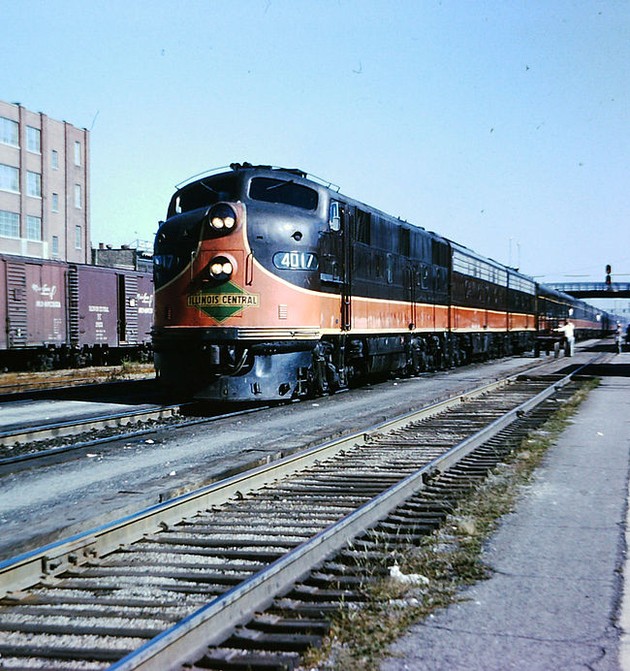
The song isn’t about the city itself, but rather a train called City of New Orleans, which travels overnight between Chicago and NOLA:

A reader in Houston, Dan, knows that train well:

My father and mother met on a train in Louisiana in 1941. My father, a 25 year old from Appleton, WI, was in the army (yes, pre-Pearl Harbor) and was coming back from his mother’s funeral. My mother, a 16 year old from Franklin, LA, in St Mary’s Parish, was introduced to my father by the nuns she was traveling with.

They corresponded throughout the war (my father saw much combat in Europe with the First Special Service Forces) and he proposed in a letter. They married when he returned in 1946. My grandfather said he knew the Civil War was over when his daughter married a Yankee.

Ah, but that is not the City of New Orleans.

The train in 1964 (Wikimedia)

During my childhood my family spent every summer in Louisiana and every winter in Wisconsin (there was something wrong with that picture). In 1963 I was five years old and my oldest brother was 14. Our mother was already in Louisiana with two of my siblings, and for some reason, the folks decided it would be a good idea for my brother and me to take the train down—just the two of us. We took the City of New Orleans. And instead of getting a roomette (I can hear my father say it would be a waste of money to get a roomette for those kids), we just had second-class seats.

We made it to New Orleans, complete with a change in depots in Chicago. At one point I got mad at my brother for trying to make me eat Jell-O with fruit in it. I got so mad I walked back from the dining car to our seats on my own. I am still not quite sure how I found the seats; I was 5, for crying out loud!

It was a fun trip. AND I get to tell anyone who cares that I rode on the City of New Orleans.

Update from a reader, Greg (who might not have seen our previous TotD linking to the Guthrie and Goodman versions):

I have a low opinion of Willie Nelson’s recording of “City of New Orleans.” I don’t detect any modifications to Arlo Guthrie’s interpretation (which is substantially different from Steve Goodman’s original) that he may have made, save for changing “Good night, America, how are you” at the end to “Good morning.” Hell, I wonder if Nelson changed that lyric simply because it’s a downer if it’s interpreted metaphorically.

(Submit a song via hello@. Track of the Day archive here. Pre-Notes archive here.)
More Notes From The Atlantic
  • Notes Home